Best Wallets for POL in 2026: Staking, dApps & Top Security Reviewed

- When you click links on this page, we may earn an affiliate commission. By using this website you agree to our terms and conditions and privacy policy.
- Participation in online gambling may be illegal in your country and is subject to age restrictions (18, 19, or 21, depending on the jurisdiction). Verify legality and age requirements before participating. Learn more
The best wallet for Polygon offers top security features. There are more than half a billion Polygon (POL) wallet addresses, many of which users access via wallet software that lacks adequate security measures or does not provide true ownership over the assets they contain.
Self-custody wallets are essential for safe storage. They enhance security and control, even for beginners. The Polygon Network is a layer-2 Ethereum scaling solution that can handle many transactions per second, with fast settlement times and low transaction fees. We base our picks on security, native POL staking support, Web3 connectivity, general usability, and pricing.
Throughout this guide, we’ll examine some of the best wallets for POL, discussing how they protect users, additional features beyond storage, whether they support crypto purchases with fiat, and their compatibility with the broader POL ecosystem to help readers decide which is right for them.
Comparing the Best POL Wallets in 2026
| Brand Name | Wallet Type | Security Features | Supported Crypto | Backup and Recovery | Staking Support | Cost |
|---|---|---|---|---|---|---|
| Tangem Wallet | Cold | EAL6+ security chip, 25-year warranty, audited, no external connectivity, PIN system | 5,000+ | Cards come in multi-packs, providing redundancy, seedless | Yes | $54.90 to $160 |
| Bitget Wallet | Hot | Multi-Party Computation, $300 million protection fund, encryption | 1 million+ | Seed phrase | Yes | Free |
| SafePal S1 | Cold | EAL6+ chip, air-gapped, open-source, self-destruct mechanism, passphrase | Thousands of tokens on 200+ blockchains | Seed phrase | Yes | $49.99 |
| Uphold Wallet | Hot | Regulated, private key encryption, employee background checks, and regular audits | 325 | Username and password | Yes | Free |
| Zengo Wallet | Hot | MPC, seedless, create segregated wallets, Multi-Factor Authentication | 1000+ | Email authentication, recovery file, 3D FaceLock (optional) | Yes | Free ($9.99 monthly premium subscription) |
| Binance Wallet | Hot | MPC, self-custody, risk detection, technical audits | Thousands of assets on 34 networks | Quick Backup, recovery password | Yes | Free |
| Trezor Safe 3 | Cold | EAL6+ security chip, PIN/passphrase systems, TOR routing | 7,000+ | Seed phrase, multi-share backup (split seed into multiple shares) | Yes | $79 |
| Rockwallet | Hot | SOC 2 Type II/ISO27001 certification, 2FA, biometrics | 18 | Seed phrase | No | Free |
| Cypherock X1 | Cold | Audited by Keylabs, open-source, EAL6+ secure element | 18,000+ | Seed phrase, multi-sig (2 of 4 cards required for recovery) | Yes | $129 |
| Coinbase Wallet | Hot | End-to-end encryption, biometric/PIN locks, and Secure Enclave tech | 5000+ | Private Keys, 12-word recovery Phrase | Yes | Free |
Top Wallets for POL
What are the Best Crypto wallets for Polygon? (In-depth Reviews)
Tangem
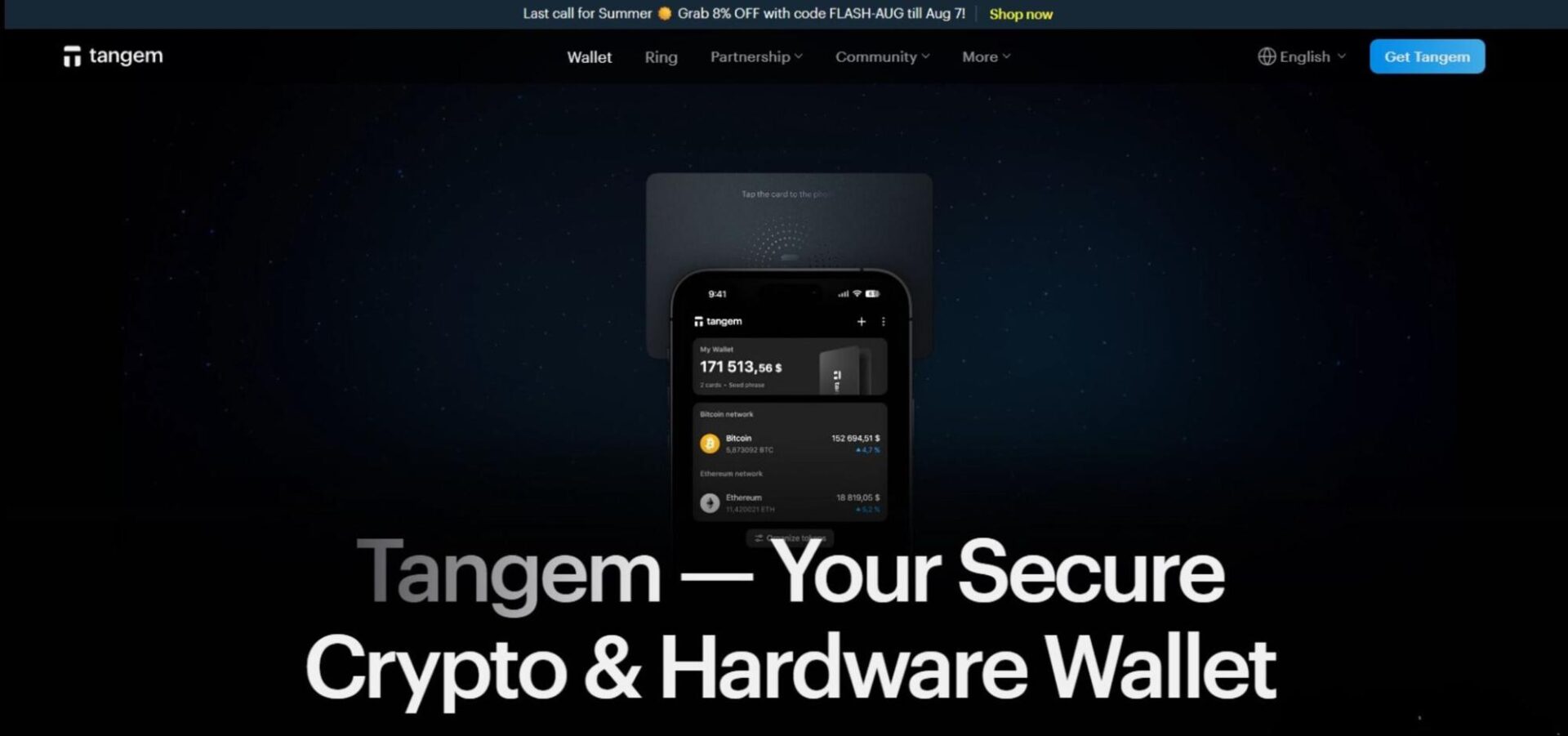
Tangem is a unique, credit-card-style cryptocurrency wallet that utilizes NFC for connectivity, enabling seamless connections to mobiles. The main advantage of Tangem is recoverability. Tangem is sold in packs of two or more cards, which can be linked to a single wallet, allowing for recovery even if one card is lost.
Users can store thousands of assets across dozens of networks, making it a strong choice for individuals who hold a diverse range of assets beyond Polygon. Tangem features an EAL6+ security chip, access code protection, and an IP69K dust/water/temperature resistance, making it exceptionally durable and secure.
Due to its NFC integration, Tangem is only compatible with mobile devices; it doesn't support laptops or desktop computers. The Tangem app enables users to buy, swap, and stake cryptocurrencies directly from their hardware wallet, providing a convenient and streamlined experience that reduces the need for transfers to external platforms.
Prices start at $54.90 for a two-card pack and $69.90 for a three-card pack. With seamless Web3 connectivity enabled via Tangem's WalletConnect integration, a 25-year warranty, a no-battery design, and built-in redundancy measures, Tangem is among the best POL cold storage solutions if long-term protection is your priority.
Pros
-
EAL6+ security chip
-
25-year warranty
-
Straightforward Web3 connectivity
-
Affordable hardware wallet
-
Highly secure and durable
Cons
-
Requires a mobile device
-
No display for address verification
- Bitcoin
- Ethereum
-
Tether
70
No result
- English
- German
-
French
3
No result
Technical Features Critical for POL Holders

There are several key features of the Polygon network that are essential to understand for anyone seeking a secure POL wallet. They include:
Native Staking and Delegation
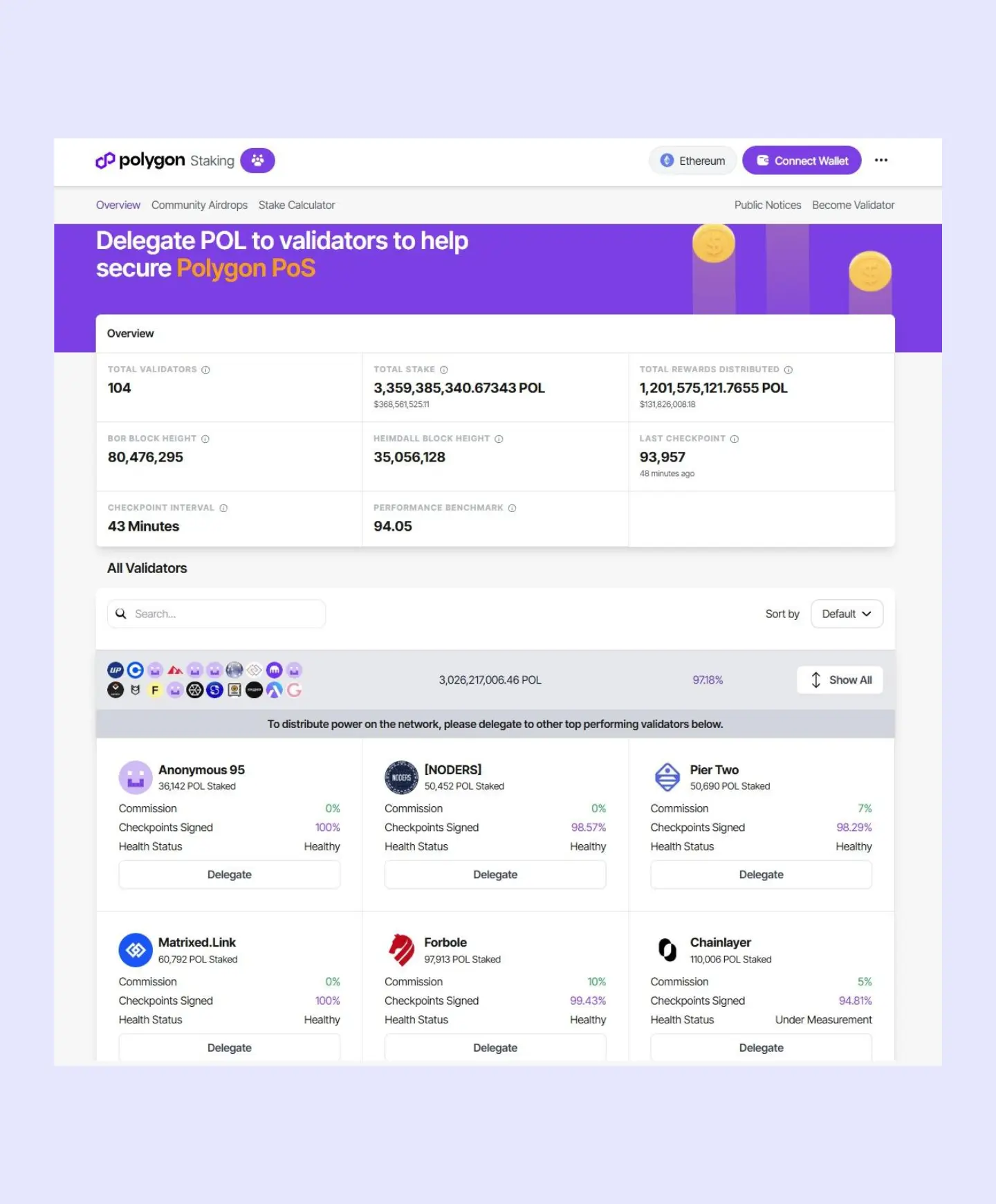
Wondering how to stake POL with a wallet? Polygon completed its migration from the MATIC token to POL in September 2025, introducing the Proof-of-Stake (PoS) consensus mechanism and native staking support. It’s crucial to note that to stop staking, there’s a 40-hour unbonding period during which your tokens will be inaccessible.
Users can earn rewards for delegating their holdings to POL validators, who handle the technical aspects and take a commission that typically ranges from 0% to 10%. However, some validators charge up to 100% commission, so it’s essential to check the rates before delegating your POL.
For security reasons, Polygon staking takes place on the Ethereum network via the Staking.Polygon.Technology website. Users connect a comptable non-custodial wallet and securely delegate their assets. The reward rate dynamically changes based on the amount of POL staked, the signed checkpoint percentage, and network conditions.
Anyone can register to become a Polygon validator, but there can only be a maximum of 105 validators at a given time. For most people, delegating POL to an active validator that charges a reasonable commission is the simplest and most effective way of staking POL.
Understanding POL Network Fees (Gas/Rent)
Once POL network fees have been explained, they’re easy to understand. Polygon is a layer-2 scaling solution for the Ethereum network. As such, it uses a similar fee structure to Ethereum. Costs are measured in ‘gwei’, where one gwei equals 0.000000001 POL.
According to the PolygonScan Gas Tracker, which measures average transaction fees, the standard POL gas fee is around 45 gwei or 0.000000045 POL (substantially less than 1 cent). Fees may vary due to network congestion. More activity typically results in higher gas fees.
Most of the wallets we’ve included offer a way to set custom transaction fees. You’ll be able to choose between standard, fast, and rapid fees (naming conventions may vary across wallets). Some will enable you to set custom fees, but this isn’t recommended due to the dynamic nature of Polygon’s fees.
POL Token Standards and NFT Support
The POL token standard can be challenging to grasp if you’re unfamiliar with how layer-2 crypto networks operate. There is no native token standard on Polygon because it’s built on top of Ethereum, with POL as the gas token.
Your Ethereum and Polygon wallets will share an address. You can use the Polygon network to send POL to an Ethereum address and access the tokens on the Polygon network. However, POL sent to the Ethereum mainnet without bridging will be lost.
Most Ethereum Virtual Machine (EVM) compatible wallets will support the Polygon network. Similarly, Polygon NFTs follow the same standard as those on Ethereum (ERC-721), but there are key differences.
Notably, the cost of issuing or transferring an NFT is significantly lower on Polygon. Your POL NFT wallet must also explicitly support the Polygon network; otherwise, you will be unable to view or manage your NFTs.
Security Best Practices for Your POL

Even if you’re using one of the best POL wallets, there are a few simple steps you can take to enhance the security of your wallet and better protect your Polygon investment.
Protect Your Seed Phrase
Never store your seed phrase digitally, such as in a screenshot or text file. Doing so leaves you vulnerable to network attacks or malware. Moreover, if the device you’ve used to back up your seed becomes lost or damaged, you could lose your ability to recover your POL wallet.
To keep your POL secure, use analog seed phrase storage methods. Metal seed storage devices cost around $50 and ensure your seed is permanently protected, even against fire or water damage.
Pen and paper are a low-cost alternative. It costs nearly nothing to write your seed on paper. Moreover, storing or hiding a paper seed is extremely simple. Users can also easily create multiple backups, which can be stored in different locations for redundancy.
Secure Hardware Wallet Interaction
Hardware wallets feature specialized anti-tamper mechanisms and physical security chips that detect attempts to flash counterfeit software or modify the device. As such, it’s much safer to verify sensitive information on a hardware wallet device, rather than on a computer or phone.
To ensure your funds arrive as expected, always verify the destination address matches the independent recipient using your hardware wallet’s display. If supported, confirm your seed using the hardware wallet instead of viewing it on your computer or phone, as this may leave you more vulnerable to security risks.
Conclusion & Final Recommendation
There’s no straightforward answer to which POL wallet is best. You should pick a solution that caters to your specific needs. For example, active traders may prefer wallets with swap functionality, while Web3 enthusiasts may require WalletConnect integration, and long-term investors benefit more from cold storage.
If you prefer using decentralized exchanges or like to earn rewards by participating in DeFi protocols, then Binance is a great choice. It integrates WalletConnect for streamlined dApp connectivity. Binance also provides a fiat on-ramp, straightforward Web3 support, and excellent security, making it one of the best software wallets for POL.
Not everyone desires advanced features or complex security systems. Beginners or people seeing a simple POL storage solution should consider Zengo. It eliminates seed phrase storage requirements, boasts an intuitive interface, and is easily recoverable. Moreover, Zengo delivers an excellent mobile experience, making it a strong choice for frequent travelers.
There’s no substitute for a hardware wallet when long-term security is your priority. Based on our research, Tangem is best because it’s durable, highly secure (EAL6+), requires no charging, features a 25-year warranty, and has minimal components that users can accidentally damage or wear out.
FAQ Section
What is the difference between a POL "account" and a "wallet"?
Your POL wallet exists independently on the blockchain. Wallet software is used to interact with and manage the wallet in a human-friendly way. If you have the seed phrase, you can access your POL using any compatible wallet, even one different from the one you originally used to store the assets.
How much does it cost to send POL from one wallet to another?
Polygon is a layer-2 scaling solution for the Ethereum network. Therefore, it can handle a high number of transactions and facilitates low-cost transfers. POL fees are dynamic and vary constantly based on network conditions. On average, they cost around 50 to 60 gwei, equal to a fraction of a cent.
If I lose my phone, can I recover my POL on a different wallet?
Even if you lose your phone or hardware device containing your POL wallet, it can be easily recovered using your seed phrase and any compatible wallet software. As such, it’s essential to store your seed where it’s out of reach, safe for the long term, and reasonably convenient to access.
Why has MATIC changed to POL?
Polygon migrated from the MATIC token to POL in early September 2025. Users could swap their MATIC to POL at a 1:1 ratio. The upgrade was community-led and expanded the token’s utility, enabling a connection with Polygon’s ‘Agglayer,’ which paves the way for streamlined inter-blockchain connectivity.