CHIP Crypto and USD.AI Review: The Boldest Bet on Who Gets To Finance the AI Race


Permian Labs wrapped up the CHIP crypto token’s ICO and Token Generation Event in late March 2026, putting roughly 2 billion tokens into circulation and marking the live debut of one of the more structurally ambitious DeFi projects in recent memory. The protocol behind it, USD.AI, targets a financing gap that sits at the intersection of two of the fastest-moving forces in global markets right now: AI infrastructure and on-chain credit.
Framework Ventures led a $13 million Series A in August 2025, with YZi Labs and Bullish also investing. Bullish further committed $4 million in September 2025. Meanwhile, the protocol secured a $500 million facility with Sharon AI in January 2026, a $500 million facility with QumulusAI in October 2025 and selection into OBEX’s inaugural $1 billion deployment cohort in March 2026.
What is CHIP Crypto and What Does It Do?
CHIP is the governance and utility token of the USD.AI DAO. It sits one layer above the protocol’s two stablecoins, USDai and sUSDai. CHIP also serves as the voting and risk-management mechanism for the entire system.
Token holders use CHIP to vote on which GPU hardware qualifies as collateral, how loan-to-value limits get set and where protocol fees flow. Staked CHIP, held as sCHIP, also serves as an insurance layer that covers potential shortfalls in the lending pool.
Governance role carries real economic weight. USD.AI’s lending decisions, including which borrowers get access to capital and at what terms, flow through CHIP holder votes. CHIP is therefore less of a speculative instrument and more of a control mechanism over a live credit market.
What Is USD.AI And How is it Related to CHIP Crypto?
Permian Labs, a Delaware-based company serving as the protocol’s technical service provider, built USD.AI as a two-sided credit market for AI infrastructure financing. The USD.AI Foundation, a Cayman Islands entity, is the off-chain steward of the DAO that governs it.
The protocol addresses a structural mismatch that traditional finance has struggled with. GPUs depreciate at roughly 20% per year, which means a standard 6 to 12-month bank underwriting timeline eats most of the hardware’s viable collateral window before a loan even closes. USD.AI originates non-recourse loans secured by GPU hardware, funded directly through on-chain deposits, bypassing that timeline entirely. CHIP governs the parameters that make that system run.
How Does USD.AI Work?
Based on USD.AI documentation, Capital enters USD.AI when depositors put in PYUSD, PayPal’s regulated dollar-backed stablecoin and receive USDai in return. USDai holds a 1:1 peg and does not accrue yield on its own.
Depositors who want returns stake their USDai to receive sUSDai, which earns from two sources simultaneously: interest paid by GPU infrastructure borrowers on active loans and Treasury bill income generated on idle reserves between deployments. The yield accrues continuously in the exchange ratio between USDai and sUSDai, so holders do not need to claim anything manually.
On the borrowing side, neoclouds and data center operators apply for financing secured by their physical GPU fleets. Loans originate at 70 to 80% loan-to-value ratios on a three-year amortization schedule, with lien filings and bankruptcy-remote SPV structures providing enforceable collateral rights off-chain. This means the protocol holds real legal recourse against hardware assets, not just token-based representations.
From Collateral Approvals to Fee Structures, CHIP Coin Governs It All
CHIP holders vote on which GPU models, including NVIDIA H200s and B200s, qualify as collateral and set the maximum LTV parameters that determine how much borrowers can access against their hardware. At the same time, staked CHIP holders act as the protocol’s backstop. In a shortfall event, the protocol can draw on the sCHIP insurance module to cover bad debt, which means stakers carry real risk exposure in exchange for their participation rights.
Fee governance rounds out the picture. CHIP holders set origination fees, net interest margin spreads and the parameters around QEV, the protocol’s auction-based redemption mechanism. Every fee rate and routing decision goes through an on-chain vote, keeping the structure transparent and adjustable without relying on a central team to make those calls.
CHIP Coin Tokenomics After the TGE
The ICO ran from Feb. 22 to March 4, 2026, at $0.03 per token. Total supply stands at 10 billion CHIP, with 2 billion currently in circulation.
Distribution splits four ways.
- Investors hold 29.6%, subject to a 12-month cliff and a 24-month linear vest.
- Ecosystem incentives, covering airdrops, liquidity mining and partnerships, account for 27.5%.
- Core contributors at Permian Labs hold 23.5% under a 36-month vesting schedule.
- Reserves for R&D and strategic grants cover the remaining 19.5%.
CHIP Coin Price Prediction
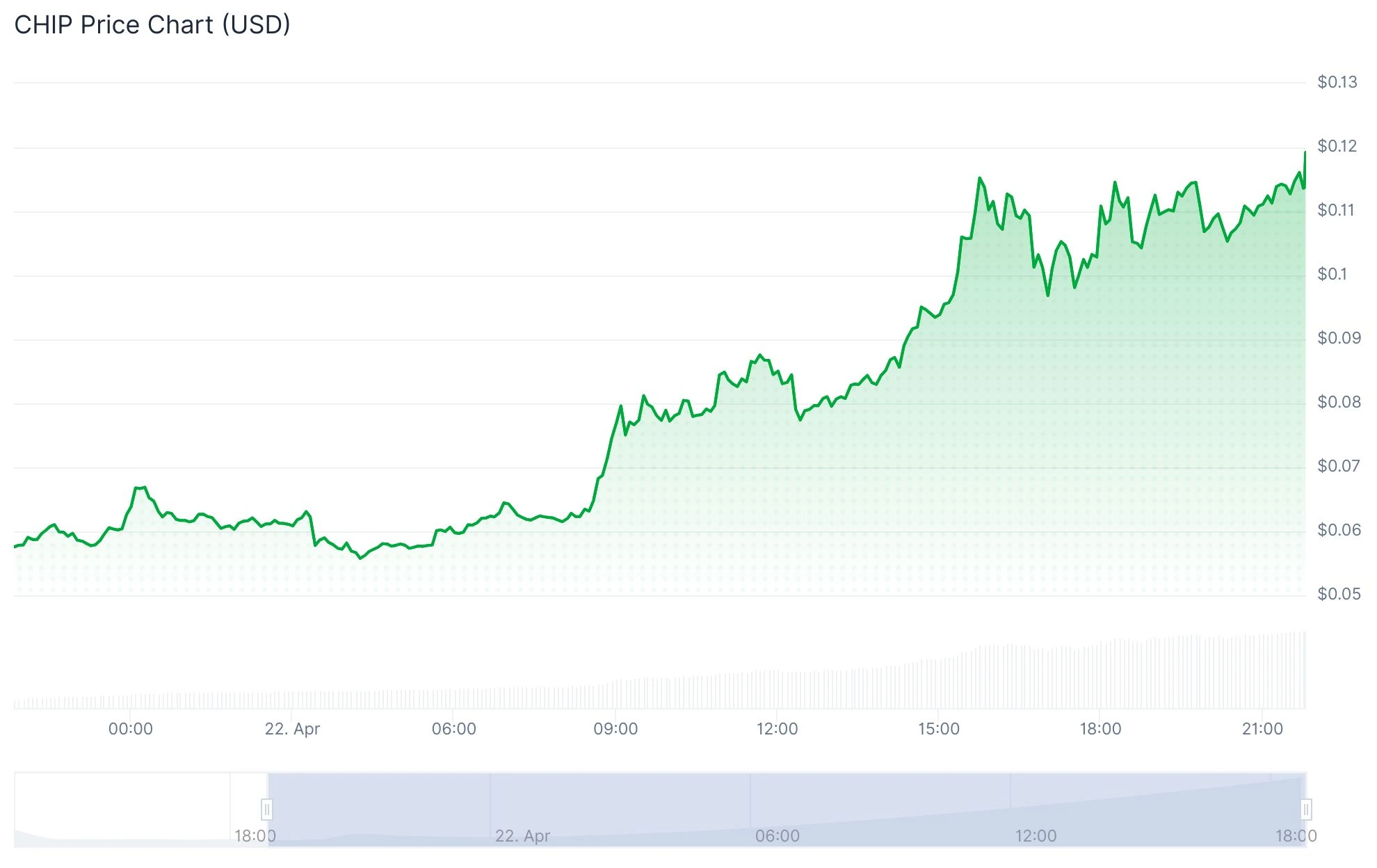
CHIP reached an all-time high of $0.1192 on April 21, 2026. Market cap sits between $199 million and $218 million as of 22 April 2026 | Source: CoinGecko
The 8 billion tokens still locked in vesting schedules represent a clear supply overhang. Investor and contributor tokens begin unlocking progressively from early 2027 onward. That timeline will test how well protocol growth can absorb the added supply.
Active governance proposals to onboard sUSDai to Aave V3 Arbitrum in April 2026, alongside a Messari valuation report from March 2026, point to growing institutional awareness of the protocol. Broader DeFi adoption of sUSDai would increase capital flow through the system and generate more fee revenue for governance to direct. Consequently, the adoptoin creates a stronger case for holding CHIP as a productive asset rather than a speculative one.
Investors treating CHIP as a long-term position should track loan origination volumes and active facility drawdowns. These would be the most direct indicators of protocol health. Price will follow those fundamentals more reliably than short-term trading patterns.