- Coinbase Review: Pros and Cons
- CoinBase Background and Reputation
- How to Sign Up for Coinbase
- Initial Setup & User Experience
- Coinbase Key Features & Services
- Other Coinbase Products and Services
- Coinbase vs Other Crypto Exchanges
- Who is Coinbase Best Suited For?
- Conclusion & Final Verdict
- FAQs (Frequently Asked Questions)
Coinbase Review 2026

- When you click links on this page, we may earn an affiliate commission. By using this website you agree to our terms and conditions and privacy policy.
- Participation in online gambling may be illegal in your country and is subject to age restrictions (18, 19, or 21, depending on the jurisdiction). Verify legality and age requirements before participating. Learn more
This Coinbase Review covers the fundamentals of Coinbase and why it is regarded as one of the best crypto exchanges in the world, with a heavy focus on security and a user-first approach. Coinbase has introduced an array of products over the years that cater to the needs of every crypto enthusiast, including new and experienced traders and investors, by offering standard and advanced modes with different capabilities.
Despite being intuitive and relatively simple, Coinbase is a capable exchange but remains best suited to beginners or moderately experienced traders and investors. In addition to the design, they offer other services like crypto staking to help you earn interest on your crypto portfolio, and charge almost 0% as fees on most services.
Throughout our Coinbase review, we'll cover key aspects of the platform to help you decide whether it's the right exchange for you. We'll examine its ease of use, history, features, fees, customer support, and more.
Coinbase Review: Pros and Cons
Pros
- Standard and advanced modes
- Regulated in multiple countries
- Offers spot and derivatives trading
- One of the best-known crypto platforms globally
- Never lost user funds
- Supports various currencies and payment methods
Cons
- High trading fees and staking commission
- Relatively high cash withdrawal fees
CoinBase Background and Reputation

Company Overview
Founded in 2012, Coinbase is one of the most well-known and influential cryptocurrency exchanges globally. Known for providing a beginner-friendly yet robust trading experience with features that cater to advanced users, Coinbase will appeal to a broad range of people, including crypto enthusiasts, casual investors, and experienced traders.
Brian Armstrong and Fred Ehrsam launched Coinbase to facilitate the buying and selling of Bitcoin via bank transfers. The project quickly garnered attention from investors and evolved into the feature-rich exchange we see today.
While Coinbase is a publicly traded company listed on the Nasdaq, it operates without a physical headquarters, although it has offices worldwide. Being a public company affords Coinbase several benefits for users. It must be regularly audited, and its financials must be transparent, ensuring no foul play and providing peace of mind for clients.
Regulation & Licensing
Because Coinbase is listed on the stock market and is subject to strict oversight and frequent audits, it must be above board and follow each country's regulatory framework. In the USA, FinCEN regulates Coinbase. While researching for our Coinbase review, we found that it holds money transmitter licenses in most states, including New York, but doesn't support Hawaii.
Leading authorities outside the USA have issued Coinbase licenses. For example, the UK's Financial Conduct Authority (FCA), Germany's Federal Financial Supervisory Authority (BaFin), and the Bank of Ireland have approved the crypto investment platform. Coinbase also holds a Markets in Crypto Assets (MiCA) license, enabling it to operate legally in Europe.
Trust & History
Is Coinbase legit? The exchange has been at the forefront of the crypto industry for over a decade and has remained solvent, trusted, and reliable. Coinbase has consistently been transparent regarding its financials, challenges, and services.
Unfortunately, Coinbase was the victim of a significant hack in 2025. Attackers compromised its customer support team and got them to reveal data of 69,000+ customers. The hacker group attempted to blackmail Coinbase into paying a ransom until the company went public with the incident and warned affected users, which was primarily viewed as a responsible move.
Coinbase has been at the center of a few other controversies over the years, but the exchange has been cleared of wrongdoing or has not been directly involved with them. It has delisted tokens like XRP due to regulatory pressure, which drew contempt from users. Coinbase has handled any issues well and remains one of the most transparent exchanges.
User Reviews

Checking out user reviews is essential when deciding whether a centralized exchange (CEX) like Coinbase is legitimate and worth using. People share their personal experiences, often providing unique insights users can't glean from general reviews. For example, having difficulty with deposits in a specific country. Here's what users had to say about Coinbase:
On Trustpilot, Coinbase was reviewed favorably and holds a 3.9/5 rating based on around 18,500 reviews. It replies to 95% of negative reviews and responds within 2 weeks on average, comparable to Binance. Users say it's trustworthy, easy-to-use, and reliable, but complain of having their accounts locked and Coinbase's customer support team being difficult to reach.
The general sentiment is that Coinbase is a robust, simple-to-use, secure crypto exchange platform. It offers a selection of advanced crypto trading features while remaining accessible to anyone, regardless of their experience level. However, the support team can be challenging to reach for complex issues, and users report that Coinbase can delist assets or lock accounts.
How to Sign Up for Coinbase
Learning how to use Coinbase doesn't have to be challenging. We've created this simple step-by-step guide to help our readers get started.
Step 1: Create and Verify a Coinbase Account
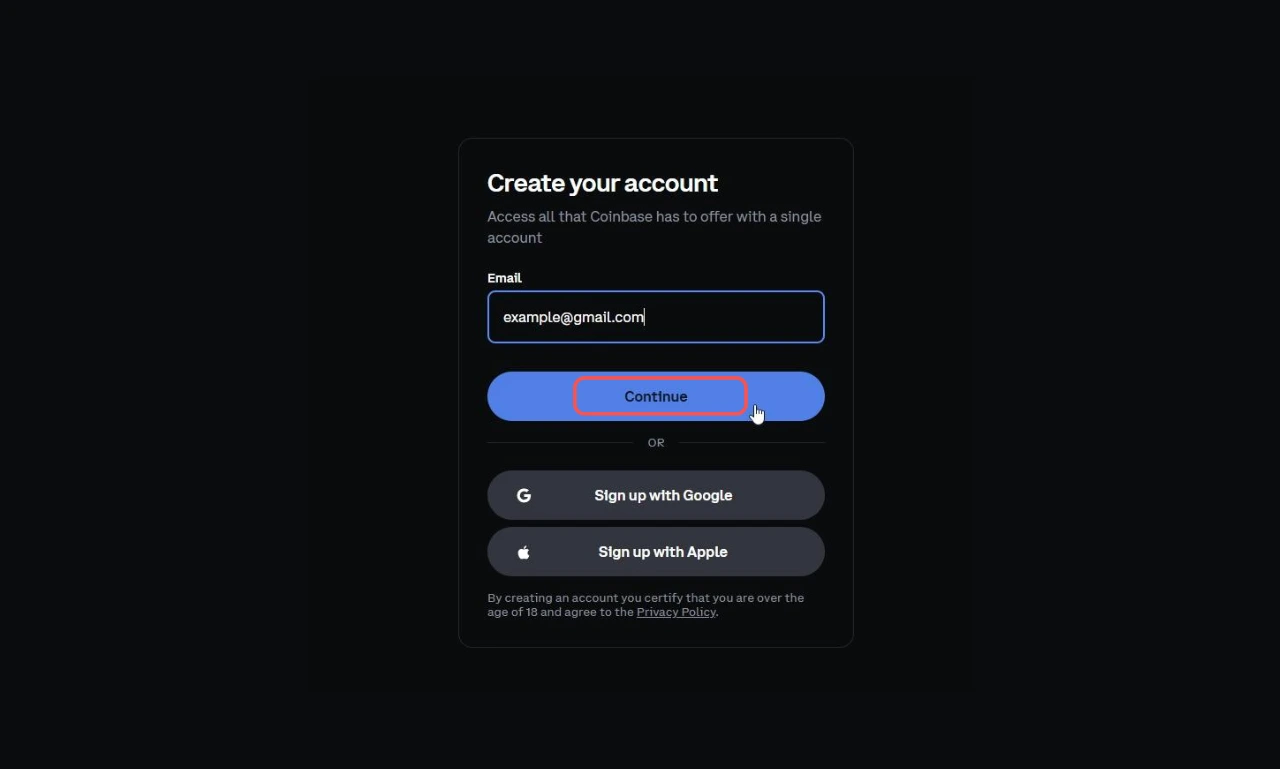
The Coinbase sign-up process is quick and straightforward. Users enter an email address and password. You must verify your account using a code sent to your phone number or email. Setting a password isn't required if you sign up with Google.
Step 2: Verify Coinbase Account
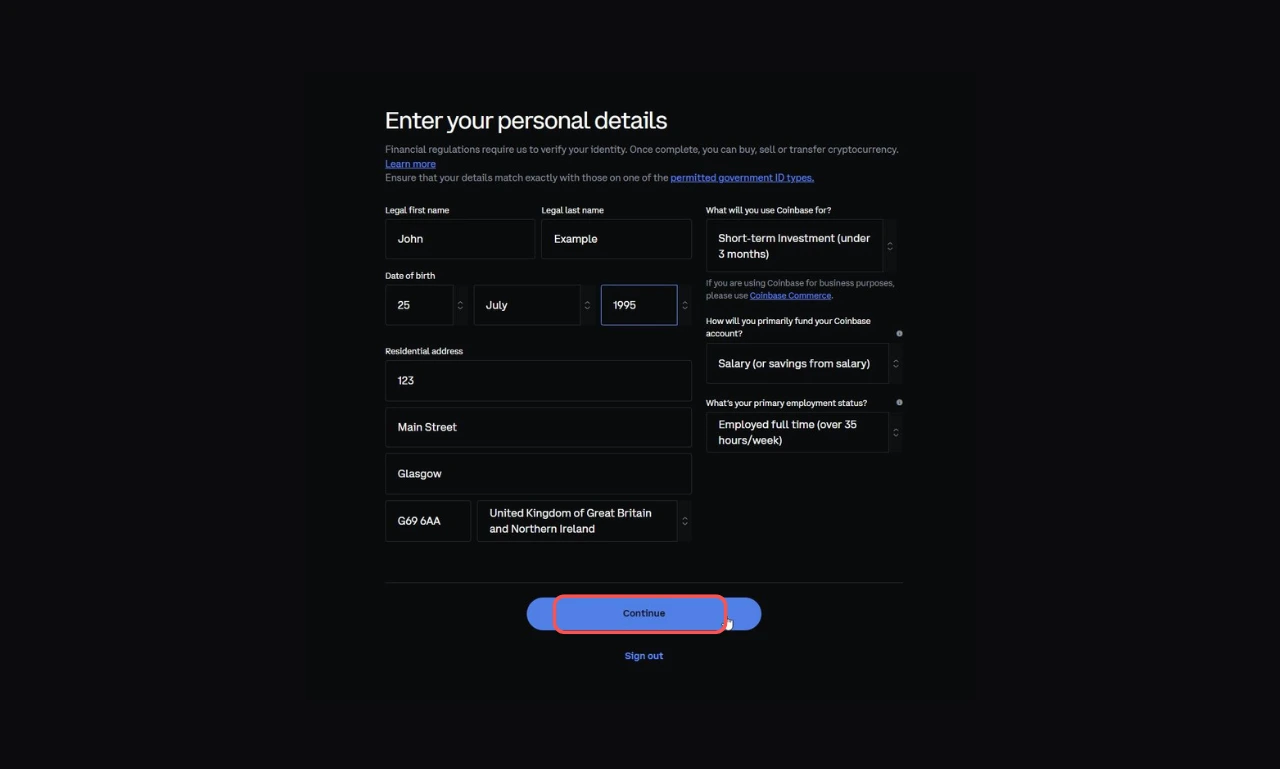
Once your Coinbase account has been created, complete Know-Your-Customer (KYC) verification and provide details about your financial status. For KYC, you must provide personal information like your name and address, then a photo ID (passport, driving license). Afterward, you need to enter your employment status and financial information..
Coinbase prompted me to verify my identity via its FaceMatch service, which compares user ID photos with a live selfie. However, it didn't provide me with a QR code to scan on mobile, as is typical; I could only verify with my computer webcam, which is highly inconvenient. I was forced to download the mobile app and complete verification there instead.
When I went through the KYC process, verification took around 60 seconds after I had submitted my personal information, and a photo of myself and my identification document.
Step 3: Link a Payment Method and Deposit Funds

Next, you'll need to link a payment method and deposit funds. You can do this by clicking the 'Pay with' button on the fiat on-ramp interface. It'll prompt you to add a payment method, choose one you prefer, then follow the instructions. Afterward, enter a deposit amount on the on-ramp, select an asset, click 'Review order' to check fees, and confirm the purchase.
Alternatively, you can click 'Deposit cash' below the 'Review order' button and follow the process to fund your account directly, rather than using fiat to buy Shiba Inu or another crypto. This method lets you wait for a good opportunity or use cash to trade on Coinbase Advanced.
Initial Setup & User Experience
A crypto exchange should be simple to set up and use. Overly complicated platforms negatively impact the user experience. Because Coinbase is a beginner-friendly crypto exchange, ease of use is particularly important.
Ease of Use
Coinbase is accessible to anyone, regardless of experience. It offers a standard mode that makes buying, selling, and swapping digital assets convenient and intuitive. Even if you've never used an exchange, Coinbase will feel familiar and straightforward.
Complex features/services (derivatives, TradingView) are available on Coinbase. However, the exchange hides them behind a toggleable advanced mode, preventing accidental access and ensuring the exchange remains beginner-friendly and not overwhelming.
Display & Buttons/Touchscreen
The Coinbase interface is user-friendly and approachable. Key sections are available on a persistent left navigation bar, while the buy/sell interface is fixed on the right for easy access. It boasts a toggleable dark mode, which makes Coinbase easier on the eyes. The web platform is responsive, and most sections open quickly, but the order review menu takes longer to load.
Mobile App Review

On mobile, Coinbase is equally responsive and feature-rich. Key sections are always available via a bottom navigation bar, while a hamburger menu contains the Advanced mode toggle and features like recurring buys and Coinbase One. Coinbase Advanced is available within the same app and boasts TradingView charts, but lacks drawing tools and technical indicators.
Besides reducing charting capabilities, the Coinbase mobile app offers the same features as the desktop version. Users can access staking, derivatives, and a simple fiat on-ramp. However, Coinbase Wallet is a standalone mobile app dubbed Base.
Coinbase app reviews are highly positive. On the iOS App Store, it holds a 4.6/5 rating based on over 185,000 reviews. The story is similar on Android, with the app boasting a 4.5/5 rating based on more than 900,000 reviews. Users generally agree that it's easy to use and convenient for investing, but shared issues with the verification process and fee structure.
Coinbase Key Features & Services

So, Coinbase is well-regarded by users, but what tools and services does it offer? Below, we'll explore its buying/selling interface, crypto staking capabilities, and any other key Coinbase features.
Buying & Selling Crypto

There are 295 Coinbase-supported coins in total. This selection comprises majors, including Bitcoin and Ethereum, and smaller projects like SQD, KNC, and CVX. While Coinbase previously removed XRP from the platform following its Securities and Exchange Commission lawsuit, the asset was relisted in 2023, so the exchange is suitable for new XRP investors.
Only users who have completed KYC verification can buy or sell cryptocurrency on Coinbase. The exchange provides multiple ways to buy Bitcoin and hundreds of other cryptocurrencies. Coinbase boasts a simple buy/sell/convert tool that supports recurring buys and purchase methods, including stablecoins, credit/debit cards, bank transfers, and PayPal.
In addition to directly buying crypto with fiat currency, Coinbase lets users deposit fiat using Easy bank transfer, credit/debit cards, and manual bank transfers. Once funded, Coinbase users can purchase crypto using the simple buy tool using account funds or use the Coinbase Advanced order-book exchange to buy and sell more precisely.
Whether you're a new investor/trader or have been involved in crypto for some time, Coinbase is a solid choice. The simple buy tool makes acquiring digital assets straightforward, making it a suitable crypto exchange for beginners. Coinbase Advanced's TradingView integration and order book system make it a strong choice for more experienced crypto enthusiasts.
Trading Platform

Coinbase is one of the top cryptocurrency platforms, catering to a wide range of users. To ensure that it's accessible regardless of user experience, it's divided into the standard platform, which offers simple crypto trading and a fiat on-ramp, and Coinbase Advanced, boasting robust charting tools, technical indicators, an order book, and a range of crypto trading order types.
On Coinbase Advanced, users can access four order types, which is relatively limited compared to advanced crypto trading platforms like Bybit, which offers nine. Coinbase offers:
- Limit: Set a price for the order to execute
- Market: Executes at the current price
- Stop-limit: Places a limit order when a certain price is hit
- TWAP: Breaks large orders into smaller multiple small ones that are executed at regular intervals
Experienced traders seeking a platform with powerful charting capabilities will find Coinbase suitable. It boasts TradingView integration, meaning users can access a diverse range of drawing tools and technical indicators. People can instantly plot Fibonacci retracements or access popular indicators like Bollinger Bands or Volume Weighted Average Price (VWAP).
Despite what many people assume, Coinbase supports derivatives trading. It's compliant with the USA's Commodity Futures Trading Commission (CFTC), but is unavailable across a large part of the world, including the UK. It's a perpetual-contract-style market available in the USA with 10x leverage or in eligible international markets with 5x.
Coinbase has a reported daily trading volume of around $3.2 billion, and CoinMarketCap awards it a liquidity score of 781, higher than OKX (747), MEXC (635), and the Crypto.com Exchange (753). The order book on Coinbase Advanced reveals that across a price variance of just 1%, dozens of BTC worth of liquidity is available at any given time.
Supported Wallets & Custody
Coinbase offers a custodial wallet, meaning the exchange controls the wallet's private keys and recovery code. This type of wallet boasts convenience but is less secure. A non-custodial wallet, where the user controls the private key, provides additional safety but requires the user to store the recovery code or keys carefully, adding a weak link to the security chain.
We discovered that Coinbase also offers a dedicated non-custodial, Web3-compatible wallet. It links to popular decentralized applications (dApps) like PancakeSwap and OpenSea for easy, secure access. While performing a crypto wallet review, we found that it offers a fiat on-ramp and a swaps tool, but requires a $0.03 fee paid in Base to be activated.
Coinbase Wallet supports seed phrases. As such, users can recover their wallet to any compatible, multi-asset wallet. Moreover, the wallet's recovery code support means its users can conveniently import wallets from other providers, like MetaMask, into Coinbase Wallet for easy management, funding, or trading.
Earning & Lending

Crypto staking is a powerful tool that enables people to passively earn rewards on their crypto holdings, while contributing to network performance and security. Coinbase offers a basic staking program focused on simplicity rather than advanced controls or structured earn products.
There are 132 assets available for staking on Coinbase. Users simply have to opt in; there's no complex procedure. It offers up to 14.71% APR, which is competitive compared to similar tools on other exchanges. Unfortunately, it lacks other interest-bearing services; there is no Coinbase lending tool or Bitcoin mining pools for users to contribute to.
Security Measures

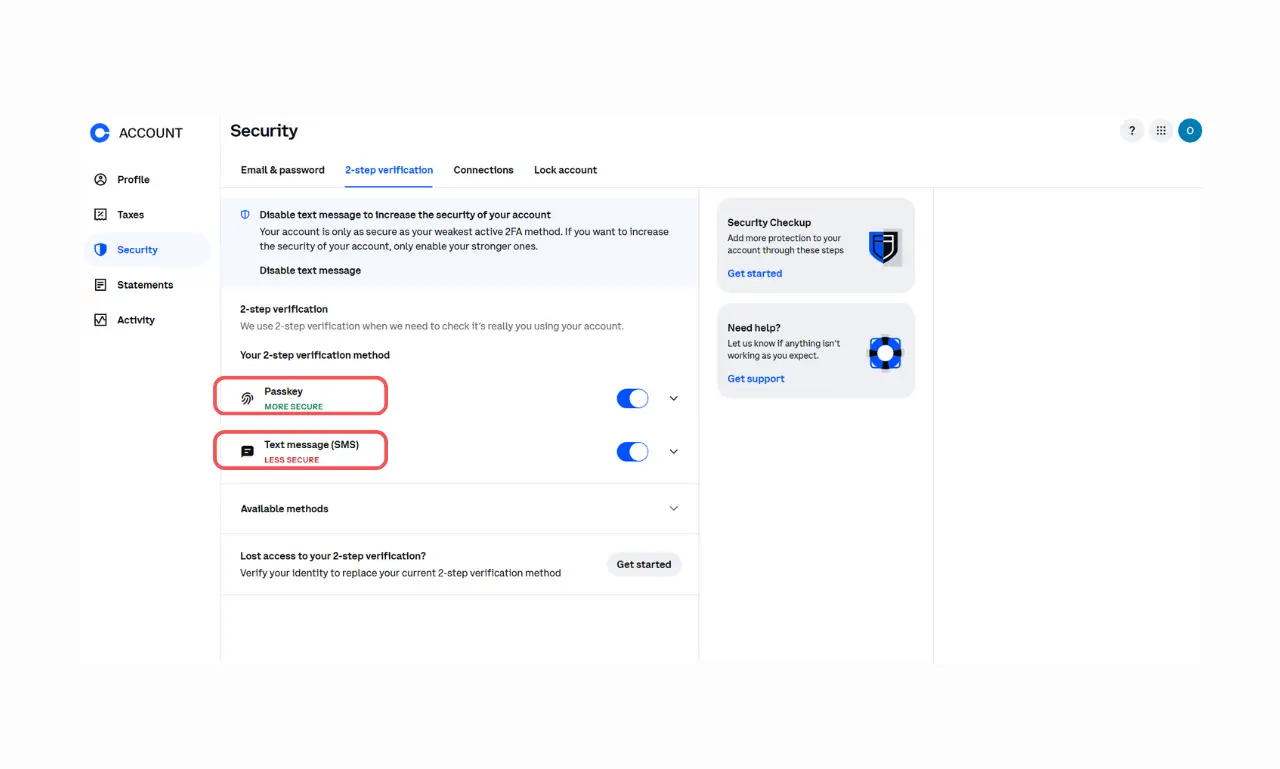
The Coinbase security team has done an excellent job of making the exchange safe for users. It offers many additional verification method options. Users can set up Two-Factor Authentication (2FA) via SMS (although Coinbase advises against this) or through notifications on the Coinbase mobile app.
As one of the best crypto exchanges, it's no surprise that Coinbase offers additional ways to protect your account. It supports biometric or PIN-based passkeys, dedicated authenticator apps, or, for the most protection, a hardware security key. Users can also delegate trusted contacts who can verify them when conducting sensitive actions like recovering their accounts.
According to a CSIS study, hacking a major exchange, like Bybit, causes significant volatility and harms consumer confidence. While Coinbase's wallets have never been hacked, they make poor targets as 98%+ of customer crypto is stored in cold storage, so even if bad actors exploited them, they couldn't steal substantial user funds and negatively impact the market.
The best crypto exchange may offer insurance to protect your deposits or balance. Coinbase does. It holds crime insurance that protects a portion of assets against theft or digital attacks. Coinbase stores funds in FDIC-insured banks for US-based users, protecting cash balances up to $250,000 per user. The polices do not protect people who've had accounts compromised.
Coinbase is a public company, so it must be regularly audited. The company has a dedicated team for internal audits and annually conducts third-party audits to enhance safety. Coinbase backs user assets 1:1 and displays proof of reserves for its wrapped tokens (like cbBTC), but not other assets. However, its financials are audited quarterly for transparency.
Coinbase lets users set up a withdrawal address allowlist, which means funds can only be transferred to delegated wallets. This prevents bad actors from withdrawing if they compromise your account. Still, this Coinbase feature was difficult to find as it can only be accessed on the Advanced platform. Coinbase doesn't support anti-phishing codes on its communications.
Payment Methods & Fees
Coinbase charges deposit fees using certain payment methods. Costs vary by currency, amount, and payment method. During our Coinbase review, I tested the deposit system and found Coinbase's fees were 0.3% to 0.39% for credit/debit card deposits. Bank and crypto deposits are free. Users report a 2.5% fee for PayPal deposits, but it was 3.85% on $100 for me.
A good range of Coinbase deposit methods is available, but how does it fare for withdrawals? Coinbase's charges vary by country and payment method:
| Country | Payment Methods | Coinbase Withdrawal Fee |
|---|---|---|
| UK & EU | Instant card cashout | Up to 2% with a minimum of £0.55 |
| UK | Faster Payments (FPS) | Free |
| EU | SEPA | Free |
| USA | Instant card cashout | Up to 1.5% with a minimum of $0.55 |
| USA | Instant bank cashout | 1.5% up to $10,000 ($0.55 minimum), then a flat $150 fee above $10,000 |
| USA | ACH transfer | Free |
| USA | Wire | $25 |
Ready to have Coinbase's cryptocurrency fees explained? It charges a variable spread for buying Cardano and other assets on the standard platform. While testing for my Coinbase review, I found that BTC costs 1%, while AMP is free. Coinbase Advanced charges users 0.60% (maker) and 1.20% (taker), but fees decrease significantly based on your 30-day spot trading volume.
While not a low-fee exchange, Coinbase is a regulated and widely used crypto trading platform, so it cannot get away with charging unexpected or hidden fees. Regardless, Coinbase levies a commission when you're earning interest on crypto via staking. The standard rate is 35%, but it can go as low as 25.25% for Coinbase One members subscribed to the Premium tier.
Coinbase requires no minimum deposit to fund your account. The Coinbase withdrawal limits are $1 minimum for bank account withdrawals and $0.01 for cryptocurrency. Coinbase's fee structure for deposits makes it one of the best crypto exchanges for people investing low amounts or frequently buying at regular intervals.
Customer Support

Coinbase offers multiple support channels, ensuring users can get assistance when required. The exchange offers a help center, chatbot, and live chat. However, based on my experience, the help center is lackluster. Finding concrete information on withdrawal fees and spread charges is challenging, but it covers many topics in good detail.
I contacted the Coinbase customer support team for information on withdrawal fees. The bot couldn't help but kept directing me to deposit funds. I requested a human agent and was connected within about 2 minutes. Human support is available 24/7, and my agent was helpful, knowledgeable, and kind, resulting in an excellent experience.
Geographical Availability
Coinbase is a global crypto exchange operating with few restrictions. The only countries it doesn't serve are those sanctioned by the US or the US Treasury's Office of Foreign Assets Control (OFAC), such as Iran and Russia.
Unlike decentralized exchanges, Coinbase is an international, regulated trading platform that must comply with specific guidelines. Features like derivatives trading are restricted in some countries, such as the UK. To prevent the platform from being used for illegal activities, it must follow Know-Your-Customer (KYC) and Anti-Money Laundering (AML) guidelines.
Other Coinbase Products and Services
We've covered its main features throughout our Coinbase crypto exchange review, but the platform offers additional tools that investors and traders can use to enhance their experience.
Recurring Buys
It can be more effective to buy Ethereum and other cryptos progressively, over an extended period, rather than all at once. This strategy is called Dollar-Cost-Averaging (DCA). It lets people utilize price movements to attain a better overall buy-in cost. Coinbase offers a recurring buy tool that supports daily, weekly, biweekly, and monthly purchases to simplify DCAing.
Tax Software

When you profit from trading or investing, you must pay taxes to the relevant authorities. Failing to do so can result in fines, audits, or even prison time. Coinbase has partnered with tax software providers Crypto Tax Calculator and CoinTracker to simplify the process. Users can import a set amount of Coinbase transactions for free and get a discount on premium plans.
Coinbase One

Users can subscribe to a monthly premium Coinbase plan for reduced trading fees and superior rewards. There are three plans: Basic ($4.99), Preferred ($29.99), and Premium ($299.99). The plans grant users free trading (only on the standard platform, spread still applies), less commission on staking, enhanced USDC staking APRs, and priority customer support.
Coinbase vs Other Crypto Exchanges
Here is how Coinbase stacks against other top crypto exchanges in the market
| Crypto Exchange | Top Choice For | Price | Products and Offerings | Standout Features |
|---|---|---|---|---|
| Coinbase | People seeking a simple exchange with advanced charting capabilities | Standard: variable spread | Advanced: 0.60% / 1.20% | Fiat on-ramp, crypto staking, derivatives trading, simple interface, TradingView integration | Caters to new and experienced traders/investors and geo-specific features |
| Binance | People who want a diverse and powerful exchange | 0.1% | TradingView integration, fiat on-ramp, P2P, crypto loans, trading bots, staking, derivatives | Advanced trading capabilities, feature-rich |
| Youhodler | Using crypto loans for leverage | 0.2% hourly rollover fees | Crypto loans, cascading loans, leverage trading, fiat on-ramp, simple interface | MultiHodl (cascading loans tool providing 70x leverage) |
| OKX | An international exchange with region-specific features | 0.08% / 0.1% (varies by country) | Spot, margin, futures, options, trading bots, copy trading, P2P, earn products, crypto loans | Spot, margin, futures, options, trading bots, copy trading, P2P, earn products, crypto loans |
| ByBit | Traders and investors looking for a versatile international exchange | 0.1% | AI trading helper, trading bots, demo trading, stocks | Multiple advanced earn products, blending crypto and traditional finance |
Who is Coinbase Best Suited For?
Coinbase is a surprisingly versatile platform for trading, selling, or buying Solana and hundreds of other crypto assets. The standard platform caters to beginners or people seeking a simple fiat-to-crypto on-ramp. Coinbase Advanced provides powerful charting/analysis tools and derivatives trading, making it suitable for experienced users plotting complex strategies.
With it catering to various experience levels, Coinbase is a well-rounded crypto exchange. It's ideal for beginner and intermediate traders/investors as the platform can evolve as you practice. However, it charges excessively high fees compared to platforms like Binance, Bybit, or OKX, so professional traders and people seeking to minimize costs may prefer an alternative.

Conclusion & Final Verdict
Coinbase is a popular platform for trading and investing in cryptocurrency. It offers a standard and advanced platform, making it exceptionally well-rounded and broadly appealing. Throughout our Coinbase review, we were impressed with the exchange's simplicity. It makes buying, selling, trading, or staking crypto straightforward and accessible.
As Coinbase offers derivatives trading with up to 10x leverage and boasts TradingView integration for charting/analysis, it's a capable trading platform. However, it’s let down by excessive fees on the advanced platform. As such, Coinbase is a strong choice if you're new to the trading/investing world and would like a simple, but robust platform to grow alongside.
FAQs (Frequently Asked Questions)
How does Coinbase make money?
Coinbase makes money by charging a spread fee (the difference between an asset’s buy and sell price) or a commission on trades (0.60% / 1.20%). It also charges a percentage of staking earnings for providing the service. Coinbase takes a portion of the transaction to fund its operations whenever you buy, sell, swap, or stake crypto.
Can I earn passive income on Coinbase?
Coinbase has fewer tools for earning rewards on crypto holdings than advanced exchanges like Binance or Bybit. However, it offers a crypto staking service that enables users to earn up to 14.71% APR for pledging their assets to the program. In total, 132 assets, including Ethereum, Solana, and Cardano, can be staked on Coinbase.
What are the tax implications of using Coinbase?
Crypto profits are subject to tax. The type of tax and the rate you must pay vary by country and whether you’re a professional or casual trader/investor. Because Coinbase is a regulated exchange, it must report earnings above a certain threshold, and users must complete KYC. To prevent fines or issues, consult a tax professional to ensure you pay the correct amount.
What is KYC/AML, and why is it required on Coinbase?
Know-Your-Customer (KYC) verification is a regulatory requirement for crypto exchanges. It mandates that they gather customer information to prevent illicit activities, such as tax avoidance. Anti-money laundering (AML) guidelines also require exchanges to gather user financial data (salary, employment status, etc.) to prevent money laundering.
How long does it take to withdraw money from Coinbase?
Coinbase withdrawal times depend entirely on the payout method you choose. Instant cashouts offer the fastest turnaround, usually hitting your account within 30 minutes to 24 hours, whereas a standard ACH bank transfer takes a slower three to five business days. If you opt for wire transfers or crypto network withdrawals, processing speeds will fluctuate based on standard banking hours and real-time blockchain traffic.


