- Key Takeaways
- Tangem Review: Pros & Cons
- First Impressions & Unboxing
- How to Set Up Your Tangem Wallet
- Tangem Wallet User Experience
- Tangem Wallet Security Features
- Supported Cryptocurrencies & Tokens
- Connectivity & Compatibility
- Tangem Wallet Advanced Features
- Pricing & Value for Money
- Tangem vs. Competitors
- Who is Tangem Best Suited For?
- Other Hardwallet Wallet Options
- Conclusion & Final Verdict
- FAQs (Frequently Asked Questions)
Tangem Wallet Review 2026

- When you click links on this page, we may earn an affiliate commission. By using this website you agree to our terms and conditions and privacy policy.
- Participation in online gambling may be illegal in your country and is subject to age restrictions (18, 19, or 21, depending on the jurisdiction). Verify legality and age requirements before participating. Learn more
Most Tangem wallet Reviews in 2026 don’t break down why some of the products released by this company are regarded as some of the top hardware wallets in the world. The latest product, the Tangem ring, shows that crypto wallets don’t have to look boring.
To make it simpler, Tangem is an innovative hardware wallet that looks similar to a credit card. It features no batteries or internet connectivity. Instead, a special chip handles all aspects of security. It's affordable, convenient, and rated for 25+ years, making it suitable for beginners, frequent travelers, and long-term investors.
Hardware wallets are known to be safer than soft wallets because they are physical devices that add extra protection to crypto storage by requiring device access to conduct transactions and using special security chips that store the private key used to sign transactions and access funds. To answer the burning question on your mind, ‘Can Tangem wallet be hacked?’ Well, you are about to find out.
Key Takeaways
- The Tangem wallet is affordable compared to competitors and suits people without large portfolios.
- Tangem wallets can be cards or wearable rings with NFC connectivity.
- The downside is that due to the prevalent use of NFC for scanning, Tangem wallets can only connect to mobile devices with full NFC support. Luckily, most high-end mobile phones have this feature. Please note that as of the time of writing this article, the Tangem app is unavailable on computers.
- Tangem owners can create multiple backups, enabling recovery if a card or ring is lost.
- Although people can set them up, Tangem doesn't require seed phrases, which enhances convenience.
Tangem Review: Pros & Cons
Pros
- Tangem is cost-effective and one of the cheaper hardware wallets on the market.
- The wallet comes in the form of a credit card or ring, for easy transportation and safekeeping
- Tangem has achieved an EAL6+ security rating.
- People can use seed phrases, but they’re not required to create a wallet
- The Tangem app supports storing, staking, swapping, and buying crypto
- The device is rated for 25+ years of use, is dust/waterproof, and X-ray/EMP resistant
- Users can store NFTs in Tangem and manage them using NFT marketplaces that support WalletConnect
Cons
- Because it uses NFC, the Tangem app is only available on mobile, not laptops or desktops
- The wallet comes without any accessories or cards to write down seed phrases.
- Seed phrases are generated within the Tangem app and transferred to the cards, which introduces a weak point
First Impressions & Unboxing
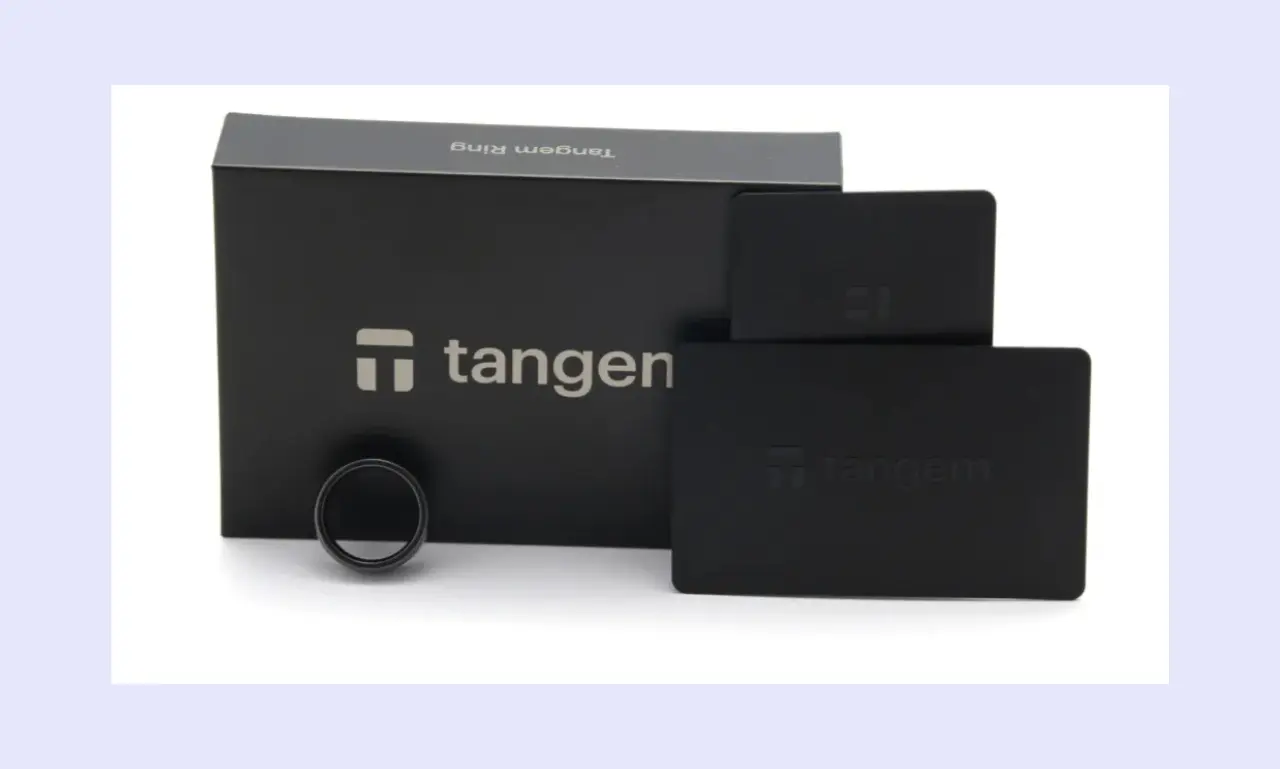
First impressions are crucial. They dramatically impact your opinion and how you feel about a new device or service. We felt Tangem was a solid wallet. Here’s why:
Packaging
Supply-chain attacks, where bad actors tamper with the wallet or flash malicious firmware, are significant risks when buying a Tangem or another hardware wallet. If successful, these attacks compromise your wallet and enable people to gain control of a user's funds.
The Tangem hardware wallet comes in unbranded outer packaging, making it challenging for bad actors to identify it in the supply chain. The Tangem box is sealed in transparent plastic or uses a sticker-seal system, which can help determine whether someone has accessed it before. There are no tamper-evident stickers or similar protections.
Tangem has stated that packaging can vary slightly due to the company altering it. But, it also claims that it's safe to purchase a Tangem wallet from any retailer worldwide due to its end-to-end certification and the in-built chips and firmware being impossible to modify. If the app doesn't prompt you to create a wallet when scanning a card, factory reset it for safety.
What's in the box?

While hardware wallets often come with many accessories, like lanyards, recovery code cards, stickers, charger cables, and keyrings, Tangem is bare bones. The only items in the box are the NFC-enabled wallet cards (or a ring if you ordered one) and a Tangem setup guide.
Build Quality
As we've mentioned, Tangem is bare bones regarding its box contents, and the same is true for the design and build quality. It uses robust plastic that offers a sturdy feel and a sleek design. The cards are rated for 25+ years of use, so they're strong enough for daily use. It comes in multiple colorways, including black, no-branding, and art with a cat eating ramen.
How to Set Up Your Tangem Wallet
Learning how to use Tangem only takes a few minutes. Still, it can be somewhat confusing if you're unfamiliar with hardware Bitcoin wallets. To streamline the setup process, we've created this step-by-step guide:
Step 1: Download the App

You must install the official app before creating or accessing your Tangem crypto wallet. In the App Store (iOS) or Google Play Store (Android), search for 'Tangem - Crypto Wallet', select the option with a Tangem logo, and install the app.
Step 2: Scan Tangem and Create Wallet

Once the app is installed, you can set up the wallet. Open the app, take a card or ring, and hold it next to your phone's NFC antenna. Afterward, click 'Create Wallet', tap 'Add a Card or Ring', and scan one of your Tangem devices.
Step 3: Create and Finalize Backup

Once you've scanned the first card, you should create a backup for added protection. Tap the 'Add a card or ring' button again, scan your second card or ring, and choose 'Finalize Backup' to complete the process.
Step 4: Set Access Code

Setting up an access code can add an extra layer of protection. It should be unique and strong. It can be a word, phrase, or number, providing plenty of options and versatility. Click 'Create', enter your code, and select 'Continue'.
Step 5: Open Your Tangem Wallet

Following your access code setup, your wallet is almost ready to use. Click 'Scan', keep your card/ring near the NFC antenna, and do the same with the second card. Allow the app to access biometric security to prevent unauthorized access, then tap 'Continue to My Wallet', and you can start sending and receiving crypto.
Tangem Wallet User Experience
A cryptocurrency wallet should be convenient and straightforward to use. Otherwise, people are less likely to utilize it consistently, eliminating most security benefits. Here's how Tangem performed during our hardware wallet review:
Ease of Use
The Tangem wallet setup process is straightforward and can be completed within a few minutes, regardless of your experience level. It eliminates one of the most challenging and time-consuming aspects of using crypto wallets: noting down, verifying, and safeguarding your 12 or 24-word seed phrase, drastically improving ease of use.
The Tangem companion app is also intuitive and well-designed. Based on my research and experience, adding new cryptocurrencies, swapping between wallets, and accessing features like swaps and the fiat on-ramp are simple, as sections are clearly labeled and relatively streamlined, making the Tangem wallet suitable for beginners.
Display & Buttons/Touchscreen
Unlike most hardware wallets, Tangem devices do not have buttons or a screen. They are battery-free cards or rings. As such, there is no way to interact with the wallets other than scanning them with the Tangem app, which is highly responsive and easy to navigate, thanks to a sleek interface and clear options.
Tangem Wallet Security Features
Is Tangem safe? This is people's primary question when deciding whether a particular wallet is right for them. Wallet security is achieved through a variety of factors related to seed phrases, physical/software security, and preventing unauthorized access. Here's how Tangem performed during testing:
Private Key Storage

Crypto wallets are composed of public and private keys. Public keys are effectively an identifier, while private keys are used to sign transactions and confirm you are who you say you are. Because the key can grant people complete access to your assets, securely storing private keys is one of the most critical functions of a crypto wallet.
When you create a seedless Tangem wallet, the device stores private keys directly within its secure chip, completely offline. The Tangem app doesn't hold private keys, preventing them from being stolen if your mobile is compromised. But the app generates the recovery phrase and sends it to a card/ring if you opt for a seed phrase wallet.
PIN Protection
Crypto wallets generally enable people to add an additional PIN or passphrase as an extra layer of protection. It prevents unauthorized access, even if someone finds your physical hardware wallets or seed phrase.
Tangem allows people to set up an access code to prevent access even if their hardware wallet is stolen. The code can be numbers, letters, or phrases. To prevent brute force attempts, the device automatically becomes locked after six failed attempts, with the lock period increasing by 1 second up to 45 seconds for subsequent failures, making brute force more inefficient.
Seed Phrase / Recovery Phrase
Tangem has campaigned against seed phrase usage and warns that it negatively impacts security by introducing a human element and a single point of failure to crypto wallets. Although users can opt to create seed phrase wallets if they desire.
Tangem supports 12 and 24-word seed phrases created using the BIP39 standard and BIP44 derivation paths (how wallets generate multiple addresses). Seed phrases are generated on the Tangem app and sent to the card/ring, not on the wallet's secure hardware. In-app seed phrase creation isn't ideal for people focused on limiting digital or internet exposure.
Physical Security

The packaging of a Tangem wallet is relatively basic, but it either comes wrapped in clear plastic or sealed with stickers, making it easy to tell if it's been tampered with. Moreover, because Tangem stores key data within the secure chip and only uses NFC, the wallets cannot be loaded with malicious firmware or connected to a computer, providing robust physical security.
Firmware Verification

The company has made its firmware completely unalterable to protect against bad actors flashing fraudulent firmware to Tangem devices.
There is no way to push a Tangem firmware update. It's stored in the secure chip and cannot be updated or modified. If the firmware is not genuine, users will not be prompted to create a wallet when scanning their card, and it is recommended that they reset the wallet to factory settings.
Open Source vs. Closed Source
Open source software has publicly viewable code that anybody can analyze and review to determine whether it has bugs or malicious hidden code. Closed-source software is proprietary code that is not accessible to the public. It can be more secure (as people cannot reverse engineer it as easily), but it means bugs are more likely to make it into production.
Tangem uses a mixture of open and closed source. The code for its companion app is entirely open source and can be viewed on GitHub, providing peace of mind that it's well-designed and isn't hiding anything. Yet, the code for its hardware wallets is closed source to prevent them from becoming vulnerable to exploits.
Audits & Certifications
As we mentioned, the Tangem hardware wallet code is closed source. Yet, it has been successfully audited by two independent organizations: Kudelski Security (2018) and Riscure (2023), both of which are publicly available audits.
The Tangem wallet's security chip has achieved an Evaluation Assurance Level (EAL) of 6+ (EAL6+), ensuring no backdoors. EAL6+ is in the same tier as its competitors, like Cypherock X1. The wallet has also achieved an IP68 rating, protecting it against dust and water damage. The device is also invulnerable to X-rays and EMPs following the ISO 7816-1 standard.
Supported Cryptocurrencies & Tokens

The primary purpose of any crypto cold storage device is to store crypto assets securely. Because they are physical devices, hardware wallets have limited storage space. Yet, some can squeeze in support for a significant number of cryptocurrencies. Here's how Tangem fares:
Native Support
There are thousands of Tangem coins supported and available for storage. They range from major assets to relatively unknown projects. The exact quantity changes as new cryptocurrencies are launched, as Tangem supports projects built on established networks like Ethereum.
Some of the most significant layer-1 (independent blockchains) Tangem supports include Bitcoin, Ethereum, XRP, Solana, Train, BNB, Cardano, Hedera, Toncoin, Litecoin, Polkadot, NEAR Protocol, Kaspa, Cosmos, VeChain, and Avalanche.
ERC-20 Tokens & Other Standards
Because the Tangem wallet supports many layer-1 blockchains, it can store thousands more assets built upon these networks. For example, ERC-20 assets in an Ethereum wallet. With some of the most significant projects, like Chainlink, existing on blockchains like Ethereum, supporting various token standards is a notable advantage.
Tangem can store assets on the Ethereum, XRP Ledger, Solana, Tron, Hedera Hashgraph, Avalanche, Polygon, Shibarium, Optimism, Arbitrum, Base, Solana, Ton, Cardano, Cosmos, Fantom, Kusuma, PulseChain, Tezos, and Telos networks, among others, ensuring that it supports almost any cryptocurrency.
NFT Support
While researching for our Tangem review, we found that while the wallet technically supports NFTs, the Tangem app doesn't have Non-Fungible Token (NFT) management capabilities. As such, the company advises people against sending NFTs to the wallet. Still, users can store NFTs in Tangem and manage them using NFT marketplaces that support WalletConnect.
Integration with Wallets/dApps
Tangem offers WalletConnect support, enabling it to link with every wallet and Decentralized Application (dApp) that supports the connectivity standard. As WalletConnect is highly popular, most Web3 projects, wallets, and dApps support it. But, to keep your holdings secure, it is recommended that you use separate wallets for asset storage and dApp interaction.
Connectivity & Compatibility

The way you connect to an offline wallet like Tangem can impact security and convenience. Generally, the less connectivity, the better, as it prevents network attacks or nearby people from hijacking signals to gain malicious wallet access.
Connection Type
Tangem's approach to connectivity is unique. It doesn't have batteries that need charging or Bluetooth connections that bad actors can intercept. Instead, it uses a Tangem secure element with an antenna and low-energy NFC to connect to NFC-enabled devices nearby. As such, the wallet never needs to be charged and is resistant to X-rays, static, and electromagnetic pulses.
Device Compatibility
The Tangem wallet uses NFC for its connectivity, so users cannot connect it to desktop PCs or laptops. Even if you own a computer with NFC Capabilities, the Tangem app is only available on mobile. Devices running Android 6.0+ with full NFC support, and devices from the iPhone 8 and up running iOS 14.5 or higher, can support the Tangem app and interact with the wallet.
It's essential to note that some phones come with partial NFC support. These devices cannot be used with the Tangem wallet as they cannot transfer enough information during activation. For example, despite having NFC, the iPhone 6/6s and 7/7 Plus's capabilities are below Tangem's requirements.
Companion App/Software

The Tangem companion app is well-designed and intuitive. After opening it, users are prompted to scan their Tangem or order a new device, indicating that a physical item is needed. After completing the wallet activation process, users have complete access to the app and its features.
Tangem features a variety of tools that can enhance convenience and help you get more from your cryptocurrency. Users can purchase crypto with fiat currency, conduct simple crypto-to-crypto swaps, stake their assets to earn rewards, and view asset-specific data to make better-informed decisions.
Tangem is one of the best hardware wallets according to iOS and Android users. It boasts 4.9/5 ratings on the Google Play Store and the App Store, based on 28,000+ and 14,000+ ratings, respectively. Users praise the app's design, the Tangem support team's assistance in complex issues, and its convenient approach to crypto asset security.
One thing worth noting about the Tangem app is that it doesn't automatically create or display seed phrases for account recovery. Tangem has campaigned against seed phrases and believes them somewhat insecure, preferring physical card backups. Users can opt for seed phrases in the wallet, but must do so manually.
Tangem Wallet Advanced Features
The Tangem crypto storage device boasts advanced features that enhance its capabilities and offer convenience to investors and traders. They include:
Staking & DeFi Integration
Crypto staking enables people to earn passive rewards for improving a network's capabilities and validating transactions. Tangem offers native on-chain staking for Solana, BNB, Tron, Polygon, and Cosmos. The service is available directly from the app and displays key information like rewards, APR, unbonding periods, and reward schedules.
Tangem can easily connect to dApps and Decentralized Finance (DeFi) applications using WalletConnect. On the company's blog, BENQI is the recommended platform. It offers liquid staking, lending/borrowing, and governance. Although other platforms, like PancakeSwap for decentralized trading or OpenSea for buying/selling NFTs.
Exchange Integration
While crypto wallets like Tangem wallets are primarily designed for storing cryptocurrencies, they can also be used for other functions, such as buying or swapping digital assets. Tangem offers both services.
Within the Tangem mobile app, users can purchase crypto with fiat currency. The service is handled by two third-party providers: Mercuryo and Simplex. As such, fees will vary by asset, volume, payment method, and provider. Many cryptocurrencies are supported, but the buy button will be grayed out if Tangem's partners don't offer it.
While testing the app for our Tangem Review, we found it also offers a powerful crypto-to-crypto swaps tool that aggregates offers from multiple third-party providers, such as ChangeHero and OKX, to provide users with the best rates. After you pick which assets you want, Tangem Express displays the best providers for you to choose from.
Multi-Signature (Multi-Sig) Capabilities
Some secure crypto wallets enable users to set up additional verification for transactions by requiring multiple signatures for confirmation. This means the user needs two or more private keys or key fragments to approve transactions. The comparable Cypherock X1 wallet achieves this by requiring the scanning of two or more physical cards.
Unfortunately, Tangem doesn't have native multi-sig capabilities. Users can set up backups, but not multiple cards to approve transactions from a single wallet. But Tangem owners can use Genosis Safe to set up multi-signature approval from their hardware wallets. The service is popular among Tangem users and is trusted by established projects, such as 1inch.
Pricing & Value for Money

While cryptocurrency security and convenience are the two primary considerations for a hardware wallet, pricing and value for money are other key aspects. If a wallet costs too much, it will exclude smaller investors or people from developing economies..
Current Price
When buying a Tangem, you can choose from four packages, each catering to various use cases. Users get free shipping above $89. There are multiple styles of Tangem cards, with certain ones on sale for slightly lower prices ($10 savings on the 3-card sets). The Tangem price for each package is:
- 2 Card Set: $54.90
- 3 Card Set: $69.90
- Family Pack (6 Cards): $139.90
- Tangem Ring (Plus 2 Cards): $160
What's Included

When you buy Tangem devices, you'll receive the number of cards you purchased and a manual to help you get started with the wallet, but that's all. Because the wallet has no battery, a charger isn't included. Similarly, because seed phrase backups are optional and Tangem advises against them, there are no cards for writing down your recovery code.
There are no extra fees for using Tangem, outside of the fees charged by its third-party service providers, and an additional $29.90 charge for an optional leather cardholder. The app is free to download and use, and the cards come with a 25-year warranty, ensuring peace of mind over the long term.
Is It Worth It?
The Tangem hardware wallet is considerably cheaper than premium wallets like the Ledger Stax ($399) or the Trezor Safe 5 ($169), making it a solid option for people purchasing their first hardware wallet or smaller investors looking to enhance their security without breaking the bank.
Whether or not a Tangem Wallet is right for you will depend on your security and convenience preferences. If you're looking for an entirely offline device with minimal external connectivity that can be easily stored or transported, then it's a great choice. But, if you desire native multi-sig capabilities or an in-built screen to confirm wallet address, other cold wallets are better.
Tangem vs. Competitors
Understanding how the Tangem Wallet compares to other popular hardware products is essential for making a well-informed decision on which is best for you. Here's how it comes to a few popular contenders.
| Hard Wallets | Security Architecture | Support Coins/Tokens | Price | Ease of Use | Connectivity | Display | Advanced Features | Build Quality | Customer Support |
|---|---|---|---|---|---|---|---|---|---|
| Tangem | Secure chip, offline | 16,000+ | $54.90 to $69 | Simple | NFC | No | No seed phrase, fiat-on-ramp, swaps | Moderate, feels good, but plastic | Help center + email |
| Ledger Nano X | Secure element, custom OS | 5,500+ | $149 | Moderate | USB-C, Bluetooth | 1.09” OLED | Swaps, staking, and NFT support | Premium. Metaland plastic | Help center, chatbot, human support |
| Trezor Safe 3 | EAL6+ secure element | 8,000+ | $79 | Simple to moderate | USB-C | 0.96” OLED | Open source dApp connectivity, passphrase | Mostly sturdy plastic | Support center, chatbot, human support |
| BitBox02 | Secure Dual Chips | 1,500+ | $173 | Simple | USB-C and USB-A | OLED with touch sensors | Multi-sig, microSD | Robust polycarbonate | Support hub, AI bot, human agents |
| Cypherock X1 | Secure element, open-source | 9,000+ | $159 | Moderate (requires setup) | USB-C, NFC | 0.96” OLED | Multi-sig, backup cards, private key distribution | Durable and solid | Livechat, FAQ page, detailed DOCs |
Cypherock is the most comparable option to Tangem. It's another card-based wallet, although it comes with a central vault device and multi-sig capabilities. While the Cypherock X1 offers enhanced functionality, Tangem is about half the price.
The Ledger Nano X is one of the most popular hardware wallets. It has a higher price tag and NFT support, but it also has USB-C and Bluetooth connectivity. Tangem devices are offline and don't require charging, so they're always ready and better suit people wishing to minimize external connectivity.
Who is Tangem Best Suited For?

Tangem is a solid hardware wallet choice for many types of users. We found it simple and highly convenient while testing the device and researching for our Tangem review. Scanning the cards via NFC is straightforward, making the setup process a breeze. Users can create backup cards in case they lose one. Moreover, the card can fit in a wallet for convenient transportation.
Tangem wallets are affordable, easy to use, and durable, making them an excellent choice for investors seeking a secure and cost-effective crypto storage solution. They provide strong digital asset protection, so they're suitable for beginners and experienced users who want to enhance security, while their 25-year lifespan is ideal for long-term investors.
The wallet is broadly suitable and will be fine for most people. Still, better options are available if you desire a screen for reviewing wallet addresses before transfers, need Bluetooth connectivity, or want to set up multi-sig without an external platform.
Other Hardwallet Wallet Options




Conclusion & Final Verdict
Our Tangem review found the device to be a well-rounded and reasonably priced hardware wallet that excels in security by limiting external connectivity and enabling multiple hardware backups. In contrast to most wallets, it doesn't feature batteries or a screen - just NFC-enabled cards or a ring that links to a mobile app.
Because it supports multiple backups and is rated for 25+ years of operation, the Tangem wallet is ideal for long-term storage. It also suits beginners or people without much capital to spend on a crypto storage system. Experienced investors will also find Tangem valuable. While unsuitable for people who want to manage their funds on a computer, Tangem is a great hardware wallet.
FAQs (Frequently Asked Questions)
Can I use Tangem with my phone?
The Tangem companion software is exclusively available on mobile devices with full NFC support. Older phones with limited NFC or laptop/desktop computers are not supported. The app is available on the App Store (iOS) and Google Play Store (Android).
What happens if I lose my Tangem?
Losing your crypto wallet can be highly stressful and cause significant financial loss. Although Tangem lets users create up to three backups per wallet. These cards or rings can be stored separately, anywhere worldwide, providing solid redundancy. Users can also save a seed phrase linked to their Tangem wallets to recover them without device access.
Can Tangem freeze my wallet?
The Tangem company has no control over the wallets it issues. There is no mechanism enabling Tangem to freeze wallets. They exist on the blockchain, not any special proprietary software. Moreover, users have complete control over the private keys and seed phrases linked to their wallets, meaning only they can recover them.
How do I update my Tangem's firmware?
Unlike a typical hardware wallet, users cannot update the Tangem firmware. It comes downloaded into the chip and can never be altered. Tangem has taken this approach to combat supply chain attacks or accidental installations of malicious firmware versions. Tangem’s firmware is closed source for security reasons, but has passed two independent audits.


