Best Multisig Wallets in 2026: Shared Security for Your Crypto


- When you click links on this page, we may earn an affiliate commission. By using this website you agree to our terms and conditions and privacy policy.
- Participation in online gambling may be illegal in your country and is subject to age restrictions (18, 19, or 21, depending on the jurisdiction). Verify legality and age requirements before participating. Learn more
Looking to maximize your crypto security? A Multi-signature or shared crypto wallet could be worth considering. They require approval from multiple parties to complete sensitive actions, such as transferring cryptocurrency. As such, multisig wallets excel in high-trust applications, such as managing an organization’s treasury or securing long-term investments.
Throughout this guide, we’ll examine some of the best multisig wallets, explain precisely what a multisig wallet is, discuss how they work, and highlight the differences between multisig and Multi-Party Computations (MPC) setups. We also share typical use cases for multisig wallets and answer common questions. Let’s get started.
TL;DR
- The best multisig wallets are Blockstream, BitKey, Bitbox02, and Trezor
- Multi-signature wallets require approval from multiple signees to confirm a transaction, which is valuable for high-trust applications.
- Some common Multi-signature configurations include 2-of-3, 3-of-5, and 5-of-9.
- Multisig wallets typically do not require approval from every signee, providing redundancy in case one signee or signature device is unavailable.
- When you initiate a multisig transaction, it will remain pending until it receives approval, at which point the transaction will be broadcast to the blockchain and processed.
The Best Multisig Wallet Solutions for 2026
Before selecting the best multisig wallet, it’s essential to examine some of the top options and their offerings to determine which one suits your individual needs.
Some of the top multisig providers include:
Best Multisig Wallet for 2026 Reviews
BitBox
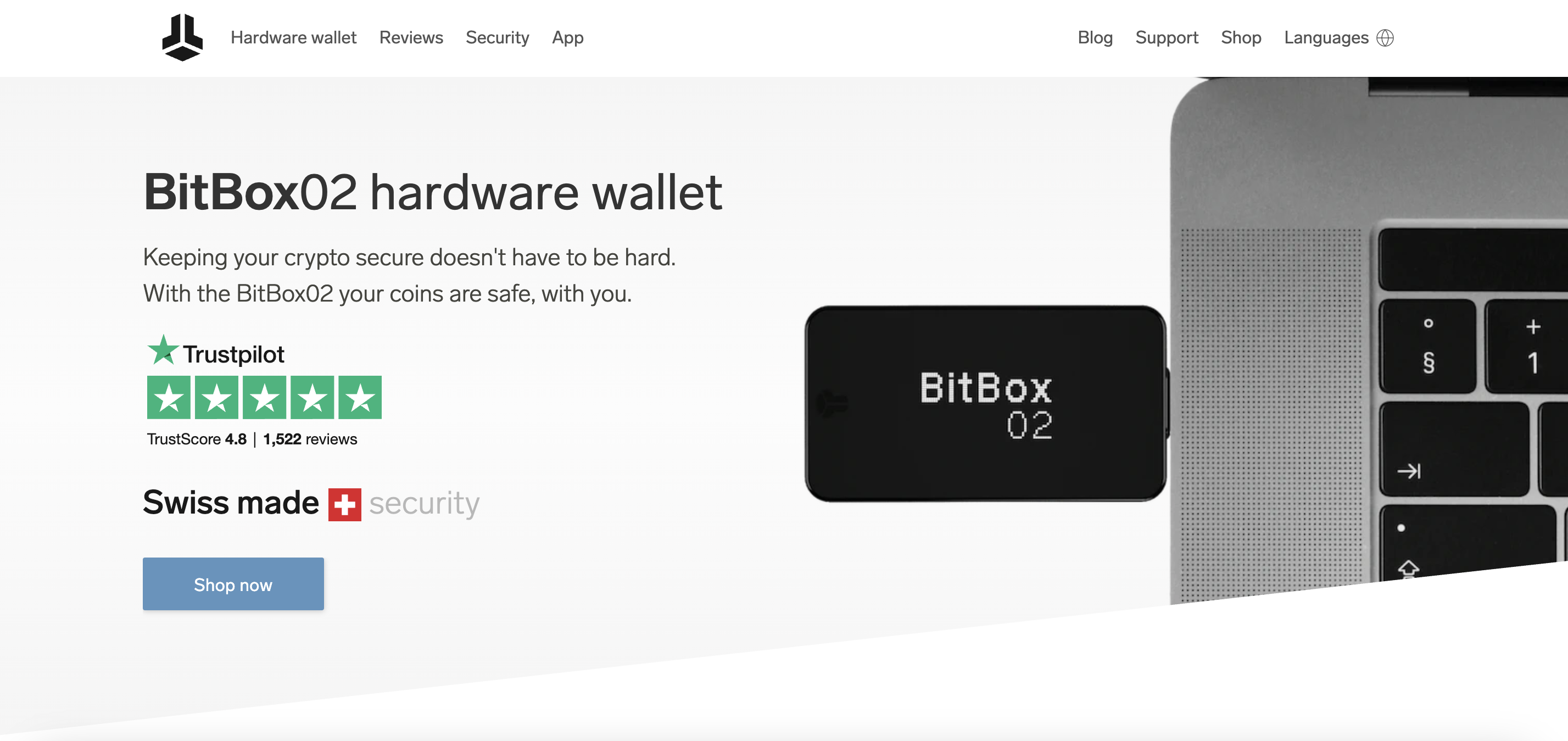
If you’re looking for a secure multisig wallet to store the bulk of your holdings, the BitBox02 is a solid option. It’s a premium device that supports over 1,500 assets. It utilizes USB-C for connectivity, but the more expensive BitBox02 Nova provides Bluetooth connectivity, which is essential for iOS users.
A BitBox02 can be used as a Multi-signature wallet with any compatible software, such as Electrum. Multiple BitBox02 devices can secure a single wallet, allowing users to create 2-of-3, 3-of-5, or 5-of-9 configurations, depending on their requirements. BitBox02 wallets also function as FIDO passkeys for other services, such as Google.
Users manage their BitBox02 wallets using the BitBox app, which is available on mobile and desktop devices. It allows people to buy and sell crypto, with an optional insurance service for added protection. Users can also create multiple, segregated accounts to split up their holdings.
The BitBox02 is ideal for adding Multi-signature security to your cryptocurrency wallet. While it’s expensive ($175 for the standard version, $205 for the EAL6+ iOS version), its broad support for external services and wallets makes it an excellent choice for enhancing your personal security both within and outside the crypto space.
Pros
-
Works as a multisig device with external wallets
-
Functions as a FIDO passkey for various services
-
Straightforward dApp connectivity
-
EAL6+ security chip (BitBox02 Nova)
-
Works with mobile and desktop devices
Cons
-
iOS users must buy the more expensive version
-
Relatively expensive

Blockstream
Blockstream Green provides a Bitcoin-focused wallet solution developed by one of Bitcoin's most influential development companies. You get access to cutting-edge Bitcoin technologies, including Lightning Network payments and liquid sidechain transactions. The platform targets users who understand Bitcoin's technical aspects and want access to the latest protocol improvements before they reach mainstream adoption.
The wallet implements 2FA security without requiring phone numbers, using hardware tokens or authenticator apps instead. Lightning Network integration enables instant, low-fee Bitcoin payments. Liquid Network support allows faster settlement times and confidential transactions. Hardware wallet compatibility is supported by most popular devices, including Ledger and Trezor.
Pros
-
Developed by Bitcoin protocol contributors with deep expertise
-
Lightning Network functionality for instant payments
-
Privacy-enhanced features through Liquid sidechain integration
-
Hardware wallet support across multiple device types
-
No phone number requirement for 2FA security
Cons
-
Bitcoin-only focus excludes other cryptocurrency options
-
Technical features may confuse less experienced users
-
Limited customer support compared to consumer-focused wallets
-
Interface design prioritizes function over user experience
-
Liquid Network adoption remains limited outside technical circles

Bitkey
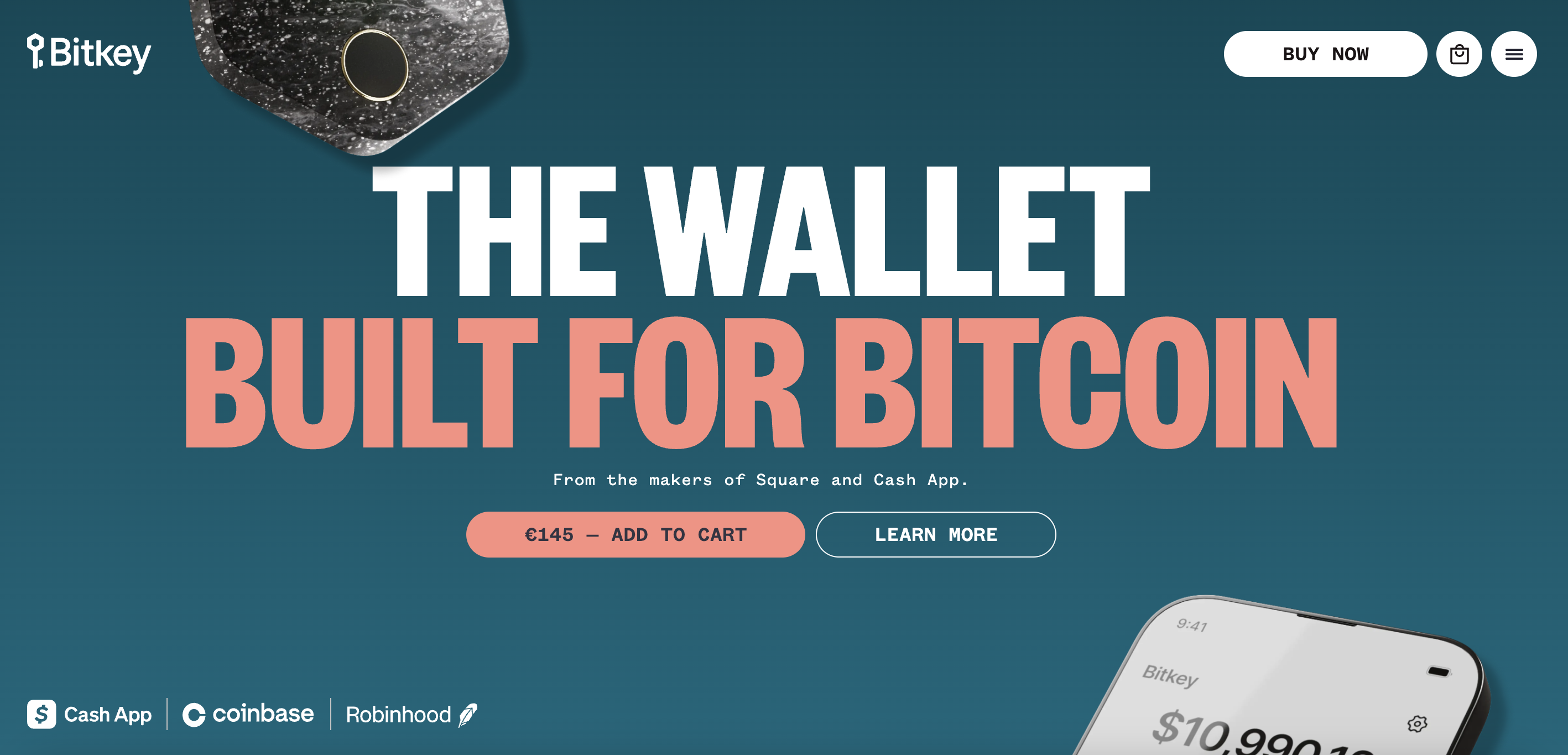
Not everyone likes to invest in altcoins or interact with DeFi protocols. Some people focus on one or two assets, such as Bitcoin. In such cases, it can be beneficial to use a dedicated Bitcoin hardware wallet, like Bitkey.
Bitkey is a pocket-sized, hexagonal wallet that utilizes a 2-of-3 Multi-signature configuration to safeguard users. One key is stored on the Bitkey device, another is stored in the Bitkey app, while the other is encrypted on the Bitkey server and cannot be used independently.
The Bitkey app is relatively basic, but users can track their Bitcoin holdings and buy/sell crypto. Bitkey also provides additional features, including an inheritance system and a fingerprint reader, which enhance convenience and security.
Costing $150, Bitkey is on the pricer side but not unreasonable for an open-source Bitcoin multisig wallet. The fingerprint reader enhances security and simplifies access compared to alternatives. Overall, Bitkey is a highly secure, if slightly expensive, multisig wallet that’s a strong choice for dedicated BTC investors.
Pros
-
2-of-3 multisig configuration
-
Built-in fingerprint scanner
-
Buy/sell functionality
-
Inheritance system
-
Pocket-friendly
Cons
-
Bitcoin-only
-
Relatively expensive
- Bitcoin
- English
Trezor
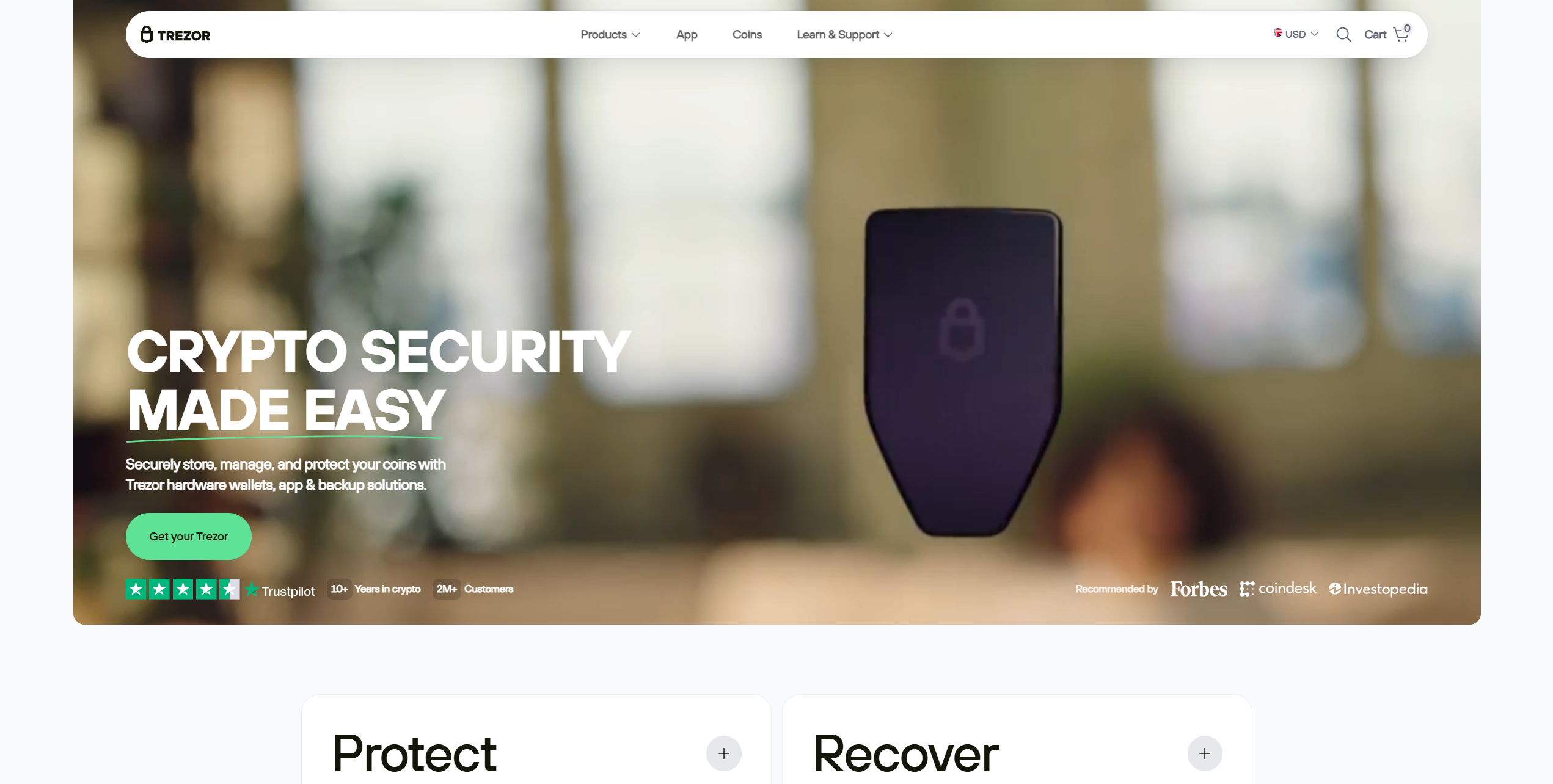
Trezor wallets are similar in function to Ledger wallets, boasting an open-source security architecture that enables users or researchers to audit the devices for bugs or vulnerabilities independently. If you're seeking a budget hardware wallet, the Trezor Model One doesn't get much better. Priced at $49, users get a small two-button device with an optional PIN system. It can store over 1,000 cryptocurrencies, but lacks some key assets, including XRP and Solana.
The Trezor Model T is a premium hardware wallet with a 1.54-inch touchscreen and USB-C connection. It offers the same seed phrase-splitting tool as the Safe 3, but is significantly more expensive at $129. Moreover, it can be used as a 2FA passkey device, enhancing flexibility. While all of Trezor's wallets are managed via Trezor Suite, which provides swap and purchase functionality, the Safe 3 is the best overall offering due to its EAL6+ security chip and seed-splitting tool. However, keep in mind that they're view-only on iOS. iPhone users cannot use Trezor wallets without another device.
Pros
-
Broad crypto asset support
-
Can connect to dApps and DeFi protocols
-
One of the most well-known hardware wallet brands
-
Products at multiple price points
-
EAL6+ security chips for Safe 3
-
Budget-friendly hardware wallet
Cons
-
No native iOS support for transactions
-
Absolute beginners might struggle with the interface at first
- Bitcoin
- Ethereum
-
Tether
204
No result
- English
- Czech
What is a Multisig Wallet? The Foundation of Shared Control
A multisig or Multi-signature wallet is a special type of cryptocurrency wallet that requires multiple signatures (generated by private keys) to authorize a transaction. Comparatively, traditional crypto wallets are typically single-signature, which makes them less resilient to compromise and reduces recoverability if the private key is lost.
If you’re struggling to understand how wallets use private keys in a typical cryptocurrency transaction, it can be helpful to learn about the signing process.
When placing a transaction on the blockchain, you must sign it using your private key. The wallet uses the public key to verify the signature and confirm that you control the wallet.
In a single-signature wallet, only one signature (typically the transaction initiator) is required to approve the transaction. For multisig transactions, you need more than one signature. On a multisig wallet, the majority of approvers must sign it for it to be executed, enhancing security and redundancy compared to single-signature alternatives.
Understanding Single-Signature vs. Multisig Nature
To better illustrate the multisig vs single-sig debate, it can help to use an analogy:
Think of a single-signature wallet as a house key. It can open the front door and provide access to the house’s contents, but there is a single point of failure. If the key is lost, stolen, or broken, you may struggle to gain entry.
A Multi-signature wallet is more akin to a safe with several locks, each with its own key. Multiple keys must be inserted for the locking mechanism to open; a majority (e.g., 2 of 3) is required, not every key. No single key holder can open the safe, enhancing security.
Due to their architecture, Multi-signature wallets are more secure than single-signature alternatives. Because multiple private keys are required for access, they’re great for applications where high trust is essential. For example, Decentralized Applications (dApps) and an exchange’s hot wallet can both manage millions of dollars in assets, making safety crucial.
The M-of-N Configuration Explained
The ‘M-of-N’ configuration sounds complex, but it’s relatively simple.
- M represents the signature threshold required for transaction approval.
- N represents the total number of potential signees.
Some common M-of-N setups include 2-of-3, 3-of-5, or 5-of-7. The configuration is chosen deliberately, in relation to the intended application, based on the security and recoverability requirements.
Higher signature thresholds are more secure because an attacker must compromise a greater number of keys to access the wallet. Therefore, a 5-of-7 is more secure than a 2-of-3 multisig setup, and so forth. N-of-N setups, which require access to all keys, are the most secure.
If the signature-to-key threshold is too high, recoverability can be limited. In an N-of-N setup, losing one key means you won’t be able to access the wallet. In contrast, a 3-of-5 setup lets you lose up to 2 keys and still access the wallet, providing key redundancy while maintaining security.
How Multisig Wallets Work: The Transaction Flow
So, how do multisig wallets work? If you’re new to crypto, it can be challenging to understand the transaction flow. However, taking the time to understand how transactions work can make selecting the best multisig wallet significantly easier, as you’ll know what to expect.
Initiating and Signing a Transaction
A single person can provide multiple signatures when using a multisig wallet. Typically, the wallet software can provide one signature, while a hardware wallet device stores keys for another, and an additional wallet manages the third key.
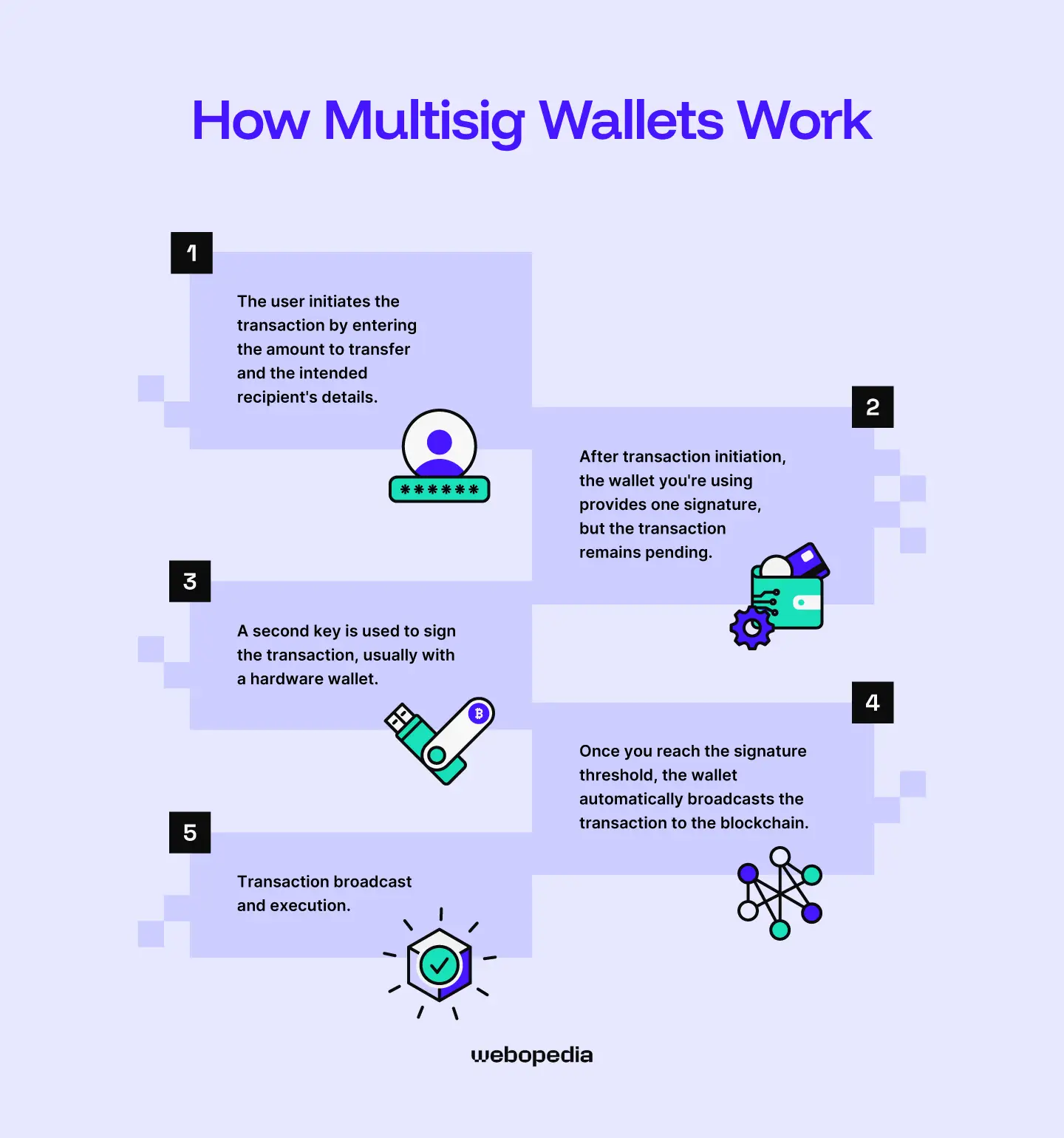
The user can initiate a transaction, but it remains pending until they provide the remaining signatures; at that point, it’s finalized and broadcast on the blockchain. In a step-by-step format, the process is roughly as follows:
- The user initiates the transaction by entering the amount to transfer and the intended recipient’s details.
- After transaction initiation, the wallet you’re using provides one signature, but the transaction remains pending.
- A second key is used to sign the transaction, usually with a hardware wallet.
- Once you reach the signature threshold, the wallet automatically broadcasts the transaction to the blockchain.
Broadcasting and Execution
What exactly does broadcasting a transaction mean? Once the signature threshold has been met, the transaction is bundled and broadcast to the blockchain, where network validators verify that the transaction is valid and authentic. After confirming, transaction execution occurs, finalizing the transaction and recording it on the blockchain.
The broadcasting and validation processes are decentralized and do not rely on central intermediaries. Validation is consensus-driven and handled by network participants who are rewarded with crypto for their efforts, resulting in a fully trustless process.
Why Choose a Multisig Wallet? Use Cases for Max Security
Multi-signature wallets offer phenomenal security, but they’re not suitable for every situation.
Because these types of wallets require more technical knowledge and are less convenient for day-to-day transactions, they’re best reserved for applications where safety is critical, such as when large sums of money are involved, as they reduce the risk of human error or insider theft.
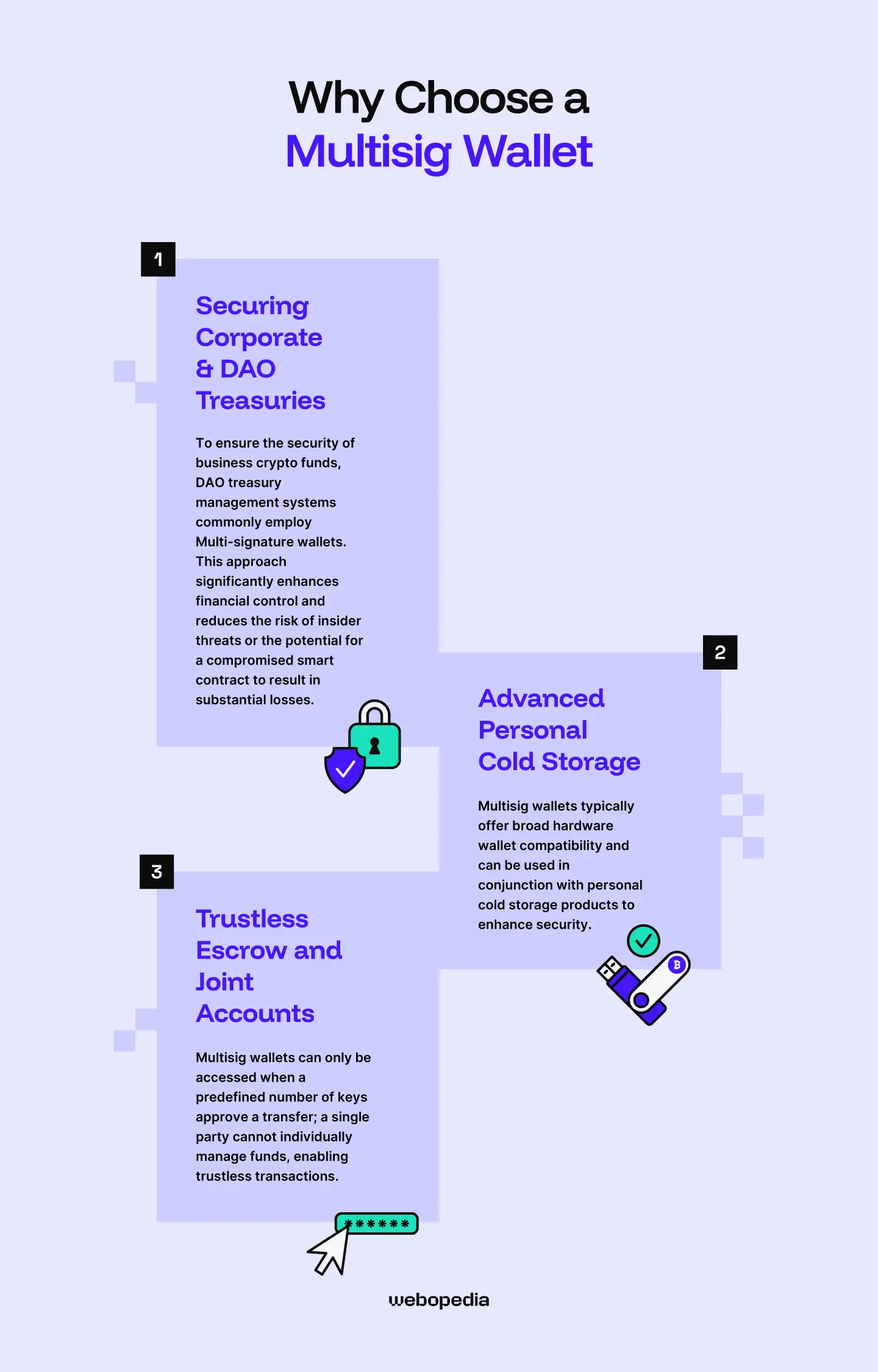
Securing Corporate & DAO Treasuries
A Decentralized Autonomous Organization (DAO) is an entity that operates without a central authority, instead opting for a democratic design, where all members can propose or vote on updates or changes to direction.
To ensure the security of business crypto funds, DAO treasury management systems commonly employ Multi-signature wallets. This approach significantly enhances financial control and reduces the risk of insider threats or the potential for a compromised smart contract to result in substantial losses.
Multisigs for DAO treasury security typically require confirmation from multiple executive-level employees or core DAO members to approve a transaction and release funds, thereby creating a more secure environment for all parties involved.
Advanced Personal Cold Storage
Everyone with significant wealth stored in cryptocurrency is a target for attackers. Anyone can track your holdings on the blockchain, and bad actors can potentially tie your address to your personal information, depending on the information you lost online.
However, multisig wallets significantly enhance security by requiring access to multiple keys, which can be stored in various locations worldwide, making them extremely challenging to compromise without detection. If discovered, the wallet owner has time to prevent the malicious access attempt and employ a loss-prevention strategy.
Multisig wallets typically offer broad hardware wallet compatibility and can be used in conjunction with personal cold storage products to enhance security. The geographical key distribution system also limits the risk of theft or disasters, such as fires or floods, making the best multisig wallets ideal for high-wealth individuals.
Trustless Escrow and Joint Accounts
In certain circumstances, it can be beneficial to form a joint account, trust, or fund rather than maintaining independent wallets. They’re effectively escrow services, keeping funds safe until a specific set of requirements is met; in this case, a transaction receiving the appropriate number of signatures.
Because they operate without a single central authority with master control, multisig wallets are excellent options for organizations or high-net-worth families. For example, if you want to leave a large sum of money to your children fairly, a multisig wallet can require all beneficiaries to be present to access the funds.
Multisig wallets can only be accessed when a predefined number of keys approve a transfer; a single party cannot individually manage funds, enabling trustless transactions. As such, all parties (or a majority, depending on configuration) must be present to access a multisig wallet, ensuring consensus and a (theoretically) fair asset distribution.
In Conclusion
- While they’re not the same, MPC wallets are suitable alternatives to multisig wallets, particularly for beginners.
- Select a multisig wallet that suits your needs and is compatible with the blockchain and assets you want to store.
- Consider which N-of-M configuration is best suited to your needs before setting up your wallet.
FAQ Section:
Can a Multisig wallet be hacked?
No type of crypto wallet is entirely immune to hacks, regardless of whether it’s a software or hardware wallet, or whether it uses a single or Multi-signature approach. However, multisig wallets are far more challenging to compromise, as a bad actor must gain control over every key to access the wallet.
What happens if one of the signers loses their key?
Assuming the wallet employs an approach like 2-of-3 or 3-of-5, where not every key is required to access the wallet, there is little risk associated with losing a single key. As long as you still hold the majority, you can continue to access your wallet and transfer funds.
Should a beginner use a multisig wallet?
Multisig wallets are typically best reserved for experienced investors who wish to maximize their security and corporate users, where trust is essential, such as in a DAO treasury. This is because a multisig wallet can be inconvenient and require an understanding of the crypto transaction flow to use effectively.
Is a multisig wallet the same as an MPC wallet?
Multi-signature and Multi-Party Computation (MPC) wallets serve similar purposes, enhancing security by modifying the interaction between private keys and wallets. While MPC wallets split the private key into multiple shares stored on separate devices, multisig wallets require several independent private keys, with a set number required for wallet access.