Best MPC Wallets 2026: Secure Your Assets Without a Single Point of Failure

- When you click links on this page, we may earn an affiliate commission. By using this website you agree to our terms and conditions and privacy policy.
- Participation in online gambling may be illegal in your country and is subject to age restrictions (18, 19, or 21, depending on the jurisdiction). Verify legality and age requirements before participating. Learn more
The best MPC wallets in 2026 should be easy to use. Through our research, we discovered that most wallets offered by centralized exchanges (CEX) like Binance or Coinbase are MPC wallets, making them accessible to everyone.
Throughout this guide, you will learn more about what an MPC wallet is, the differences between a multisig wallet and an MPC wallet, key features of an MPC wallet, and how to manage your security when owning one.
TL;DR:
- The best MPC wallets in 2026 are Zengo wallet, Binance Wallets, and Coinbase wallets
- MPC wallets split your private key into separate shares stored across multiple locations, so no single point of failure can compromise your funds.
- Unlike multisig, a multi-party computation wallet signs transactions off-chain, resulting in lower fees and better privacy.
- Most MPC crypto wallets are seedless, meaning no 12 or 24-word phrase to manage or lose.
- The best MPC wallets offer either 2-of-2 or 2-of-3 key share models depending on your security needs.
- MPC technology works for both retail users and institutions, with options designed for different experience levels.
The Best MPC Wallets of 2026
Zengo Wallet
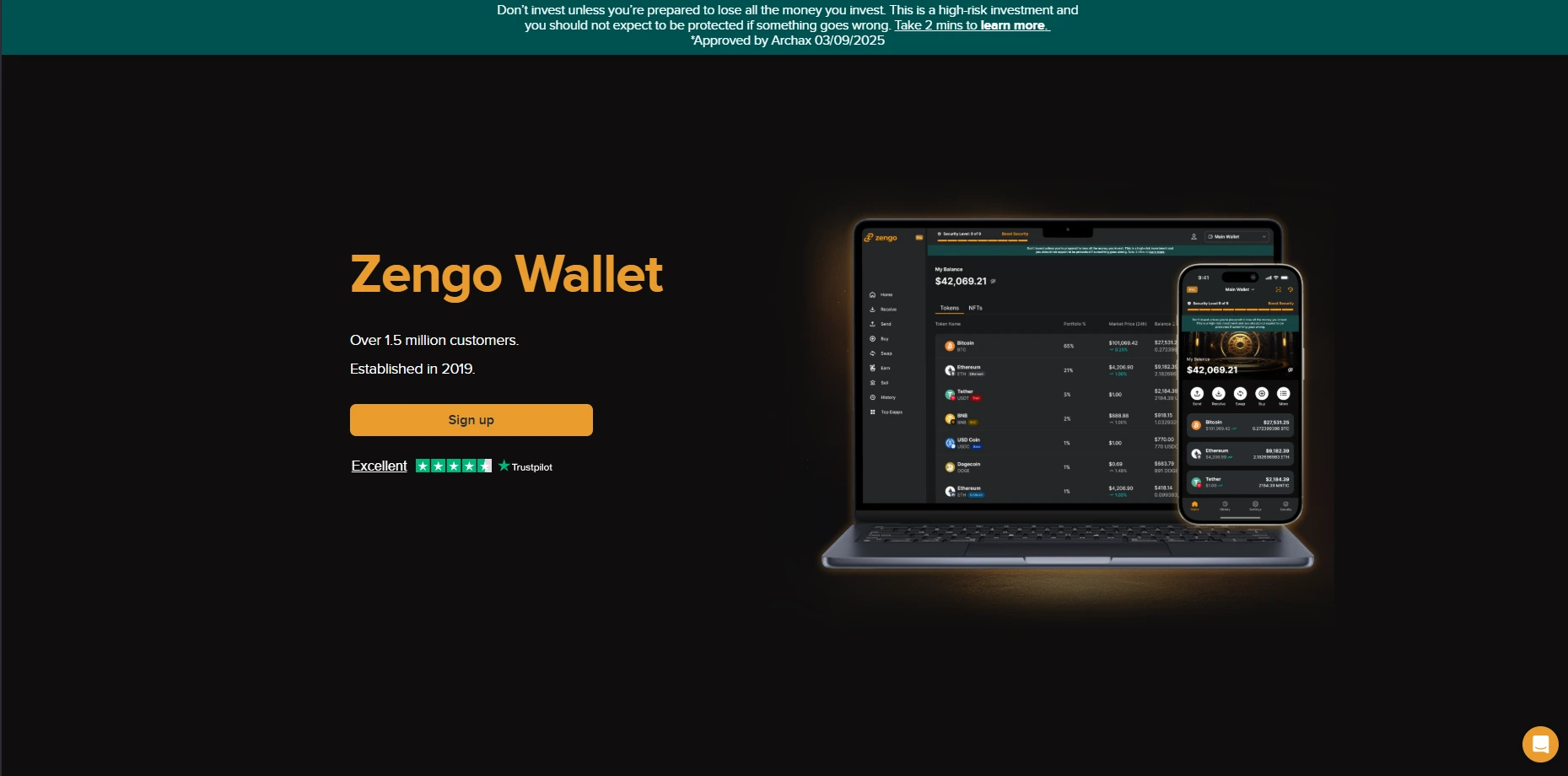
Best For: users in need of a soft crypto wallet with theft protection and legacy transfer
Zengo Wallet stands out as one of the best crypto wallets in 2025 by offering a unique keyless security model. Instead of relying on traditional seed phrases, Zengo uses Multi-Party Computation (MPC) combined with three-factor authentication, making it easier and safer to recover accounts without the risk of losing access.
Key Features: This mobile-first wallet supports over 320 cryptocurrencies on multiple blockchains, catering to users who want a seamless experience without sacrificing security. Zengo also offers built-in features like crypto buying, selling, swapping, and staking, all accessible through a sleek and intuitive app interface. Additionally, Zengo provides fiat on-ramp and off-ramp services, making it convenient for users to convert between crypto and traditional money. While it doesn’t support desktop or browser extensions, its mobile security features, including biometric authentication and a Web3 firewall, position it as an excellent choice for everyday crypto management.
Pros
- Keyless security with MPC and 3FA for safer recovery
- Supports a wide range of cryptocurrencies
- Integrated fiat on/off ramps and swapping
- Easy-to-use mobile app with biometric security
- Access to staking and dApps
Cons
- Exchange fees can be relatively high
- Limited staking options compared to competitors
- No desktop or browser extension support
- Not fully open source
RockWallet
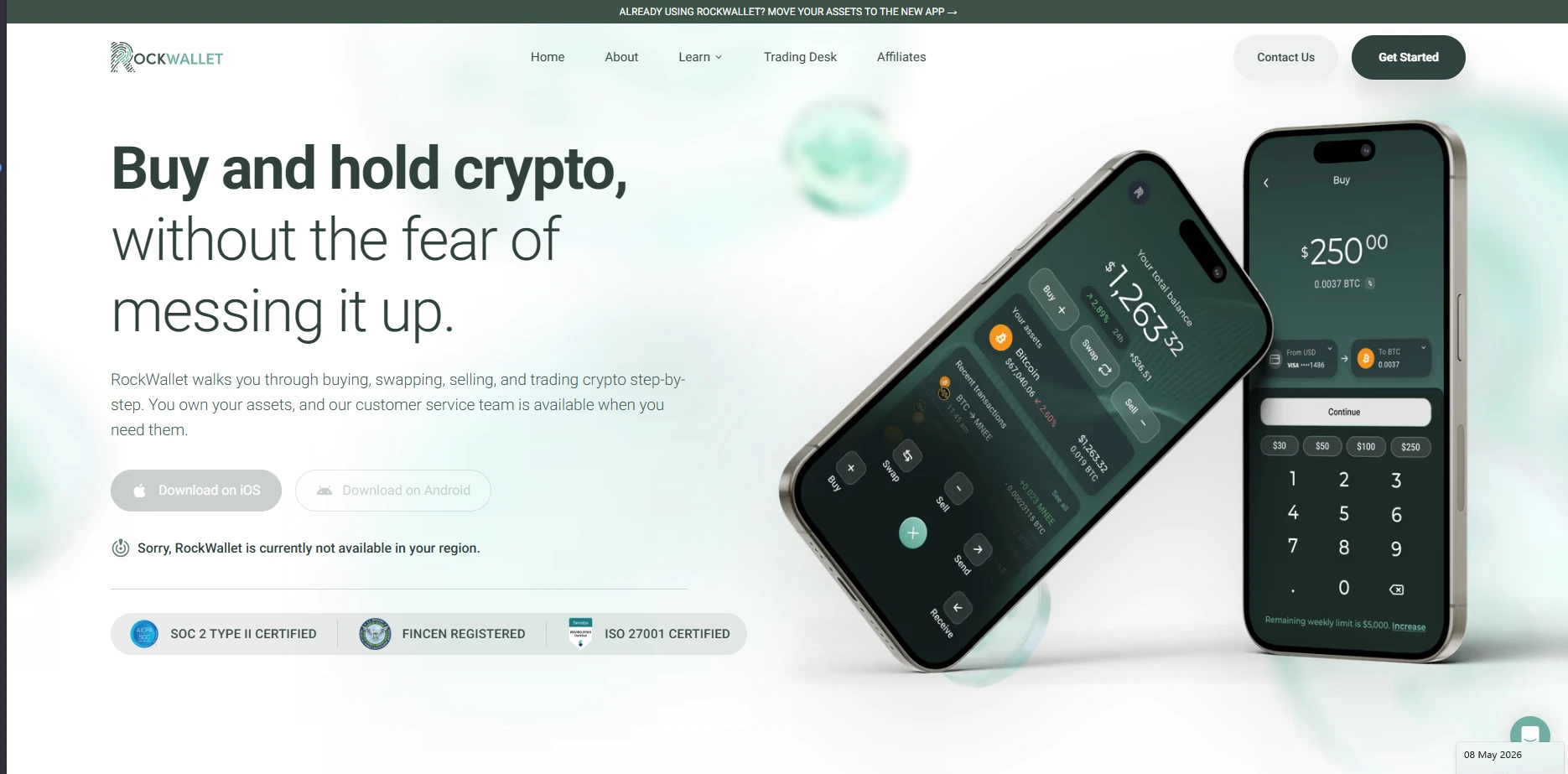
Best For: US-based users who want a simple, regulated wallet with direct bank account integration and straightforward crypto purchasing.
RockWallet focuses on providing straightforward crypto access for American users through a mobile-first platform with traditional banking integration. You can connect your bank account directly to buy, sell, and store popular cryptocurrencies without navigating complex exchange interfaces. The platform emphasizes regulatory compliance and user-friendly design over advanced trading features, making it suitable for people who want basic crypto functionality with familiar banking-style operations.
Key Features: The wallet supports major cryptocurrencies, including Bitcoin, Ethereum, and Litecoin, with direct bank account linking for purchases. ACH transfers allow fee-free deposits from connected bank accounts. Built-in price tracking helps monitor portfolio performance, while the mobile app provides core wallet functions including sending, receiving, and storing coins.
Pros
- Direct bank account integration simplifies funding
- Fee-free ACH deposits reduce transaction costs
- Regulated US operations provide legal compliance assurance
- Simple interface suitable for crypto newcomers
- Mobile-focused design offers convenient access
Cons
- Limited crypto selection compared to major platforms
- US-only availability restricts international users
- Basic feature set may disappoint advanced traders
- Higher spreads on crypto purchases than on exchanges
- Limited customer support options for problem resolution
Coinbase Wallet
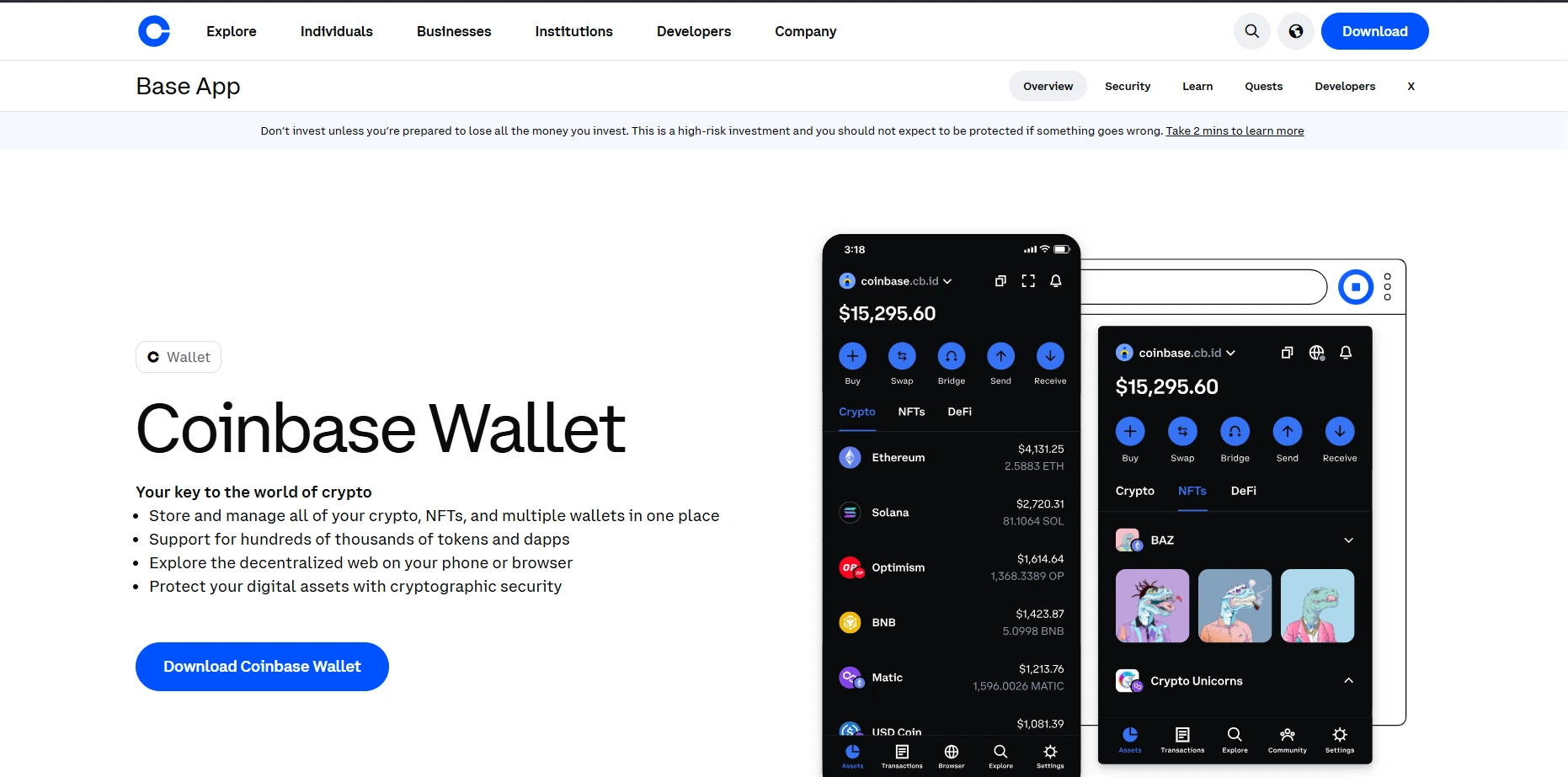
Best For: Mainstream users who want seamless integration between centralized exchange (CEX) services and self-custody wallet features with social media functionality.
Base App represents Coinbase's evolution of its original wallet into an all-in-one platform that combines crypto storage with social networking features. You can manage your coins and collectibles while participating in a creative economy where content creation gets rewarded. The platform bridges traditional crypto wallet functions with modern social app experiences, targeting users who want both financial tools and community interaction in one application.
Key Features: The app stores cryptocurrencies, non-fungible tokens (NFTs), and DeFi positions across multiple blockchain networks, including Bitcoin, Ethereum, and Solana. Built-in buying, swapping, staking, and minting capabilities eliminate the need for external services. USDC rewards provide passive income opportunities, while passkey backups simplify wallet recovery. Smart wallet technology offers sponsored transaction fees, and the platform supports millions of tokens across popular networks.
Pros
- Integration with Coinbase's established ecosystem and reputation
- Social features combine finance with community interaction
- Supports extensive cryptocurrency and NFT collections
- Multiple payment methods available in over 120 countries
- Simplified backup process using modern passkey technology
Cons
- Platform transition may confuse existing Coinbase Wallet users
- Social networking focus might not appeal to privacy-conscious users
- Dependency on Coinbase's infrastructure creates centralization concerns
- New app format is still in beta development
- Less suitable for users wanting pure wallet functionality
What is an MPC Wallet and Why is it the Future of Key Management?
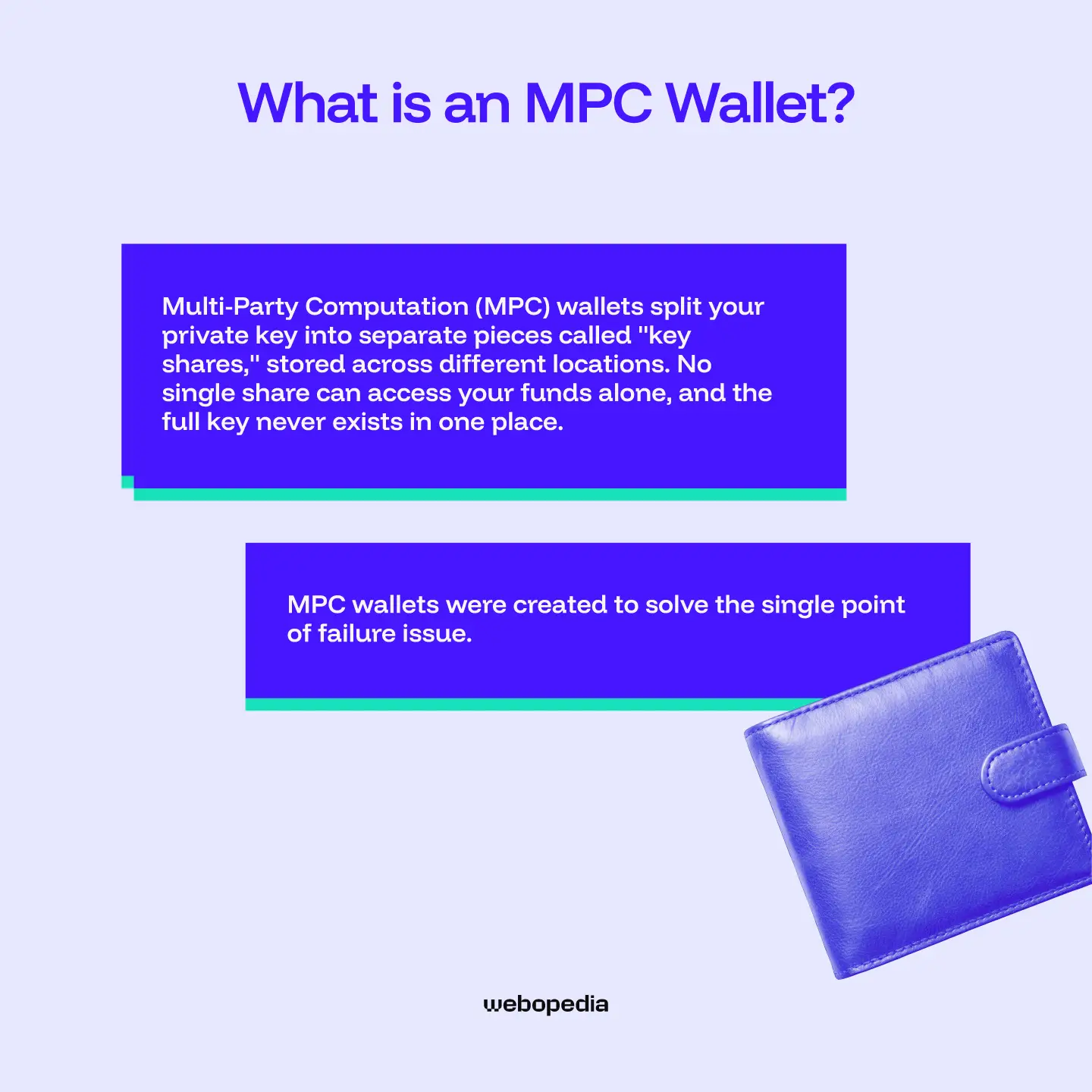
Multi-Party Computation (MPC) wallets split your private key into separate pieces called "key shares," stored across different locations. Think of it like a digital vault that requires multiple encrypted codes to open.
No single share can access your funds alone, and the full key never exists in one place. Below, I'll get the MPC wallet explained in plain terms, covering the core problem it solves and how distributed key generation (DKG) actually works.
The Core Vulnerability MPC Solves
Traditional crypto wallets rely on a single private key or a 12 to 24-word seed phrase to control your funds. If you lose it, your crypto is gone forever. If someone steals it, they have full access to everything you own. There's no recovery option, no customer support to call, and no way to reverse the damage.
This creates what security experts call a single point of failure. Your entire wallet's safety depends on one piece of information staying both accessible to you and hidden from everyone else. That's a tough balance to maintain. You might write your seed phrase on paper, but paper can burn, get lost, or be found by the wrong person. You could store it digitally, but that opens the door to hackers, malware, and phishing attacks.
The statistics paint a grim picture. Billions of dollars in crypto have been permanently lost due to forgotten seed phrases or stolen private keys. Even experienced holders fall victim to sophisticated scams designed to extract this one critical piece of data.
MPC wallets directly address this vulnerability by removing the single point of failure. Instead of one key that controls everything, the system distributes responsibility across multiple key shares. No single share can authorize a transaction on its own, which means no single point of attack can compromise your wallet.
Distributed Key Generation (DKG) Explained
DKG is the technical process that makes MPC wallets possible. Unlike traditional wallets ,where one device creates and stores a complete private key, DKG involves multiple independent parties generating key shares simultaneously. The critical point is that a full private key never exists at any moment during this process.
Here's how it typically works. When you set up an MPC wallet, three separate parties create their own key shares: your device, the wallet provider's secure servers, and an independent backup location. Each party generates its share through complex cryptographic calculations that are mathematically linked but physically separated. These shares work together to sign transactions without being combined into a single key.
To visualize this, imagine three bank executives who each hold a unique code to a vault. The vault only opens when two of them enter their codes simultaneously into separate terminals. No single executive can access the vault alone, and at no point do they need to share their codes with each other or combine them into one master code. The vault simply verifies that valid codes were entered and grants access.
When you initiate a transaction, it's a similar process. Your device uses its key share to create a partial signature, while the provider's server does the same with its share. These partial signatures are combined through secure cryptographic protocols to produce one valid signature that the blockchain accepts. Throughout this entire process, the complete private key is never reconstructed or exposed anywhere.
This setup also simplifies recovery. If you lose your phone, you don't lose access to your funds. The backup share and provider share can authenticate your new device and generate a fresh key share for it, all without compromising security.
MPC vs. Multi-Signature (Multisig): The Critical Difference
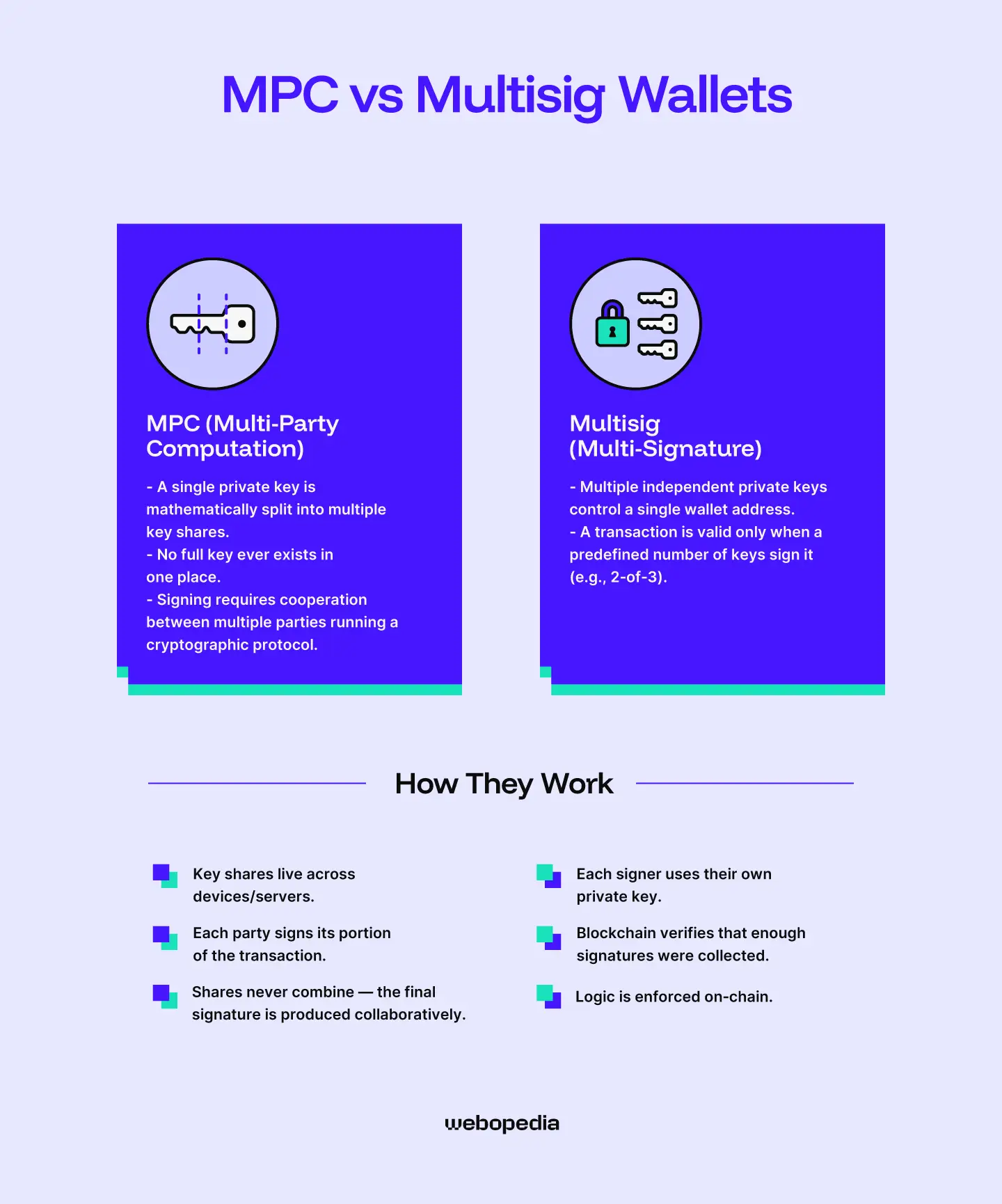
MPC and multi-signature (multisig) both split control among multiple parties, but the similarities pretty much end there. Let me walk you through how each one actually handles transaction signing and what that means for your security and costs.
How Multisig Wallets Work (On-Chain)
Multisig wallets require multiple complete private keys to approve a transaction. For example, in a 2-of-3 setup, you have three independent keys, and any two of them must sign before funds can move. Each key is fully formed and stored separately, often by different people or on different devices.
The signing process happens directly on the blockchain through a smart contract. This contract holds your funds and enforces the rules about how many signatures are needed. When you want to send crypto, each required signer submits their approval as a separate on-chain transaction.
This on-chain approach comes with some downsides. Every signature requires its own transaction fee, so a 2-of-3 approval costs more in gas than a standard single-signature transfer. The process is also slower since you're waiting for multiple transactions to confirm.
On top of that, your multisig setup is publicly visible on the blockchain. Anyone can see that you're using a multisig contract and how many signers are required, which reveals information about your security model.
How MPC Wallets Work (Off-Chain)
MPC wallets take a completely different approach by handling the signature process off-chain. Instead of multiple full keys signing separately on the blockchain, your key shares work together behind the scenes to produce a single standard signature.
When you send a transaction, your device and the wallet provider each use their key shares to generate partial signatures. These pieces combine through cryptographic protocols before anything touches the blockchain. The result is one normal-looking signature that gets submitted as a regular transaction.
From the blockchain's perspective, your MPC wallet looks identical to any other single-signature wallet. There's no smart contract revealing your security setup, no multiple transactions eating up gas fees, and no waiting for several on-chain confirmations. You pay standard transaction costs and get standard confirmation times.
This off-chain coordination also keeps your security model private. Nobody scanning the blockchain can tell you're using MPC or how your key shares are distributed. Your wallet simply appears as a regular address with nothing unusual about it.
MPC vs. Multisig: Side-by-Side Comparison
Here's a quick breakdown to help you compare MPC and multisig wallets at a glance.
| Feature | Multisig Wallet | MPC Wallets |
|---|---|---|
| Ket Features | Multiple complete private keys | Key shares that never form a full key |
| Signing Process | On-chain, each key signs separately | Off-chain, shares combine into one signature |
| Transaction Fees | Higher (multiple on-chain signatures) | Standard (single signature submitted) |
| Transaction Speed | Slower (waiting for multiple confirmations) | Standard confirmation times |
| Privacy | Publicly visible multisig contract | Looks like a regular wallet address |
| Blockchain Compatibility | Limited to chains supporting smart contracts | Works across most blockchains |
| Recovery Complexity | Must secure and recover multiple full keys | Key shares can be refreshed or regenerated |
| Best Suited For | DAOs, shared treasury management | Individual holders, institutional custody |
How to Choose the Best MPC Wallet for Your Needs
Not all MPC wallets are built the same, so picking the right one comes down to knowing what to look for. Below, I'll cover the security models you should compare, what makes recovery easy, and how to check whether a wallet actually supports your favorite chains and tokens.
Security and Key Share Model
The first thing to check is how a wallet distributes its key shares. Most MPC wallets use either a 2-of-2 or 2-of-3 model. With 2-of-2, your device holds one share, and the wallet provider holds the other. Both need to participate in every transaction, which keeps things simple but also means you're fully dependent on that provider staying online.
The 2-of-3 model adds an independent backup share, typically stored with a third party or on a separate device you control. This gives you more flexibility for key share recovery if you lose your phone or the provider runs into technical problems.
If you're a retail user, 2-of-2 is usually enough since it's quick and easy to manage. Institutional users tend to go with 2-of-3 for the added control over their setup.
You'll also want to check whether the wallet has gone through wallet security audits by reputable third-party firms. These audits dig into the cryptographic protocols, server infrastructure, and any weak points that could be exploited.
A wallet that openly publishes its audit reports shows transparency and tells you that independent experts have actually verified the security claims. If you can't find any audit information, treat that as a red flag.
User Experience and Recovery
One of the biggest selling points of MPC wallets is the seedless wallet experience. You won't need to write down a 12 or 24-word phrase and stress about where to hide it. Instead, your key shares handle security behind the scenes while you access your wallet through familiar methods like biometric authentication, whether that's your fingerprint or face scan.
This ease of use makes a real difference in daily transactions. You open the app, verify your identity with a quick scan, and you're ready to go. There's no typing out long phrases or fumbling with hardware devices. For retail users who want something that feels as smooth as a banking app, this is a major upgrade.
The simplified recovery process is another win. If you lose your device, you don't have to panic about a misplaced piece of paper. Instead, you verify your identity through the wallet provider and backup share, then set up your new device with fresh key shares.
Institutional users often add extra verification layers during recovery for compliance reasons, but the process still beats coordinating multiple hardware wallets or tracking down scattered seed phrase backups.
Asset and Chain Compatibility
Before committing to any MPC wallet, make sure it actually supports the blockchains and tokens you use. Multi-chain support varies widely between providers. Some wallets cover only Ethereum and a handful of EVM-compatible networks, while others include major Layer 1 chains like Bitcoin, Solana, and more. Check the supported networks list carefully so you're not stuck moving funds to a different wallet later.
If you're active in decentralized finance (DeFi), DeFi integration is worth investigating. Can the wallet connect to popular protocols directly through a built-in browser or WalletConnect? The same goes for NFT storage. Some wallets display your collections neatly with images and metadata, while others barely acknowledge that NFTs exist.
Your use case matters here. Retail users who mostly hold and trade a few major tokens won't need every chain under the sun. Institutional users managing diversified portfolios across multiple networks will want a wallet that can handle everything in one place without constantly switching between apps.
In Conclusion
Now that you understand how MPC works, compare providers based on their key share model, audit history, and supported chains before committing. Test the recovery process on any wallet you're considering. A smooth recovery experience now saves major headaches later.
It is important to check whether the wallet integrates with DeFi protocols and NFT platforms you actually use. Look for third-party security audits when evaluating any MPC crypto wallet. Published reports signal transparency and verified security claims.
Choose between 2-of-2 for simplicity or 2-of-3 for an added recovery backup, depending on whether you're a retail holder or managing institutional funds.
FAQ Section
Can an MPC wallet be hacked?
MPC wallets are significantly harder to hack than traditional wallets. An attacker would need to breach multiple independent locations holding separate key shares at the same time, which is far more difficult than stealing one private key or seed phrase. That said, no system is completely hack-proof. Pick a wallet with third-party security audits and keep your own devices secure. Good security on your end still matters.
Do I still have a seed phrase with an MPC wallet?
MPC wallets are typically seedless by design. There’s no 12 or 24-word phrase to write down, hide, or stress about losing. Instead of paper backups, these wallets use distributed key shares and identity verification for recovery. If you want a secure crypto wallet without seed phrase management, MPC is built exactly for that. Some providers offer optional encrypted backups, but traditional seed phrases are generally eliminated.
Are MPC wallets only for institutions?
MPC technology started in institutional custody, but today, plenty of wallets cater to retail users as well. Zengo is a solid example of an MPC wallet built for everyday holders who want stronger security without added complexity. Whether you’re managing a personal portfolio or handling business funds, you’ll find MPC options designed for different needs and levels of experience. The gap between institutional-grade security and everyday usability has pretty much closed at this point.