Bitstamp Review 2026

- When you click links on this page, we may earn an affiliate commission. By using this website you agree to our terms and conditions and privacy policy.
- Participation in online gambling may be illegal in your country and is subject to age restrictions (18, 19, or 21, depending on the jurisdiction). Verify legality and age requirements before participating. Learn more
Bitstamp is, without a doubt, one of the oldest crypto trading platforms. In this Bitstamp review, I'll take a close look at one of the top crypto trading platforms still running. Founded in 2011, Bitstamp has built its reputation on regulatory compliance and straightforward trading, now backed by Robinhood's $200 million acquisition.
But many potential users are wondering, "Is Bitstamp legit in 2026, or has it fallen behind newer competitors?" This exchange works best for users who prioritize safety and regulation over having hundreds of altcoins or complex trading tools.
Pros and Cons of Using Bitstamp
Pros
- Bitstamp security is top-tier, with cold storage, multi-signature wallets, and certified audits
- Bitstamp fees drop significantly at higher tiers, and bank transfer deposits are free
- Bitstamp customer support runs 24/7 by phone and email
- Bitstamp deposit methods include bank transfers, cards, Apple Pay, Google Pay, and PayPal
- Bitstamp lending offers daily yields, no lock-ins, and monthly transparency reports
Cons
- Bitstamp supported coins are currently around 115-125, well below larger competitors
- Bitstamp interest rates on staking are limited to just two coins, unavailable in the US
- KYC can be slow, with some users reporting account freezes during compliance checks
- No margin trading, copy trading, launchpad, or live chat support
Bitstamp Background and Reputation
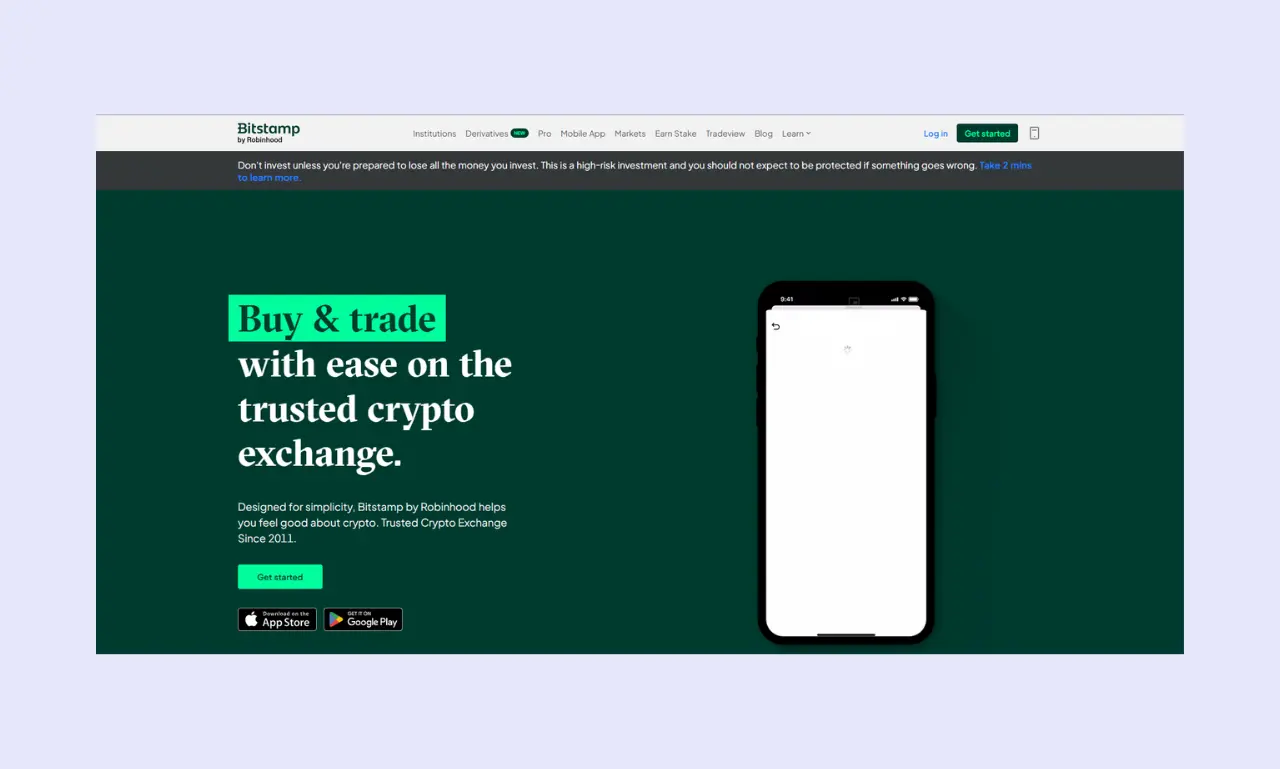
Picking the right exchange goes beyond just features and fees. In this crypto exchange review section, I'll cover Bitstamp's history, its regulatory standing, how it has handled security issues, and what actual users think of it.
Company Overview
Bitstamp was co-founded by Nejc Kodrič and Damijan Merlak in Slovenia in August 2011. It was originally created as a European alternative to Mt. Gox, which dominated Bitcoin trading at the time. The company later moved its registration to the UK in 2013 and then relocated its headquarters to Luxembourg in 2016, where it obtained an EU payment institution license.
Today, Bitstamp operates offices in Luxembourg, the UK, Slovenia, Singapore, and the US. It is widely recognized as the longest-running crypto exchange still in operation, serving over four million customers. The exchange is currently led by Global CEO Jean-Baptiste Graftieaux, who joined the company in 2014, at first as the Chief Compliance Officer, and took over the CEO role after rejoining in 2022.
A major shift came in June 2024 when Robinhood announced its plan to acquire Bitstamp in June 2024 for $200 million. The deal closed mid-2025, making Bitstamp a subsidiary of Robinhood Markets, Inc.
The acquisition gave Robinhood access to Bitstamp's institutional client base, its white-label crypto infrastructure (known as Bitstamp-as-a-Service or crypto-as-a-service). Bitstamp continues to operate under its own brand, now branded as "Bitstamp by Robinhood."
Regulation & Licensing
Bitstamp is one of the most heavily regulated crypto exchanges in the world, with over 50 active licenses and registrations across multiple regions. In the European Union, it received a Crypto Asset Service Provider (CASP) license under the Markets in Crypto-Assets (MiCA) regulation in May 2025, granted by Luxembourg's financial regulator, The Commission de Surveillance du Secteur Financier (CSSF).
This license, combined with European passporting rights, allows Bitstamp to operate its trading platform, execute client orders, and provide crypto custody across the entire European Economic Area. It also holds a Payment Institution license in Luxembourg and a MiFID authorization through the Slovenian Securities Market Agency for crypto derivatives.
In the US, Bitstamp USA, Inc. holds a BitLicense from the New York State Department of Financial Services (DFS), which is one of the hardest crypto-specific licenses to obtain. It is also registered as a Money Services Business (MSB) with FinCEN and carries money transmitter licenses in multiple states.
In the UK, Bitstamp is registered with the Financial Conduct Authority (FCA) under the Money Laundering Regulations for crypto-related activities. It also holds a Major Payment Institution (MPI) license in Singapore, giving it a foothold in Asia.
This kind of regulatory coverage is rare in the crypto industry. For you as a user, it means Bitstamp is held to strict standards around anti-money laundering (AML), customer protection, and financial transparency, no matter where you're based.
Trust & History
Bitstamp hasn't had a spotless record, but how it handled past incidents says a lot about the way it operates. The most notable event was a hack in January 2015, when attackers stole roughly 19,000 BTC (worth about $5 million at the time) from one of its hot wallets.
The breach resulted from a sophisticated phishing campaign that targeted six Bitstamp employees over several weeks using personalized emails and Skype messages. One employee eventually opened a malicious file, which gave the attackers access to the hot wallet's private keys.
What matters here is how Bitstamp responded. It immediately suspended operations, notified users, and chose to rebuild its entire trading platform from scratch rather than simply patching the old system.
All customer balances were honored in full, with losses covered from the company's own reserves. Bitstamp also brought in forensic investigators and cooperated with the FBI, US Secret Service, and UK cybercrime units.
Before that, in February 2014, Bitstamp temporarily paused Bitcoin withdrawals amid a large-scale DDoS attack targeting multiple exchanges. No funds were lost, and the co-founder refused to pay a 75 BTC ransom demand from the attackers.
There have been no major security incidents reported in over a decade, a strong signal that the lessons from 2015 have led to lasting improvements.
User Reviews
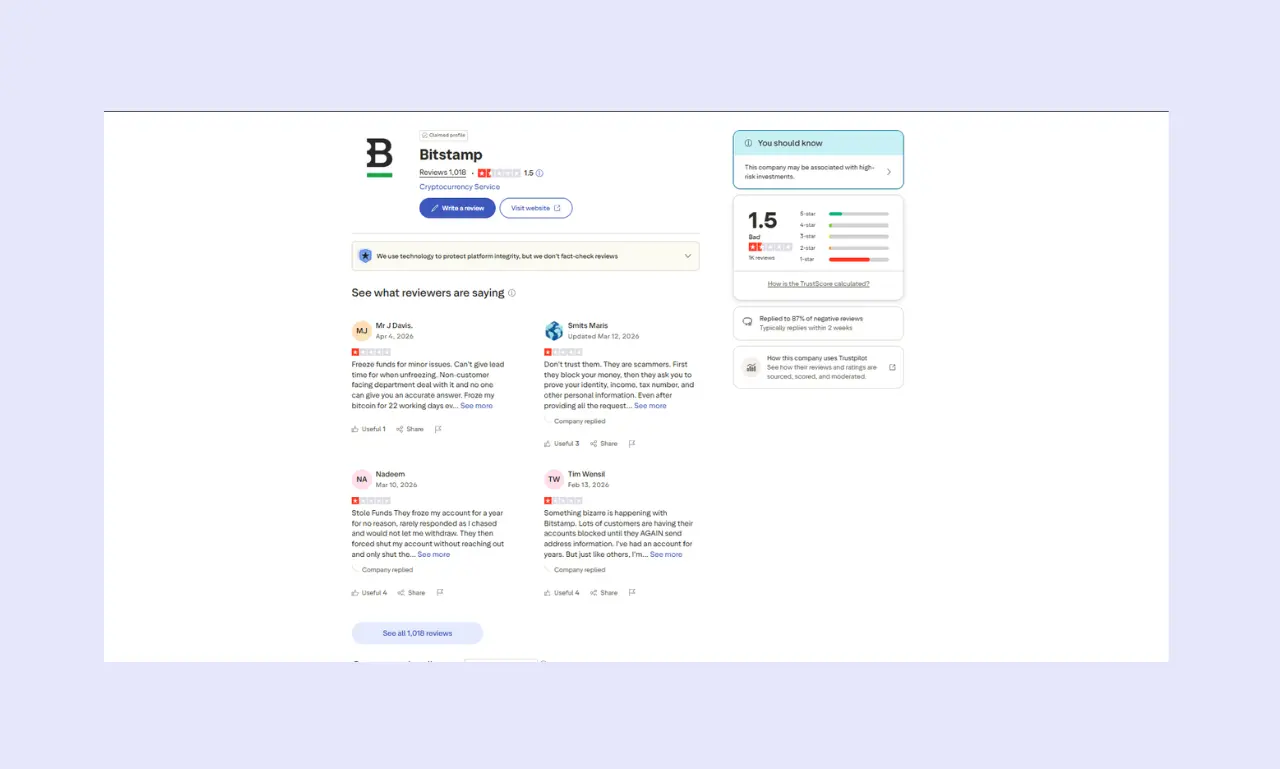
User feedback on Bitstamp is mixed, and the picture changes depending on where you look. On Trustpilot, Bitstamp currently sits at roughly 1.7 out of 5 stars, though most crypto exchanges score poorly on the platform (Binance at around 1.4, Kraken at 1.6, and Gemini at 1.4).
The most common complaints involve frozen accounts, slow know-your-customer (KYC) verification, and delays with withdrawals. Many of these issues stem from Bitstamp's strict compliance checks, which can feel frustrating when you just want access to your funds.
On Reddit, the sentiment is more balanced. Long-time users tend to praise Bitstamp for its reliability, clean fiat on-ramps, and smooth transaction processing. The criticism you'll find there usually centers on the smaller number of listed coins compared to larger exchanges and the occasional slow response from customer support.
In the app stores, Bitstamp scores well, with solid ratings on both iOS and Android that I'll cover in more detail later in this review.
Industry benchmarks also paint a favorable picture: Bitstamp earned a top AA rating from CCData (formerly CryptoCompare) nine consecutive times, and Forbes gave it a perfect transparency score in its Best Crypto Exchange rankings. So, while everyday user reviews can be rough, the exchange's standing with professional rating bodies tells a different story.
Initial Setup & User Experience
Now that you know what Bitstamp is and where it stands, let me walk you through what it's actually like to use. I'll cover the Bitstamp signup process, how easy the platform is to navigate, and how it feels on different devices.
How to Sign Up for Bitstamp
Here's a quick recap of the setup process:
- Head to bitstamp.net or download the app and tap "Get Started."
- Fill in your name, email, and date of birth.
- Select your country.
- Confirm your email and set a strong password.
- Start the KYC process by choosing a personal or corporate account.
- Upload a valid government-issued ID and a proof of address document (utility bill or bank statement).
- Provide financial background details, such as income and sources of funds (US users will also need to complete a FATCA form).
For KYC verification, you'll need to provide a government-issued photo ID (passport, national ID card, or driver's license) and proof of address, such as a utility bill or bank statement.
Bitstamp will also ask for financial background details, such as your occupation, annual income, and source of funds. US taxpayers will need to complete a Foreign Account Tax Compliance Act (FATCA) form using their Social Security Number or Tax Identification Number.
Approval typically takes anywhere from a few hours to 1 to 3 business days, depending on how clear your documents are and current demand. I'd recommend enabling two-factor authentication (2FA) right after registration. Once verified, learning how to use Bitstamp is straightforward thanks to the clean layout and guided flows.
Ease of Use
Bitstamp is one of the more approachable exchanges out there, especially if you're new to crypto. The platform doesn't overwhelm you with dozens of menus or complicated features right away. Instead, it keeps things clean and focused. You can buy or sell crypto in just a few taps without needing to understand order books or trading terminology.
One thing that sets Bitstamp apart is its demo account, which allows you to practice trading without risking real money. This is a helpful feature not all exchanges offer, giving beginners a safe space to get comfortable before committing funds.
That said, the KYC process can be a bit of a hurdle. Bitstamp's verification is thorough, sometimes requiring multiple documents and additional financial information, and a few users report delays.
It's more involved than what you might encounter on some other platforms, but that's a direct result of Bitstamp's strict regulatory requirements. Once you're past that step, though, the day-to-day experience is smooth and intuitive enough that most people won't feel out of their depth.
Display & Buttons/Touchscreen
On desktop, Bitstamp's web platform keeps things minimal and uncluttered. The main navigation is clearly laid out at the top of the page, with labeled buttons for key actions such as Markets, Deposit, Withdrawal, Earn, and Settings.
There's no visual overload or unnecessary clutter, making it quick and painless to find what you need. If you've ever felt lost on a more feature-heavy exchange like Binance or KuCoin, Bitstamp's stripped-back layout will feel like a breath of fresh air.
One thing to note is that the web interface uses a dark theme by default, and there's currently no option to switch to a light mode on the desktop version. Whether that's a plus or a minus depends on your preference, but some users have complained about it. The platform loads quickly and responds well across different screen sizes, so resizing your browser window or running it on a smaller laptop screen shouldn't cause any usability issues.
Something unique to Bitstamp is its Crypto Pulse feature, which provides real-time sentiment data drawn from one of the largest global crypto surveys in the industry. It's built right into the platform and gives you a snapshot of how both retail and institutional participants are feeling about the market.
Not many exchanges offer this kind of built-in research tool, and it adds a layer of context that goes beyond price charts. Overall, while Bitstamp's desktop interface may look understated compared to flashier competitors, it prioritizes clarity and function over visual complexity.
Bitstamp Key Features & Services
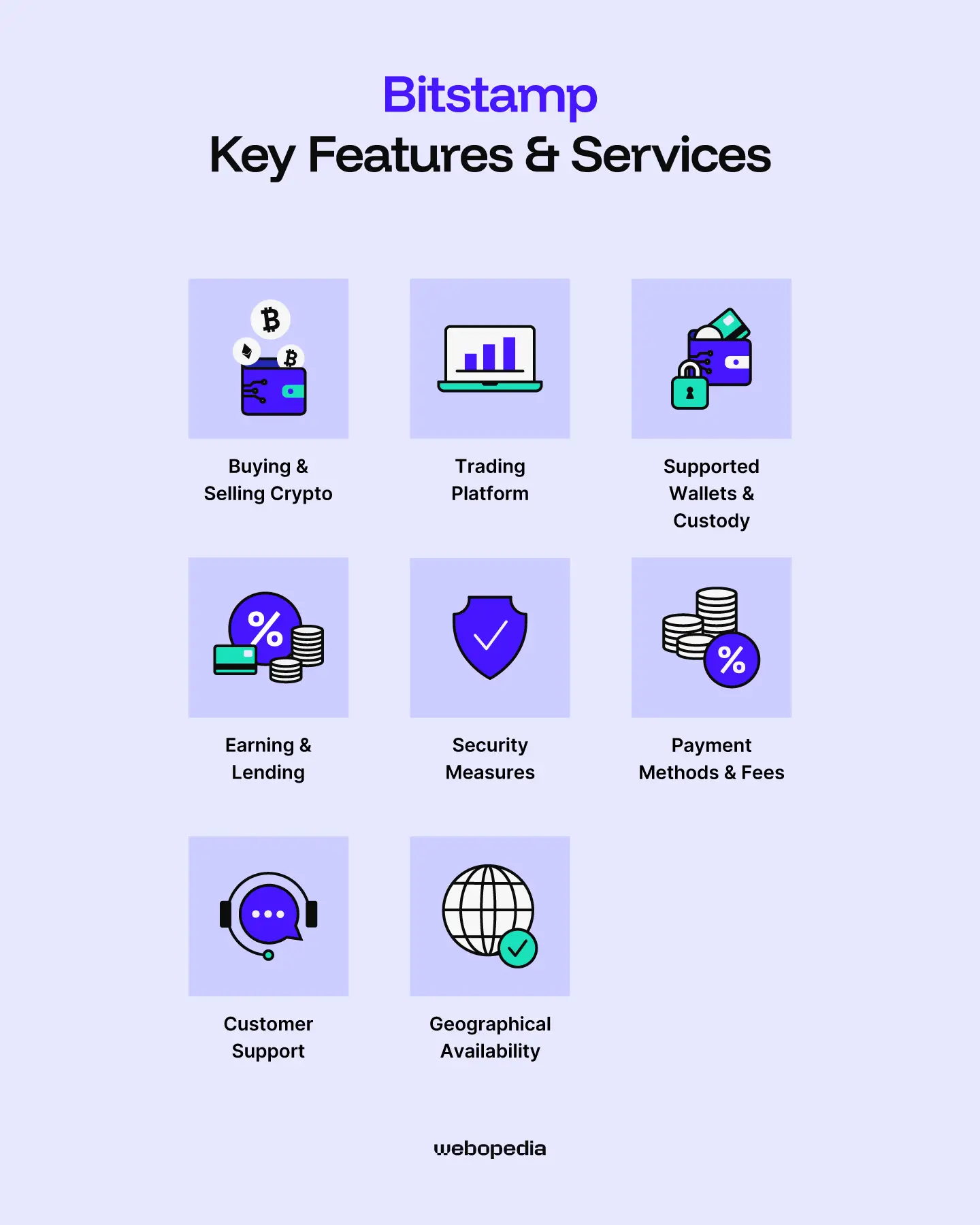
This is where I dig into what Bitstamp actually offers, from how you buy and sell crypto to fees, security, earning options, and customer support. I'll break down each feature so you know exactly what to expect.
Buying & Selling Crypto
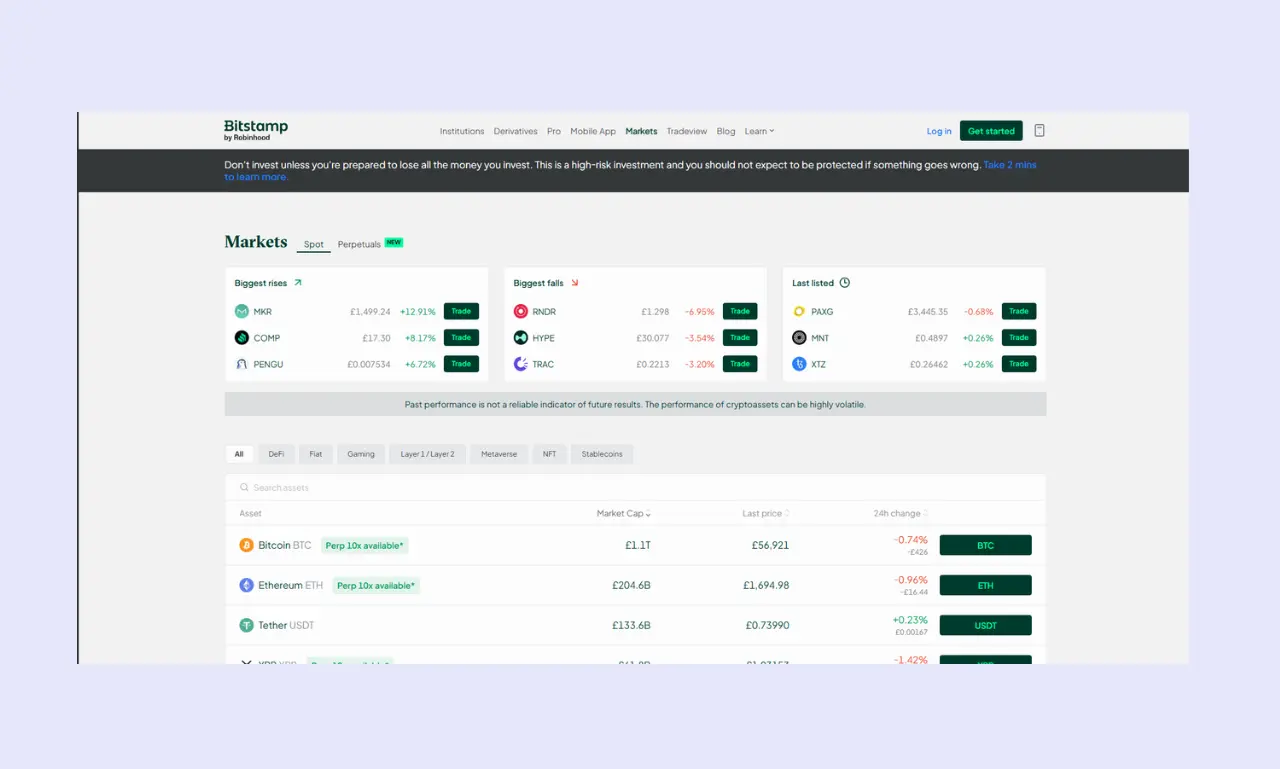
Bitstamp takes a curated approach to its coin listings. Instead of offering hundreds of tokens, it lists around 115 to 125 carefully selected cryptos, all vetted through its Digital Asset Listing Framework. You'll find the major cryptocurrencies here, including Bitcoin (BTC), Ethereum (ETH), XRP, Solana (SOL), Cardano (ADA), Litecoin (LTC), Bitcoin Cash (BCH), and Dogecoin (DOGE).
Popular altcoins like Chainlink (LINK), Polkadot (DOT), Avalanche (AVAX), Uniswap (UNI), Aave (AAVE), 1inch, Algorand (ALGO), and ApeCoin (APE) are also available. For stablecoins, it supports USDC, Tether (USDT), EURC, and Multi-Collateral DAI, though availability varies by region (USDT is no longer tradable for EU and EEA users under MiCA rules).
On the fiat side, Bitstamp stands out for its strong on-ramps and off-ramps. It supports four fiat currencies: USD, EUR, GBP, and SGD. You can deposit and withdraw funds through several methods, making it easy to buy Bitcoin in the US or sell Ethereum in the EU without jumping through extra hoops.
One thing Bitstamp does not offer is peer-to-peer (P2P) trading, so if that's something you rely on, you'll need to look elsewhere. I'll cover the specifics of payment methods and fees in a dedicated section further down.
For beginners, buying and selling is refreshingly simple. Basic mode offers a quick-buy flow that locks in a firm price for 10 seconds, so there are no surprises at the point of purchase. You pick your coin, pay, and it appears in your balance. Selling follows the same clean process, and you can send funds straight back to your bank account without needing a secondary platform.
For beginners, buying crypto is as easy as it gets. Basic mode allows you to purchase any supported coin in seconds using a card or bank transfer, with a firm price locked in for 10 seconds so there's no surprise at checkout. Selling works the same way, and funds can be withdrawn directly back to your bank account without needing a third-party service.
Trading Platform
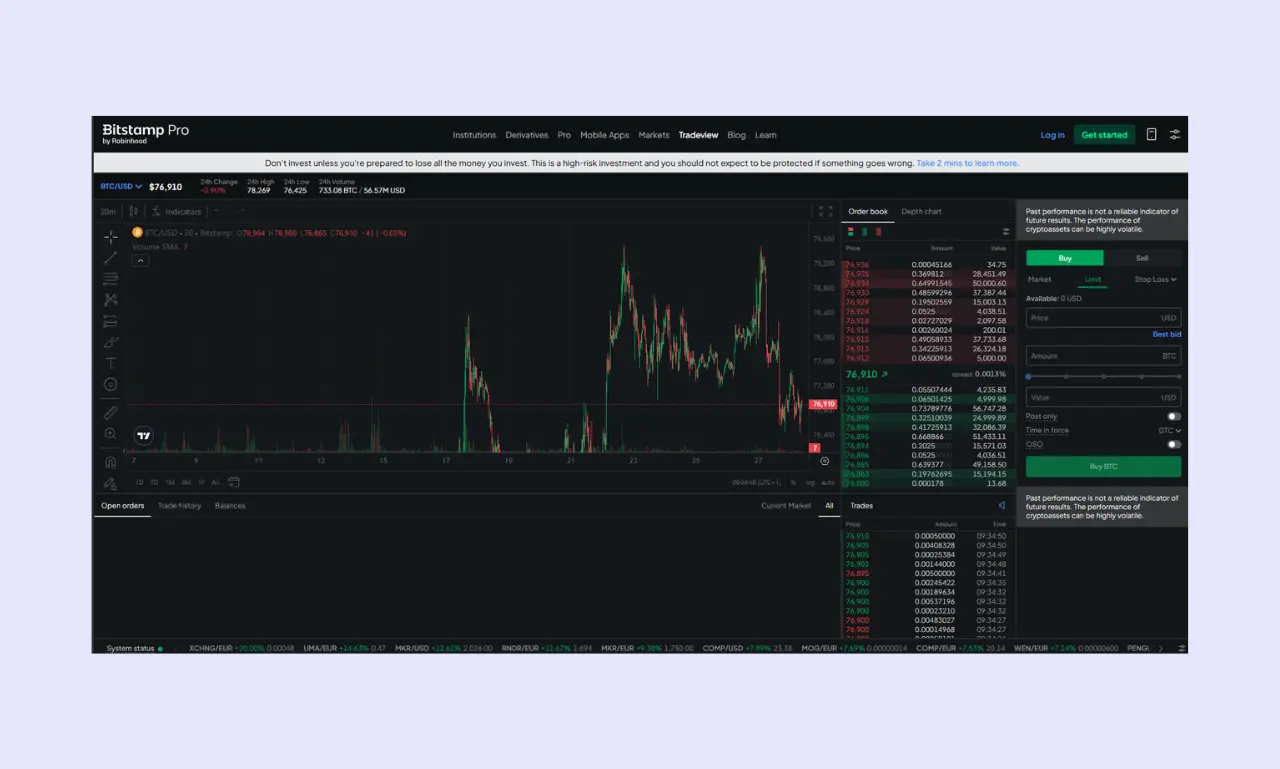
Bitstamp's trading platform splits into two interfaces: Basic and Pro (Tradeview). Pro is where the real advanced crypto trading muscle lives. It gives you full order books, market depth visualization, a live trade feed, and a fully integrated TradingView charting suite with over 100 technical indicators, including the Relative Strength Index (RSI), the Moving Average Convergence Divergence (MACD), Bollinger Bands, moving averages, and Fibonacci retracements. You can customize timeframes, draw trend lines, and set alerts directly on the chart.
For order types, Bitstamp keeps it focused rather than overwhelming. You get market orders, limit orders, stop orders, and stop-limit orders. In April 2025, Bitstamp removed trailing stops and stop-market buy orders, so if you're moving over from another exchange, your saved strategies may need to be adjusted. The platform doesn't support One-Cancels-the-Other (OCO) or bracket orders, which is a limitation for more strategy-focused traders.
On the derivatives side, Bitstamp offers USD-margined perpetual swaps for BTCUSD and ETHUSD, but only for eligible EU users through its MiFID-licensed entity, Bitstamp Financial Services Ltd. Maximum leverage is capped at 5x for retail traders, with both cross and isolated margin modes. Derivatives aren't available in the US, Canada, Japan, or Singapore. There's no spot margin trading or options as of September 2026.
One area where Bitstamp really shines is its backend infrastructure. The platform runs on a Nasdaq-built matching engine, making it the first fiat-to-crypto exchange to use trading tech on par with traditional stock markets. This engine handles orders up to 1,250 times faster than its previous system and supports 400 times higher throughput. For API users, execution speeds drop to under a millisecond, which matters a lot for high-frequency and algorithmic traders.
Liquidity on Bitstamp is solid on major pairs. Daily trading volume is at around $240 million to $535 million, with BTC/USD accounting for the bulk of that. It also runs an Over-the-Counter (OTC) Request-for-Quote (RFQ) desk for institutional trades between $100,000 and $2 million per transaction, giving large investors a way to execute big orders without slipping the public order book.
Supported Wallets & Custody
Bitstamp is a custodial exchange. If you're wondering, "Is a custodial exchange safe?" the answer depends on the provider, and in this part of the Bitstamp review, I'll explain why its setup is stronger than most.
What makes it stand out is that it doesn't manage custody in-house. Since 2019, it has partnered with BitGo Trust, one of the most respected qualified custodians in the industry, to safeguard client assets. BitGo uses bank-grade Class III vaults, multi-signature cold storage, and segregated accounts to ensure your funds are never commingled with company assets.
This third-party arrangement reduces counterparty risk and is something most exchanges don't offer: your crypto is actually held by a regulated, independent custodian rather than the exchange itself. BitGo also provides independent reporting to Bitstamp, which adds another layer of accountability.
Since Bitstamp is custodial, you don't manage a seed phrase or private keys. You just log in with your credentials and 2FA. For hardware wallet compatibility, you can't directly connect a Ledger or Trezor to Bitstamp, but you can withdraw your crypto to any compatible hardware wallet address whenever you want to move funds into self-custody.
Earning & Lending
Bitstamp's passive income tools are grouped under the Bitstamp Earn program, which includes two main services: staking and lending.
On the staking side, the options are limited. You can only stake two coins: Ethereum and Cardano ADA. As of September 2026, ETH earns around 3.1% APY with rewards distributed monthly, while ADA earns approximately 1.0% APY with rewards distributed weekly.
There's no extra lock-up period beyond what the underlying proof-of-stake (PoS) network requires, and you can opt out of staking at any time. Bitstamp charges a 15% commission on ETH staking rewards and 25% on ADA rewards, which is on the higher end compared to some other exchanges.
The lending program, run in partnership with Finnish FSA-regulated lender Tesseract, is where Bitstamp stands out. Launched in 2023, Bitstamp Earn Lending allows you to lend 10+ cryptos to vetted institutional borrowers. Supported coins currently include BTC, ETH, SOL, USDC, XRP, DOGE, PEPE, DOT, NEAR, SUI, UNI, APE, and ALGO. APYs typically reach up to 4.4% under normal conditions, though boosted promotional rates have gone as high as 9% on select cryptos for limited periods.
What sets Bitstamp's lending apart is its focus on transparency. Borrowers are categorized into five tiers based on credit rating, and all stablecoin loans require at least 100% collateral. Bitstamp publishes monthly performance reports showing pool activity, borrower risk profiles, and yield-generation details, which is rare in crypto lending. Your funds aren't lent without explicit permission, and there are no fixed lock-in periods. Bitstamp takes a commission ranging from about 15.5% to 27.27%, depending on the coin.
As of 2026, Bitstamp loans are not available, nor are credit cards, miner features, etcetera. Both Earn services have regional restrictions: staking isn't available in the US, Canada, Japan, or Singapore, and lending isn't available in the US, UK, Canada, or Japan.
Security Measures
Bitstamp takes a layered approach to security, and the setup here is more in line with traditional finance than what you typically see on a crypto exchange.
For account protection, 2FA is mandatory. You can use SMS, email, or an authenticator app like Google Authenticator. The platform also supports biometric login (Face ID and fingerprint) on mobile devices.
Beyond 2FA, Bitstamp offers withdrawal address whitelisting, so you can restrict crypto withdrawals to pre-approved wallet addresses only. IP whitelisting, email confirmations for sensitive actions, and PGP encryption for communications add further protection to your account.
On the custody side, Bitstamp stores approximately 95% of all customer funds in offline cold storage through its custodial partner BitGo, held in bank-grade Class III vaults using multi-signature technology. The remaining 5% stays in hot wallets to process day-to-day withdrawals.
This isn't unique in the industry, but the fact that custody is handled by a third-party qualified custodian rather than in-house is a meaningful distinction. BitGo also maintains up to $250 million in insurance coverage against loss, theft, and misuse of cold-stored funds. Bitstamp itself carries a crime insurance policy for additional protection against hacks or theft, though it does not offer deposit insurance in the traditional banking sense.
For audits and certifications, Bitstamp holds both SOC 2 Type 2 and ISO/IEC 27001 certifications, both of which require annual renewal and independent validation. It has also been financially audited by a Big Four accounting firm (EY) since 2016.
Regarding Proof of Reserves (PoR), Bitstamp states that it holds customer funds on a 1:1 basis and has published a PoR report in the past. However, it does not currently offer a publicly verifiable, on-chain PoR system like some competitors. Instead, the exchange relies on its audited financials and independent custodian reporting through BitGo as its transparency mechanism.
Payment Methods & Fees
With cryptocurrency fees explained upfront, Bitstamp's fee structure is transparent, but the costs vary a lot depending on how you fund your account and which interface you trade on. Here's the full breakdown.
For deposits, crypto deposits are free on Bitstamp's side (standard network fees still apply). Fiat deposits via SEPA and ACH are also free. International wire transfers carry a 0.05% deposit fee with a minimum charge. Card purchases and instant buys through Apple Pay, Google Pay, or PayPal come with a flat 4% Instant Service fee, which is significantly higher than bank transfer routes.
On the withdrawal side, SEPA withdrawals cost a flat €3, ACH withdrawals are free, and international wire withdrawals are 0.1% with a minimum of $25 or €25. Crypto withdrawals use fixed network fees shown before you confirm, for example, 0.0005 BTC for Bitcoin and 0.03 ETH for Ethereum.
Trading fees follow a maker/taker model based on your 30-day volume. At the base tier (under $10,000), you'll pay 0.30% as a maker and 0.40% as a taker. As volume increases, fees drop all the way down to 0.00% maker and 0.03% taker at the highest tier.
These rates are slightly above the industry average for low-volume traders but become very attractive at higher tiers. An added benefit is that fiat and stablecoin pair volume is weighted at 20%, effectively giving you up to 80% lower fees on those pairs. Bitstamp has no native token and no token-based fee discounts.
One thing to watch out for is the cost gap between Basic and Pro modes. Buying through the quick-buy flow in Basic mode includes a spread baked into the quoted price, plus that 4% instant service fee if you're paying by card. Switching to Pro and using a bank transfer instead will save you a significant amount. There are no hidden fees or inactivity charges, and minimum order sizes generally start at $10 or €10 for most fiat pairs.
Customer Support
Bitstamp offers 24/7 customer support through phone and email, which gives it an edge over many exchanges that rely solely on ticket systems. You can reach the team via dedicated phone lines for the US (+1 800 712 5702), the UK (+44 20 3868 9628), Luxembourg (+352 20 88 10 96), and Singapore (+65 3105 1676). Email support is available at support@bitstamp.net, and there's a separate address for formal complaints.
Phone agents typically respond within 10 minutes, but email replies can take anywhere from 12 to 72 hours, depending on demand. One notable gap is that Bitstamp does not currently offer live chat, which may frustrate users who prefer instant messaging over email. The platform also provides an FAQ section and a Learn Center with educational content and tutorials.
In my experience, the quality of support is professional and helpful. However, as mentioned earlier, a recurring complaint from the community involves slow responses during account reviews or KYC-related issues, particularly around frozen accounts and withdrawal delays. This seems tied more to Bitstamp's strict compliance checks than to a lack of resources.
Geographical Availability
Bitstamp is available in over 100 countries. It covers most of Europe, North America, parts of Asia, Africa, and Australia. If you're in the US, the UK, or the EU, you can access the full core trading platform.
In the US, Bitstamp works in most states but is currently not accessible in Hawaii and Nevada due to state-level regulations. US users also can't access Bitstamp Earn (staking or lending) or derivatives, and Bitstamp withdrawal limits vary by verification level and region.
In the EU, Bitstamp operates under its MiCA and Payment Institution licenses, with SEPA transfers available for fast, low-cost EUR deposits and withdrawals. UK users benefit from FCA registration and Faster Payments for GBP transactions, and staking was reopened for UK customers in mid-2025. In Singapore, Bitstamp holds a Major Payment Institution license and recently added SGD support and PayNow.
Restricted countries include Russia, China, North Korea, Iran, Syria, Cuba, and parts of Ukraine, in line with international sanctions enforced by the US, UK, EU, and Singapore. Canada is also restricted.
Keep in mind that even within supported regions, not all features are equally available. Derivatives trading is limited to EU users, lending is unavailable in the US, UK, and Japan, and staking is blocked in the US, Canada, Japan, and Singapore. It's always a good idea to check Bitstamp's terms of service for your specific country before signing up.
Mobile App Review
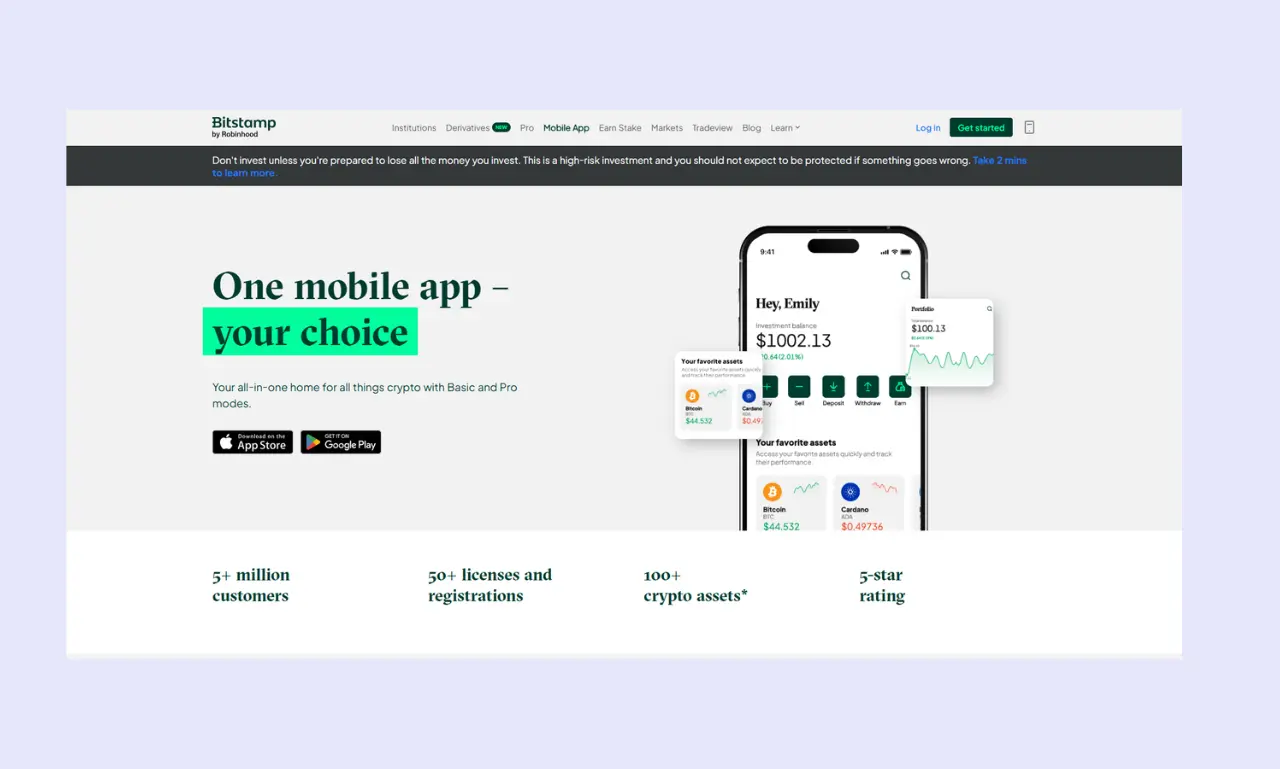
The Bitstamp mobile app is available for both iOS and Android and carries strong ratings in both stores: 4.8 out of 5 on the App Store and 4.5 out of 5 on Google Play. Those numbers put it among the highest-rated crypto exchange apps globally. This Bitstamp app review will cover what makes it stand out.
What used to be two separate apps (Bitstamp and Bitstamp Pro) has been merged into a single unified app with two switchable modes. Basic mode gives you a streamlined experience for quick buys, sells, deposits, and withdrawals. Pro mode brings in the full TradingView charting suite, order book, market depth, and all the same order types available on desktop.
You can flip between the two modes at any time without logging out. One small annoyance users report: the quick-buy feature only works in Basic mode, so if you're in Pro and want to purchase crypto with Apple Pay or Google Pay, you'll need to switch back.
In terms of feature parity, the app covers nearly everything the desktop version does. You get portfolio tracking, price alerts, biometric login, staking and lending access where available, and the ability to deposit and withdraw both fiat and crypto.
The app also supports dark and light themes, unlike the desktop platform, which is locked to dark mode only. You can save favorite coins for quick access from the dashboard, and notifications keep you updated on price movements and order status.
One unique touch is that Bitstamp originally designed its app with regular user feedback loops, which is partly why the ratings remain so high. The app is actively maintained with frequent updates, and it remains fully standalone, meaning you don't need a desktop account to get started. You can register, verify, and begin trading entirely from your phone or tablet.
Bitstamp vs Other Crypto Exchanges
Here is how Bitstamp stacks against other top crypto exchanges in the market
| Crypto Exchange | Top Choice For | Trading Fees | Products and offerings | Standout Features |
|---|---|---|---|---|
| Bitstamp | Security Compliance | 0.03% - 0.4%/0.00% - 0.30% | Tailored features, crypto bots, futures, copy trading, staking, loans | Regulatory Compliance, High Security, free or low-cost bank |
| Coinbase | A simple, but versatile exchange | 0.60% / 1.20% | Standard and advanced interfaces, crypto staking, derivatives, fiat on-ramp | Toggle advanced features on or off |
| Youhodler | Using crypto loans for leverage | 0.02% hourly rollover | Crypto loans, up to 70x leverage, cascading loans | Boost position size with cascading loans |
| Nemo.Money | Mixed asset class trading | Variable spread (0.11% to 0.15%) | Access to stocks, crypto, and ETFs, 2x leverage, asset recommendations, CFD-only | Trade multiple types of assets with leverage |
| Bybit | Advanced traders | 0.1% | Demo trading, trading bots, derivatives, crypto loans, staking | Structured earn products |
Who is Bitstamp Best Suited For?
If you're looking for a secure crypto exchange with deep regulatory roots and clean fiat rails, Bitstamp is a strong fit. It works well for beginners thanks to its simple Basic mode and demo account, making it a solid crypto exchange for beginners who want to learn without risking real money.
Long-term holders will appreciate the institutional-grade custody and insurance protections. Experienced traders and institutions benefit from the Nasdaq-powered engine, API access, and OTC desk.
That said, if you need a massive altcoin catalog, high-leverage derivatives, or privacy-focused trading, Bitstamp isn't the right match for you. Users interested in earning interest on crypto should also check regional availability before committing, as many Earn features are restricted by country.
Conclusion & Final Verdict
After reviewing Bitstamp features, fees, security, and user experience across the board, my takeaway is this: Bitstamp delivers on trust, regulation, and simplicity better than most exchanges, but it's not trying to be everything to everyone. It's a focused platform that does the basics exceptionally well. If you value knowing your funds are held by a regulated custodian, backed by insurance, and overseen by more than 50 licenses, few other platforms come close.
Where it lags behind is variety. The limited coin selection, restricted earning features, and absence of more advanced trading products may leave some users wanting more. But for those who see regulation and reliability as non-negotiable, Bitstamp remains one of the top cryptocurrency platforms and a strong crypto investment platform worth considering in 2026. It may not be a low-fee crypto exchange at the base tier, but the value it delivers in trust and infrastructure makes up for it.
FAQs (Frequently Asked Questions)
How does Bitstamp make money?
Bitstamp makes money primarily through trading fees charged on every transaction made on its platform. It also earns from commissions on staking and lending rewards, instant purchase service fees on card and e-wallet payments, and fiat withdrawal charges. On top of that, Bitstamp offers institutional services including its white-label Bitstamp-as-a-Service product and OTC trading, both of which contribute to its overall income. There are no subscription fees or hidden charges for regular users.
Can I earn passive income on Bitstamp?
You can, but with some limitations. Bitstamp Earn offers staking on a small number of supported coins and a lending program that covers a wider selection of tokens. Both services pay out rewards on a regular basis with no lock-in periods. However, these features are not available everywhere. Staking and lending are restricted in several countries, including the US and Canada, so make sure to check availability for your region before signing up if passive income is your priority.
What are the tax implications of using Bitstamp? (General disclaimer about consulting a tax professional)
Crypto transactions, including buying, selling, trading, staking, and lending, may be subject to taxes depending on where you live. Tax rules around digital currencies vary widely from country to country, and in some places, even swapping one coin for another is considered a taxable event. Bitstamp provides transaction history that you can use for record-keeping, but it’s not a tax advisor. I’d strongly recommend consulting a qualified tax professional for guidance specific to your situation.
What is KYC/AML, and why is it required on Bitstamp?
KYC and AML are standard verification procedures that financial institutions, including crypto exchanges, are legally required to follow. On Bitstamp, this means you’ll need to verify your identity before you can deposit, trade, or withdraw. The process helps prevent fraud, money laundering, and other financial crimes. Because Bitstamp is licensed in multiple jurisdictions, it must comply with these rules to operate legally and to protect its users.