Bitget Exchange Review 2026

- When you click links on this page, we may earn an affiliate commission. By using this website you agree to our terms and conditions and privacy policy.
- Participation in online gambling may be illegal in your country and is subject to age restrictions (18, 19, or 21, depending on the jurisdiction). Verify legality and age requirements before participating. Learn more
This Bitget review covers everything you want to know about this crypto exchange. Though Bitget is restricted in some areas, our assessment confirms that its crypto trading platform stands out the most for its copy trading features, high-leverage futures, and low-fee structure.
Bitget Exchange offers some of the lowest fees and an extensive list of trading pairs. You can trade tokenized stocks and ETFs, and the Bitget wallet is one of the best custodial wallets out there in 2026.
Bitget Review: Pros and Cons
Pros:
- Low trading fees and withdrawal costs
- Extensive cryptocurrency selection with hundreds of trading pairs
- Strong copy trading and futures options with high leverage
- Over $600 million Protection Fund
- Multiple fiat currencies and deposit methods
Cons:
- No regulatory approval in US, Canada, or other major markets
- Past security breach with limited transparency
- Not as beginner-friendly as some competitors
- No phone customer support available
Bitget Background and Reputation

Before trading on Bitget, you should understand its foundation and credibility. I'll walk you through the company's history, regulatory status, track record with security issues, and what actual users are saying about their experiences on the platform.
Company Overview
Bitget launched in 2018 and operates under Bitget Limited, with its headquarters in the Cayman Islands. The platform started out focusing on crypto derivatives and copy trading, which helped it build a following among traders who wanted automated strategies without doing all the manual work themselves.
Since then, Bitget has expanded way beyond those initial offerings to become a full-service centralized exchange (CEX). The company has grown its presence globally while keeping its base in the Cayman Islands, a spot that's become pretty popular among crypto businesses for its regulatory setup.
Regulation & Licensing
Bitget is licensed in the UK, Italy, Poland, El Salvador, Bulgaria, Lithuania, Czech Republic, Georgia, and Argentina in 2026. The platform doesn't operate under the EU's Markets in Crypto-Assets (MiCA) regulation yet. That framework is still rolling out across Europe.
Bitget has lost its licenses in the US and Canada, which means you can't use the platform if you're in those jurisdictions. This is pretty significant if you're looking for a heavily regulated option, since many users prefer exchanges with licenses in their home countries for added legal protection and oversight.
Trust & History
When it comes to security, Bitget has had some bumps in the road. The platform has experienced at least one security breach, which is something you should know about before trusting it with your funds. However, it doesn't seem to be transparent about past incidents.
Beyond security breaches, Bitget has faced regulatory challenges that raise questions about its long-term stability. As of 2026, the platform's revoked Canada and US licenses suggest it either couldn't meet regulatory requirements or chose not to comply with those jurisdictions' standards.
User Reviews

User sentiment around Bitget is mixed across different platforms. You'll find a range of opinions, with some users praising the platform's trading features and copy trading options, while others raise concerns about customer support response times and withdrawal processing delays. Some users appreciate the lower fees compared to bigger exchanges, though there's occasional skepticism about using a platform that's lost regulatory approval in major markets.
Even though Bitget has a 2.1/5 Trustpilot rating right now, 80% of the time, users get replies after posting complaints. The general vibe seems to be that experienced traders who know what to look for in security features are more satisfied with Bitget, while newcomers sometimes feel overwhelmed or frustrated when there are issues.
If you're considering Bitget, it's smart to read recent reviews since user sentiment can shift quickly in the crypto space, especially after security incidents or regulatory changes.
How to Sign Up for Bitget
Here's my quick nine-step guide that makes it easy for you to register on Bitget:
1. Create an Account

Head over to the Bitget website and click the sign-up button. Enter your email address, create a strong password, and verify your email address.
2. KYC Verification

Bitget makes Know Your Customer (KYC) mandatory. You have to verify your identity by uploading a government-issued ID (passport, driver's license, or national ID card works). This process usually takes 5 minutes to 24 hours (depending on your location).
3. Make a Deposit
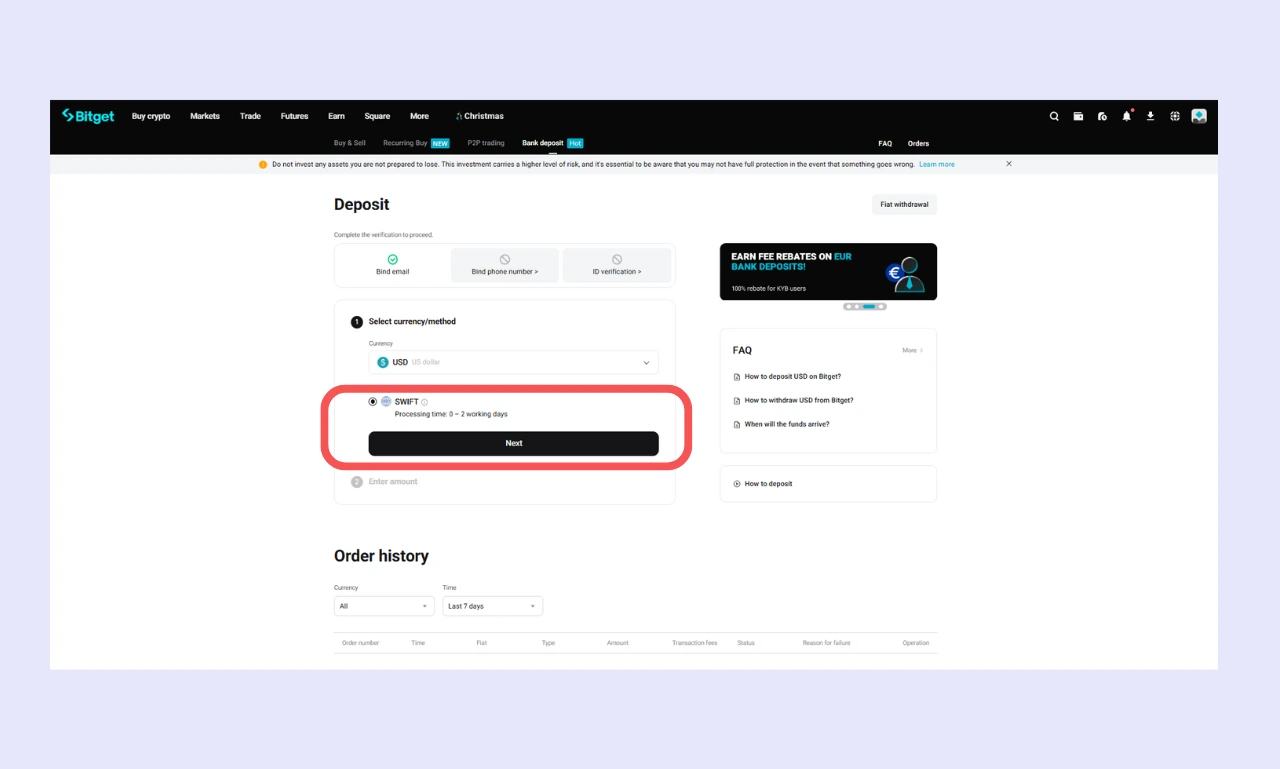
After KYC, you can freely make deposits and start trading.
Initial Setup & User Experience
Once you're signed up, the real test begins: how easy is Bitget to actually use? I'll break down the platform's usability, interface design, and mobile experience so you know what to expect when you start navigating the exchange.
Ease of Use
Bitget sits somewhere in the middle when it comes to beginner-friendliness. If you've never used a crypto exchange before, you might feel a bit overwhelmed at first because the platform throws a lot of options at you right from the start. The interface isn't as hand-holdy as something like Coinbase, but it's not impossibly complex either.
The learning curve mainly comes from the sheer number of trading options available. You've got spot trading, futures, margin trading, and copy trading all competing for your attention. For beginners, I'd recommend starting with simple spot trades and ignoring the advanced features until you're comfortable.
Experienced traders will appreciate having everything accessible without needing to dig through menus, but newcomers might wish for a simplified view. The platform offers educational resources through its Academy section, which helps soften the learning curve if you're willing to invest some time upfront.
Display & Buttons/Touchscreen
Bitget's interface is clean and well-organized, with a white background that makes everything easy to read without straining your eyes. The design follows standard crypto exchange conventions, so if you've used other platforms before, you'll feel right at home. Navigation is fluid and responsive, meaning buttons react quickly when you click them and pages load without frustrating delays.
The layout puts important trading information front and center without cluttering the screen. You can easily access your portfolio, trading pairs, and account settings without hunting through multiple menus. The buttons are clearly labeled and large enough that you won't accidentally click the wrong thing, which is important when you're dealing with money.
Overall, the interface scores high marks for clarity and usability. It's elegant and minimal without sacrificing functionality, which is exactly what you want from a trading platform.
Mobile App Review

Bitget offers fully functional apps for both iOS and Android, and the mobile experience holds up well compared to the desktop version. You'll find that most features available on desktop are also accessible on mobile, including spot trading, futures, copy trading, and account management. The apps don't feel like watered-down versions of the platform.
The mobile interface maintains the same clean, white background design as the desktop version, making it easy to navigate on smaller screens. Response times are quick, and you won't experience lag when switching between different sections. Bitget also provides an APK download option and API access for mobile users who want more flexibility.
The apps generally receive positive ratings on both the Apple App Store and Google Play Store, with users particularly appreciating the smooth performance and feature parity with desktop. However, some reviews mention occasional bugs during updates, so you might want to wait a day or two before installing major app updates if stability is your priority.
Key Features & Services

Now, let's get into what Bitget actually offers. I'll cover everything from buying and selling crypto, trading tools, and wallet options, to earning opportunities, security features, payment methods and fees, customer support quality, and where you can actually use the platform.
Buying & Selling Crypto

Bitget supports an impressive selection of cryptocurrencies that should satisfy most trading needs. You'll find all the major players like Bitcoin (BTC), Ethereum (ETH), and Solana (SOL), plus popular altcoins like Cardano (ADA), Polkadot (DOT), and Chainlink (LINK). Stablecoin options include Tether (USDT), USD Coin (USDC), and Dai (DAI), which are useful for moving funds around without exposure to price swings.
For getting money in and out of the platform, Bitget offers multiple options. You can use credit cards (Visa and MasterCard), digital payment methods like Apple Pay and Google Pay, bank transfers through SEPA, and even PIX for Brazilian users. Peer-to-peer (P2P) trading is also available if you prefer dealing directly with other users.
When it comes to ease of use, buying and selling basic crypto is fairly straightforward once you understand the interface. Beginners might need a bit of time to figure out where everything is, but the actual purchase process isn't complicated once you get there.
Trading Platform

Bitget's trading platform caters to different experience levels, though it leans more toward intermediate and advanced users than beginners. The order types go beyond simple market and limit orders to include stop-loss, take profit, trailing stop, and One Cancels the Other (OCO) orders. You'll also find more specialized options like iceberg orders and Time-Weighted Average Price (TWAP).

The charting tools are solid, giving you access to technical indicators for analyzing price movements and identifying trading opportunities. If you're into derivatives, Bitget offers futures trading with up to 125x leverage, which is high and comes with significant risk. Margin trading is also available for those who want to borrow funds to amplify their positions.
Liquidity is strong, with a liquidity score of 749 and monthly trading volume sitting at around $186 billion as of 2026. This means you can execute trades without worrying about slippage, especially on major trading pairs.
Supported Wallets & Custody
Bitget operates as a custodial exchange, which means the platform holds and controls your crypto assets on your behalf. This is different from a non-custodial wallet, where you maintain full control of your private keys and funds. With custodial services, you're trusting Bitget to secure your assets, which is convenient but also means you don't have complete ownership in the purest sense.
The platform does offer a Web3 wallet feature that provides more control, but the main exchange functions through custodial wallets. This setup makes things easier for beginners who don't want to worry about managing seed phrases or losing access to their funds through user error.
Bitget is also compatible with external hardware wallets like Ledger or Trezor for cold storage.
Earning & Lending

Bitget offers several ways to earn passive income on your crypto holdings. The platform's lending program allows you to earn interest on a wide range of cryptocurrencies, with rates reaching up to 60% APR on some assets. For Bitcoin, Ethereum, and stablecoins, you can earn up to 20% APR. The minimum amounts are reasonable: 0.001 BTC for Bitcoin, 0.01 ETH for Ethereum, and 1 USDT for stablecoins.
Interest payments are made daily, and you have flexibility with lock-in periods ranging from 5 days to 14 days. The platform supports lending for major coins like BTC, ETH, SOL, and XRP, along with numerous altcoins and stablecoins.
On the borrowing side, Bitget offers crypto-backed loans with rates starting as low as 1% for certain cryptocurrencies. You can borrow against your holdings without selling them, which is useful if you need liquidity but want to maintain your position. The platform also features products like Shark Fin and Dual Investment for more sophisticated yield strategies.
Security Measures

Bitget takes security seriously, starting with two-factor authentication (2FA) options that include both SMS and Google Authenticator for protecting your account. The platform also uses anti-phishing codes, which help you verify that emails are actually coming from Bitget and not scammers trying to steal your credentials.
One of Bitget's standout security features is its Protection Fund, worth up to $639 million. This in-house insurance covers user losses that aren't caused by your own actions or platform misconduct, which provides a significant safety net compared to exchanges without any insurance coverage. The fund is managed by Bitget itself rather than a third-party insurer.
The combination of 2FA, anti-phishing measures, and substantial insurance coverage shows that Bitget is investing in user protection.
Payment Methods & Fees

Bitget's fee structure is fairly straightforward and falls on the lower end. Spot trading fees use a maker-taker model, with makers paying between 0% and 0.1% and takers paying 0.01% to 0.03%. Futures trading fees are slightly higher, ranging from 0% to 0.02% for makers and 0.02% to 0.06% for takers.
Deposit fees vary depending on your method. Crypto deposits are free, which is standard across most exchanges. For fiat deposits using credit cards or other payment methods, you'll likely encounter fees from the payment processor. Bitget doesn't charge additional deposit fees on its end.
Withdrawal fees depend on the crypto you're moving. For Bitcoin, fees range from 0.00000135 BTC to 0.00004 BTC. The minimum deposit requirement is 0.0006 BTC, which is relatively accessible for most users.
Margin trading comes with daily interest rates between 0.002775% and 0.00222%, translating to annual rates of roughly 0.8103% to 1.012875%. This is pretty reasonable for leveraged trading. Overall, Bitget's fees are budget-friendly without any major hidden charges that should catch you off guard.
Customer Support

Bitget offers customer support through email and live chat, but you won't find phone support available. The main support email is support@bitget.com, and the live chat feature is accessible directly from the platform.
The good news is that live chat support is available 24/7, which means you can get help regardless of your time zone. Support is offered in English, Turkish, Spanish, and Chinese, giving you options if English isn't your first language.
However, you'll likely encounter bots before reaching a human agent. Some users report that this can be frustrating when you need immediate help with a complex issue. Response times are generally reasonable once you get through to a human, but the bot screening process can slow things down.
Finding contact information is easy, with support options clearly visible in the platform's help section. Overall, Bitget customer support is adequate but not exceptional, especially if you're used to phone support or instant human responses.
Geographical Availability
Bitget is available in over 150 countries across Europe, Asia, Africa, and South America. You can use the platform if you're in most European countries, including major markets like Germany, France, Italy, and Spain. It's also accessible throughout much of Asia, Latin America, and parts of the Middle East.
However, there are significant restrictions you need to know about. Bitget doesn't operate in the United States, Canada, or Singapore, three major crypto markets. The platform also blocks users from sanctioned regions like Iran, North Korea, Syria, and Cuba, along with disputed territories like Crimea, Donetsk, and Luhansk. Hong Kong residents can't use the service either.
Other Bitget Products and Services

Beyond its core exchange functions, Bitget offers a range of additional products designed to appeal to different types of crypto users. The platform includes a Launchpad for participating in new token launches, giving you early access to projects before the broader market can access them.
Copy trading is one of Bitget's signature features, allowing you to automatically replicate the trades of experienced traders. This includes both spot and futures copy trading, plus strategy trading options for more automated approaches. If you're not confident in your own trading decisions, this can be helpful. Just keep in mind you're still taking a risk by following someone else's strategy.
The platform also offers Funding Rate Arbitrage, which allows you to profit from differences in funding rates across perpetual contracts. There's a custodial bot for automated trading strategies, and various futures tools, including quant trading and signal bots. Bitget Earn provides staking and savings products beyond basic lending.
For those interested in Bitcoin ETFs or broader crypto exposure, Bitget includes features for tracking and potentially trading these instruments. The Web3 wallet integration gives you access to decentralized applications (dApps) while staying within the Bitget ecosystem.
Bitget vs Other Crypto Exchanges
Here is how Bitget stacks against other top crypto exchanges in the market.
| Crypto Exchange | Top Choice For | Price | Products and Offerings | Standout Features |
|---|---|---|---|---|
| Bitget | Copy trading and derivatives | Low fees: 0%-0.1% maker, 0.01%-0.03% taker | Spot, futures, margin, P2P, copy trading, staking, lending, Launchpad | $639M Protection Fund, extensive copy trading options, high leverage futures |
| Coinbase | Beginners and US users | Higher fees: ~0.6% for trades under $10k | Spot trading, staking, Coinbase Card, and educational rewards | Strong regulatory compliance, FDIC insurance on USD balances, user-friendly interface |
| Youhodler | Earning interest on crypto | Varies by service | Lending, borrowing, Multi-HODL, Turbocharge, savings accounts | High APY rates, unique leveraged earning products, and crypto-backed loans |
| OKX | Advanced traders globally | Low fees: 0.08% maker, 0.1% taker | Spot, futures, options, NFT marketplace, DeFi wallet, trading bots | Proof of Reserves, extensive altcoin selection, integrated Web3 features |
| ByBit | Derivatives trading | Low fees: 0.01% maker, 0.06% taker | Spot, futures, options, copy trading, staking, Launchpad | Industry-leading derivatives platform, insurance fund, and competitive leverage options |
Who is Bitget Best Suited For?
Bitget works best for experienced traders who want access to derivatives and copy trading features. If you're comfortable with futures, margin trading, and high leverage of up to 125x, you'll find plenty of tools to work with. The copy trading functionality also appeals to intermediate users who want to automate their strategies by following successful traders.
For beginners, Bitget is a mixed bag. While you can definitely learn the ropes here, the interface throws a lot at you immediately. The lack of regulatory approval in major markets like the US and Canada might make you hesitant. If you're just starting out, you might prefer a more heavily regulated platform with simpler navigation.
Long-term holders can use Bitget for staking and lending to earn passive income on their holdings. The platform's extensive altcoin selection makes it appealing if you're hunting for smaller-cap projects beyond just Bitcoin and Ethereum.
Conclusion & Final Verdict
Bitget offers great coin variety, multiple payment and withdrawal options, and numerous handy features. This low-fee crypto exchange provides earning opportunities through crypto lending, called Bitget lending, plus solid Bitget app functionality.
In this crypto exchange review, you've learned about Bitget's security measures, Bitget-supported coins, and Bitget deposit methods, as well as details about Bitget interest rates and Bitget withdrawal limits. Whether this platform fits your trading style depends on your experience level, risk tolerance, and specific cryptocurrency needs, from using Bitget as a beginner to maximizing it for advanced crypto trading.
FAQs (Frequently Asked Questions)
How does Bitget make money?
Bitget generates revenue primarily through trading fees collected on every transaction you make. The platform also earns from the spread between lending and borrowing rates, withdrawal fees when you move crypto off the exchange, and funding rates on leveraged positions. Additional income comes from listing fees for new tokens and liquidation fees when traders using leverage get margin called on their positions.
Can I earn passive income on Bitget?
Bitget offers multiple ways to earn passive income on your crypto holdings. You can lend various cryptocurrencies to earn interest with daily payments and flexible or fixed lock-in periods. The platform also provides staking services and additional yield products. Minimum deposit requirements are relatively low, making it accessible even if you don’t have large amounts of capital to invest in earning programs.
What are the tax implications of using Bitget? (General disclaimer about consulting a tax professional)
Trading, selling, and earning interest on Bitget are likely to create taxable events in your jurisdiction, but the specifics depend on your country’s laws. You’re responsible for tracking transactions, calculating gains or losses, and reporting them to your tax authority. Bitget may not provide detailed tax tools, so consider using third-party crypto tax software. It’s always a good idea to consult a qualified tax advisor familiar with crypto taxation in your location.
What is KYC/AML, and why is it required on Bitget?
KYC and AML (Anti-Money Laundering) are regulatory requirements forcing platforms to verify user identities and monitor for suspicious activity. Bitget requires you to provide personal information and government-issued ID to comply with financial regulations in its operating jurisdictions. This verification is mandatory before you can deposit, trade, or withdraw, helping prevent illegal activities like money laundering and fraud.
Why is Bitget not allowed in the US?
Bitget restricts US residents from using its platform primarily to avoid the steep operational costs and legal liabilities tied to American regulations. Navigating the country’s complex web of federal and state laws (specifically the stringent requirements for Know Your Customer (KYC) and Anti-Money Laundering (AML) compliance) presents a regulatory burden the exchange chooses to bypass.