- Bitunix Review: Pros and Cons
- Bitunix Background and Reputation
- How to Sign Up for Bitunix
- Initial Setup & User Experience
- Bitunix Key Features & Services
- Other Bitunix Products and Services
- Bitunix vs Other Crypto Exchanges
- Who is Bitunix Best Suited For?
- Conclusion & Final Verdict
- FAQs (Frequently Asked Questions)
Bitunix Review 2026

- When you click links on this page, we may earn an affiliate commission. By using this website you agree to our terms and conditions and privacy policy.
- Participation in online gambling may be illegal in your country and is subject to age restrictions (18, 19, or 21, depending on the jurisdiction). Verify legality and age requirements before participating. Learn more
Even though Bitunix is fairly new, reading the security whitepaper shows how security-focused they are. Bitunix is a crypto derivatives exchange offering trading across hundreds of cryptocurrencies with optional KYC verification. This Bitunix review goes deep into what was discovered about the exchange.
Like most no-kyc crypto exchanges, you can trade without mandatory identity checks while still accessing professional-grade tools like high-leverage futures and multi-window charting. It's primarily built for experienced traders and users interested in a platform that offers great flexibility.
Bitunix charges no fees for fiat deposits and allows users to deposit funds into their accounts via multiple methods (including a peer-to-peer marketplace).
Bitunix Review: Pros and Cons
Pros
- Trade without KYC verification
- Low fees with VIP discounts
- 500+ cryptocurrencies available
- Competitive trading fees
- Insurance protection for funds
- Advanced charting and leverage
Cons
- Newer platform
- Blocked in several locations, including the US, Canada, and China
- Slow support for complex issues
- Limited fiat withdrawals
Bitunix Background and Reputation

Company Overview
Bitunix was founded in 2021 but officially launched in 2022. The company operates under Bitunix Fintech LLC, with its headquarters in Saint Vincent and the Grenadines. As a CEX, the platform has grown to serve users across 100+ countries, though it remains restricted in several major markets, including the US and Canada.
Despite being relatively new to the crypto trading space, Bitunix has positioned itself as a privacy-focused option that doesn't require mandatory Know Your Customer (KYC) verification for basic trading activities.
Regulation & Licensing
Bitunix holds a US Money Services Business (MSB) license and a Canada MSB license, giving it some regulatory standing in North America despite restricting actual trading from these regions. The platform has also obtained a Virtual Asset Service Provider (VASP) license in the Philippines, with applications pending in Lithuania, Poland, and Australia.
For a platform launched in 2022, Bitunix is actively working to expand its regulatory footprint across multiple jurisdictions.
Trust & History
Bitunix hasn't reported any major security breaches since its 2022 launch, which is a positive sign for a relatively young platform.
The exchange maintains transparency about its operations and security measures, though, as a newer player in the market, it doesn't have the extended track record of exchanges that have been around for a decade or more.
So far, the platform has avoided the controversies and hacks that have plagued many other exchanges, suggesting careful attention to security protocols from the start.
User Reviews

User feedback on Bitunix shows mixed sentiment across different platforms. Many traders appreciate the no-KYC trading option and low fees, which frequently come up in positive reviews on Reddit and Trustpilot.
Yet, customer support is a common pain point. Some users mention receiving generic responses to technical issues and experiencing delays during busy trading periods.
The platform's relatively short history means there's less user feedback available compared to established exchanges, but the general consensus leans toward satisfaction with trading features while highlighting room for improvement in support responsiveness.
How to Sign Up for Bitunix
Creating a Bitunix doesn't require mandatory KYC for basic trading. Here's how to get started in three steps:
1. Create a Bitunix Account

Go to the Bitunix website and click on ‘sign up’ or ‘sign up now.’ You will be taken to a page where you can choose to register for a new account either by linking your google account (Gmail) to register faster or directly input your phone number or email address.

As soon as you register, you have completed the first step required to qualify for the new user bonus (terms and conditions apply).
2. KYC Verification

Even though you can use Bitunix without KYC, verifying your ID increases your trading limits and also your deposit and withdrawal limits.
To verify your account, you would have to go to the ‘settings’, and choose the ‘verification’ option. Choose any of the options given. Upload your document and wait for confirmation. It should take about 2 minutes to 20 minutes.
3. Fund Your Account

Once verified, you can start trading immediately with a $500,000 daily withdrawal limit. If you want higher limits, you can complete Basic KYC (requiring government-issued ID) for $2 million daily withdrawals, or Advanced KYC (adding proof of address and facial verification) for $5 million+ limits.
The verification process is generally quick. Email confirmation takes minutes, while optional KYC typically processes within 24 hours, though it can take longer during peak periods or if additional documentation is needed.
Initial Setup & User Experience
Here, you can learn about how easy Bitunix is to navigate for different skill levels, the platform's interface design and functionality, and what to expect from the mobile trading experience.
Ease of Use

Bitunix keeps things pretty straightforward if you're just looking to buy and sell crypto. The interface is clean enough that you won't feel lost trying to find basic functions, though there's definitely a lot going on once you start exploring.
That said, the platform is really built with experienced traders in mind. If you're brand new to crypto, you might feel a bit overwhelmed by all the options staring back at you.
It's not impossible to figure out, but I'd recommend spending some time with Bitunix Academy's tutorials before jumping into anything too complicated. The learning curve is there, but it won't stop you from getting started with simple trades.
Display & Buttons/Touchscreen
The Bitunix interface responds quickly to your actions, whether you're placing orders or switching between different trading views. Everything works without noticeable lag, which matters when you're trying to execute trades at specific price points.
The layout is organized logically, with clear sections for your portfolio, order books, and trading charts. Buttons are well-sized and placed where you'd expect them, so you're not hunting around for basic functions. The color scheme distinguishes buy and sell orders effectively without being distracting.
But when you have multiple charts open or start using some of the more technical features, the screen can feel crowded. It's not a dealbreaker, but you might find yourself adjusting your view frequently to focus on what matters most at any given moment.
Mobile App Review

Bitunix offers dedicated apps for both iOS and Android, and the mobile experience holds up well against the desktop version. You get access to most of the same trading tools, including chart analysis and order types, so you're not sacrificing much functionality when trading on the go.
The mobile app includes some standout features that you'd typically only find on desktop platforms. You can use TradingView integration, access detailed charting tools, and even run multiple trading windows simultaneously. Copy trading is also available through the app, enabling you to mirror successful traders from your phone.
Performance is solid across both operating systems. The app responds quickly to inputs and handles real-time price updates without freezing or crashing. Navigation feels intuitive once you spend a few minutes getting familiar with where everything sits.
App store ratings reflect generally positive user sentiment, though some reviews note occasional bugs during high-volatility periods and the same customer support concerns that arise on other platforms.
Bitunix Key Features & Services

Next, I'll break down how Bitunix handles crypto purchases and sales, its trading platform capabilities, wallet options, earning opportunities, security features, payment systems and costs, support channels, and where the platform operates globally.
Buying & Selling Crypto

Bitunix supports over 500 cryptocurrencies, giving you plenty of options beyond the usual (Bitcoin, Ethereum, and major altcoins such as Solana, Cardano, and Polkadot). You'll also find stablecoins like USDT, USDC, and FDUSD for when you want to park funds without leaving the platform.
Getting money onto Bitunix is pretty flexible. You can use credit or debit cards through third-party providers like Volet, Coinify, and MoonPay, or opt for bank transfers depending on your region. The platform also supports Google Pay, Apple Pay, and peer-to-peer (P2P) trading.
For beginners, buying crypto is straightforward through the Convert feature, which lets you swap between currencies without dealing with order books. Selling follows the same simple process, though withdrawing fiat can be more limited compared to the deposit options available.
Trading Platform
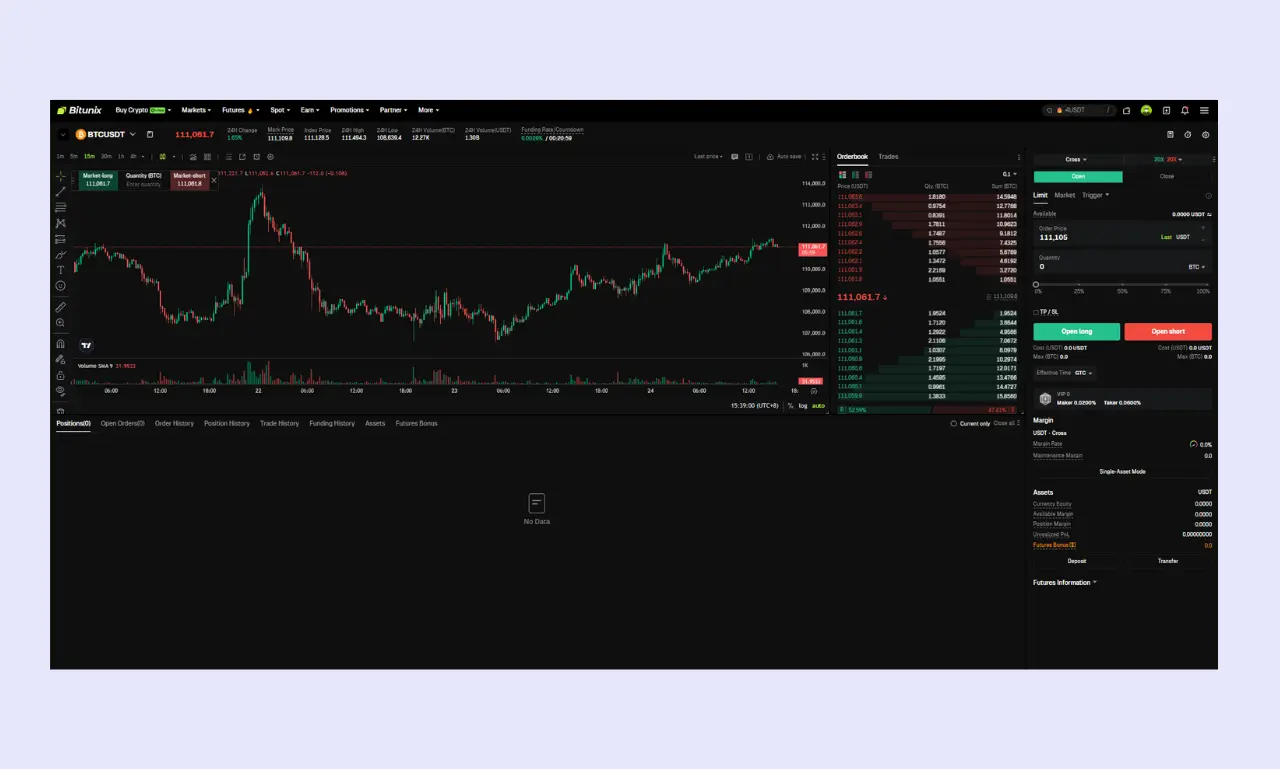
Bitunix's trading interface balances accessibility with depth, though it leans toward traders who know their way around an exchange. The web platform and mobile app both offer clean layouts, but the number of features can feel dense if you're just starting out.
You get a solid range of order types to work with: market, limit, stop, stop limit, take profit, trailing stop, and One Cancels the Other (OCO) orders. Time-in-force options like Immediate or Cancel (IOC), Good Till Canceled (GTC), Fill or Kill (FOK), and Post-Only (PO) give you control over execution.
Charting tools are impressive, with TradingView Pro integration and Bitunix's own Ultra K-Line charts for technical analysis. You can open up to 16 chart windows simultaneously if you're managing multiple positions.

The platform handles spot trading, margin trading, and perpetual futures with leverage up to 125x. Daily spot trading volume sits around $1.81 billion as of September 2026, with a Bitcoin liquidity score of 905 on CoinMarketCap, indicating strong order book depth.
Supported Wallets & Custody
Bitunix is a custodial exchange, which means it holds your crypto for you rather than giving you direct control of the private keys. With custodial setups, you're basically trusting the platform to keep your funds safe, which is convenient but means you don't truly "own" your crypto.
Since Bitunix is an exchange and not a standalone wallet, you won't be dealing with seed phrases on the platform itself. Instead, your account security comes down to your login info, 2FA, and a fund password that you'll need for any withdrawals.
Most user funds are in multi-signature cold storage wallets, keeping them offline and away from potential hackers. If you'd rather take full custody of your crypto, you can withdraw to external wallets anytime, including hardware options like Ledger or Trezor. Bitunix works with all the major networks like ERC20, TRC20, BSC, Arbitrum, Polygon, and Solana for moving funds on and off the platform.
Earning & Lending
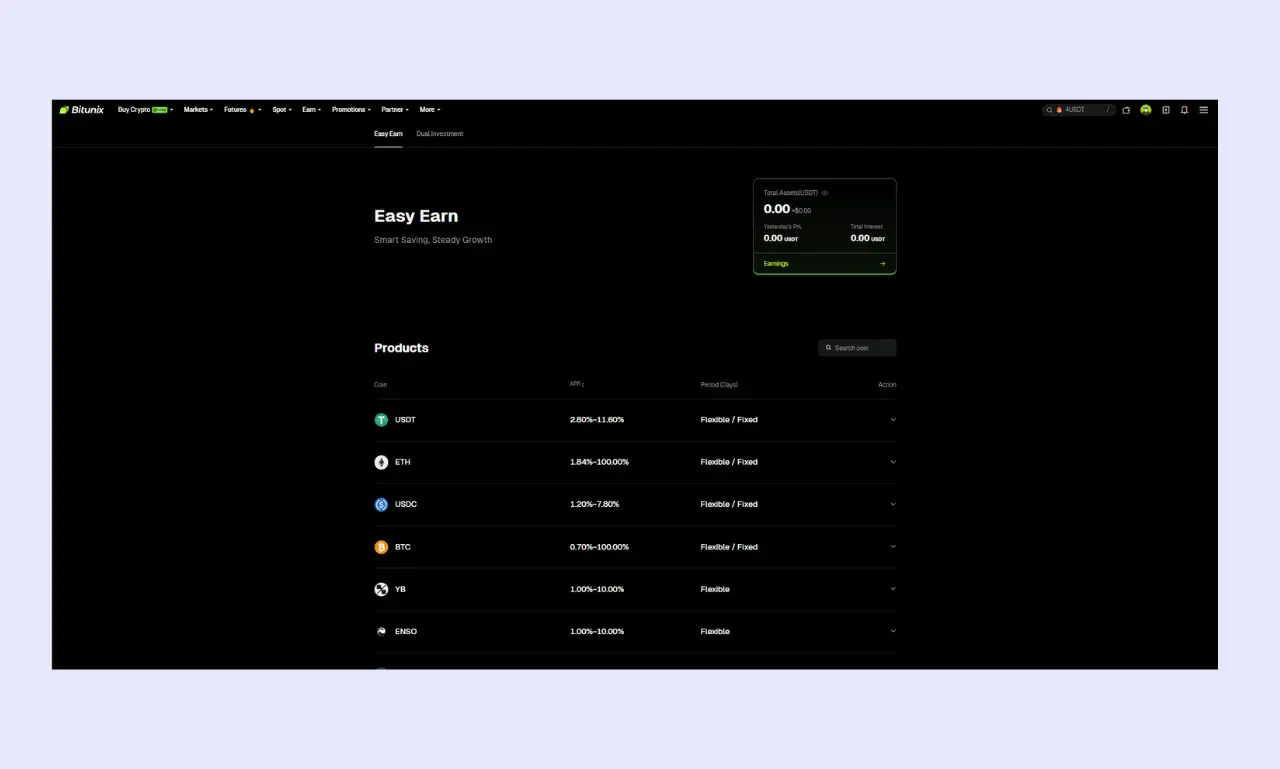
Bitunix offers earning opportunities through its Bitunix Earn program, which includes both flexible and fixed-term options. You can earn up to 2% APR on Bitcoin, Ethereum, and stablecoins like USDT, USDC, and FDUSD. The minimum deposits are pretty accessible: 0.0001 BTC, 0.001 ETH, or 1 USDT to get started, with no maximum limits specified.

Interest payouts work differently depending on which option you choose. Flexible accounts pay out daily and let you withdraw anytime, while fixed-term products lock your funds until maturity but typically offer better rates. The platform takes 15% of earned interest as a risk reserve, distributing the remaining 85% to you.
Bitunix doesn't currently offer crypto-backed borrowing or a loan service. The focus stays on earning passive income through staking and interest-bearing accounts rather than using your crypto as collateral for loans.
Security Measures

Bitunix takes security seriously with multiple protection layers. You can enable 2FA through Google Authenticator or SMS, and the platform requires anti-phishing codes to help you verify legitimate communications. Withdrawal whitelisting allows you to specify approved addresses, adding another barrier against unauthorized transfers.
The exchange maintains a 1:1 reserve ratio, which you can verify through its Proof of Reserves (PoR) transparency feature. This shows the platform actually holds the assets it claims to have on behalf of users.
Insurance coverage includes $5 million through Nemean Services, a UK-based security partner, plus a $200 million emergency reserve fund called the Bitunix Protection Fund. This protection kicks in when losses aren't caused by your own actions or security lapses.
Bank-grade risk control systems monitor for suspicious activity, and SSL encryption protects data transmission across the platform. The combination of cold storage, insurance, and transparency tools provides multiple safety nets for your funds.
Payment Methods & Fees
Bitunix doesn't charge fees for crypto deposits, though you'll pay network fees when sending from external wallets. The platform supports 55+ fiat currencies, including USD, EUR, GBP, CAD, AUD, and various regional currencies, making it accessible for local trading. Fiat deposits through third-party providers like Volet and MoonPay typically come with 3-5% processing fees, but Bitunix itself doesn't add charges on top.
Withdrawal fees vary by cryptocurrency and network. Bitcoin withdrawals cost 0.0004 BTC, while USDT ranges from $1 on TRC20 to $5 on ERC20. Ethereum fees depend on the network you choose, from 0.000001 ETH up to 0.001 ETH.
Trading fees are tiered based on your 30-day volume. Spot trading starts at 0.08% maker and 0.10% taker for basic accounts, dropping to 0.01% maker and 0.0325% taker at VIP 7. Futures fees run lower, from 0.02% maker and 0.06% taker down to 0.006% and 0.03% respectively.
Minimum deposits sit at $10 for fiat purchases, 0.0001 BTC, 0.001 ETH, or 1 USDT for crypto. No hidden fees pop up unexpectedly, though funding fees on futures positions can reach 0.01% every 8 hours.
Customer Support

Bitunix offers 24/7 live chat, which is your fastest option for getting help. You can also reach the team through email at support@bitunix.com or connect via social media channels like Telegram, Twitter, and Facebook. There's a phone number listed in the mobile app (+971553468998) for additional contact options.
Support is available around the clock every day of the week, and the team handles inquiries in over 14 languages, including English, Chinese, Spanish, French, German, Russian, and Arabic. This makes it accessible if you're not comfortable communicating in English.
Response quality is where things get mixed. While basic questions get answered fairly quickly through live chat, users report that more technical or account-specific issues often receive generic responses that don't fully address the problem. During high-traffic periods, you might also experience longer wait times than usual.
The platform scores a 4 out of 5 for support accessibility but only a 3 for efficiency, which lines up with user feedback about slow resolution times for complicated issues.
Geographical Availability
Bitunix operates in over 100 countries across Europe, Asia, Africa, South America, and Oceania, giving it a fairly broad global reach. However, there's also a lengthy list of restricted regions.
You can't use Bitunix if you're in the US, Canada, mainland China, Hong Kong, Singapore, or the UAE. Other blocked countries include North Korea, Cuba, Iran, Iraq, Syria, Russia-controlled regions of Ukraine, and France.
The platform complies with local regulations in the jurisdictions where it operates, holding MSB licenses in both the US and Canada despite not serving customers there. It's also secured a VASP license in the Philippines and has pending applications in Lithuania, Poland, and Australia as it works to expand its regulatory footprint.
Other Bitunix Products and Services
Bitunix offers several features I haven't touched or expanded on, yet that might interest you depending on your trading style.

Copy Trading lets you automatically mirror the trades of successful traders on the platform. If you're newer to crypto or don't have time to actively manage positions, you can browse top performers and allocate funds to follow their strategies. The platform provides educational resources specifically about copy trading to help you understand how it works.
Over-the-counter (OTC) trading is available for larger transactions. This service is useful if you're moving significant amounts and want to avoid the slippage that comes with big orders on the regular order books.
Bitunix has anti-price manipulation features built into the platform to protect you from artificial price swings and wash trading that can happen on less-regulated exchanges. This adds a layer of fairness to the trading environment.
The platform offers API trading for those who want to build automated trading bots or integrate Bitunix into their own systems. This is particularly useful if you're running algorithmic strategies or need programmatic access to the exchange.

Sub-accounts are available, letting you create multiple accounts under one main account. This is helpful if you want to separate different trading strategies, manage funds for others, or simply organize your portfolio into distinct buckets.

Bitunix also occasionally runs a referral program where you can earn commissions by bringing new users to the platform.
Bitunix vs Other Crypto Exchanges
Check out my quick overview of Bitunix versus other top crypto exchanges in 2026.
| Crypto Exchange | Top Choice For | Price | Products and offerings | Standout Features |
|---|---|---|---|---|
| Bitunix | Privacy-focused traders and high-leverage futures | Low fees: 0.08% maker / 0.10% taker (spot) | Spot, perpetual futures (125x leverage), margin, copy trading, P2P, OTC, Convert, Crypto staking | No mandatory KYC, $500K daily withdrawal limit without verification, multi-window trading (16 charts) |
| Coinbase | Beginners in the US | Higher fees: 0.40%-0.60% (varies) | Spot, Crypto staking, Coinbase Card, learning rewards, wallet | Strong regulatory compliance, user-friendly interface, educational content with crypto rewards |
| Youhodler | Earning passive income | Maker/taker fees vary by tier | Crypto loans, savings accounts, MultiHODL, Turbocharge, conversion | High-yield savings (up to 20% APY), instant crypto-backed loans, unique multiplier tools |
| OKX | Advanced traders globally | Low fees: 0.08% maker / 0.10% taker | Spot, futures, options, DeFi wallet, NFT marketplace, trading bots | Massive selection (350+ coins), on-chain wallet integration, proof of reserves |
| ByBit | Derivatives and futures trading | Low fees: 0.10% maker / 0.10% taker | Spot, futures, options, copy trading, staking, launchpad | Up to 100x leverage, excellent liquidity, industry-leading derivatives platform |
Who is Bitunix Best Suited For?
If you value anonymity, Bitunix stands out among the best crypto exchanges. You don't need KYC verification to start trading, and Bitunix withdrawal limits are generous without any identity verification. This makes it ideal if you want to maintain privacy while still accessing a secure crypto exchange with solid features.
For experienced and frequent traders, the platform offers advanced crypto trading tools and perpetual futures. Bitunix fees are attractive for active users, making it genuinely a low-fee crypto exchange compared to some others.
With Bitunix supported coins exceeding 500 cryptocurrencies, altcoin enthusiasts will find plenty of options. This crypto trading platform gives you access to newer tokens that might not be available on more regulated exchanges.
However, this isn't really a crypto exchange for beginners. While signing up to Bitunix is simple and doesn't require jumping through KYC hoops immediately, the sheer number of Bitunix features can overwhelm newcomers. If you're just starting out and asking, "Is Bitunix legit?" for your first exchange, you might find the interface intimidating, even though it is legitimate.
Long-term holders should note that Bitunix interest rates through Bitunix Earn aren't particularly competitive compared to dedicated earning platforms. Bitunix lending options are limited to crypto staking and savings since Bitunix loans aren't available.
Conclusion & Final Verdict
Bitunix offers a solid option for privacy-focused traders who want low fees and advanced tools, making it worth considering among top cryptocurrency platforms. While it's not the best crypto exchange for beginners or earning interest on crypto due to limited rates, experienced users will appreciate the fee structure and optional KYC.
This Bitunix review shows it's best suited for privacy-conscious and experienced traders who want low fees and high leverage. Bitunix deposit methods are flexible, Bitunix security measures include insurance coverage, and Bitunix customer support is available 24/7, though users report mixed experiences.
How to use Bitunix becomes clearer with practice, and the Bitunix app review feedback is generally positive for functionality. If you need extensive support or better earning rates, other top crypto exchanges might serve you better as a crypto investment platform.
FAQs (Frequently Asked Questions)
How does Bitunix make money?
Bitunix makes money primarily through trading fees on spot and futures transactions. The platform also earns from withdrawal fees, which vary by cryptocurrency and network. Additionally, Bitunix takes a percentage of interest earned through its staking products as a risk reserve. Third-party payment processors may share revenue when you use fiat on-ramps, though Bitunix doesn’t directly charge for these services.
Can I earn passive income on Bitunix?
You can earn through Bitunix Earn, which offers flexible and fixed-term staking options for various cryptocurrencies and stablecoins. The platform distributes most of the earned interest to users while keeping a portion as a risk reserve. You can also generate passive income through the referral program by earning commissions when people you invite start trading on the platform, if the promotion is currently active.
What are the tax implications of using Bitunix? (General disclaimer about consulting a tax professional)
Tax obligations vary significantly depending on your country of residence and local regulations. Crypto transactions may be subject to capital gains taxes, income taxes, or other reporting requirements. Bitunix doesn’t provide tax advice or automatically report to tax authorities. You should consult a qualified tax professional familiar with cryptocurrency regulations in your region to understand your specific obligations.
What is KYC/AML, and why is it required on Bitunix?
KYC and Anti-Money Laundering (AML) are identity verification processes that crypto exchanges use to comply with financial regulations and prevent illegal activities. Unlike most platforms, Bitunix makes KYC optional for basic trading. You can trade without verification but with lower daily limits. Higher verification levels unlock increased limits for larger transactions and may be required in certain jurisdictions.