
Key Takeaways
- 69.2% of retail accounts lost money, with combined losses of $338.9 million across roughly 2.9 million accounts.
- Accounts classified as automated earned $246.8 million, generating 80.8% of orders despite representing just 4.1% of accounts.
- Losses increased inactivity: 15.2% of accounts stopped trading for at least 30 days after a loss, compared with 6.1% after a win.
Most retail accounts on Polymarket lose money, according to Galaxy Research, highlighting a divide between prediction markets’ usefulness as forecasting tools and their profitability for participants.
The report found that 69.2% of approximately 2.9 million accounts finished below break-even, recording combined losses of $338.9 million.
Research analyst Will Owens examined public blockchain records curated by Stork to assess trading behavior, profitability, and specialization.
The findings cover Polymarket’s international platform, which operates separately from its U.S. exchange. They describe wallet addresses rather than verified individuals, an important distinction when interpreting how many people lost money.
Retail Accounts Lose $339 Million as Automated Traders Gain
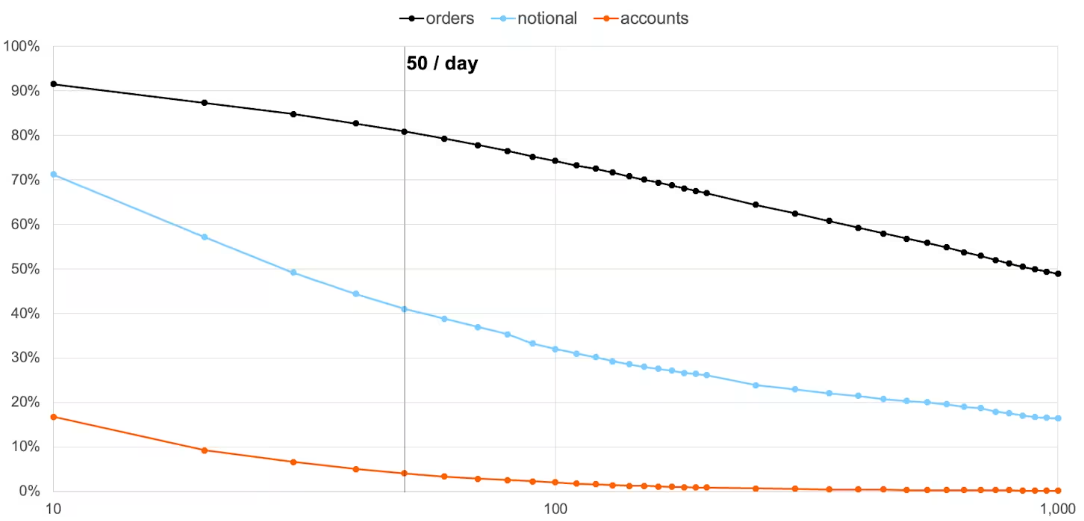
Galaxy separated accounts by trading frequency, excluding 125,429 addresses that exceeded its 50-order-per-active-day cutoff.
Those accounts represented just 4.1% of the total population but generated 80.8% of all orders and 41% of notional trading volume. The remaining accounts formed the report’s retail cohort.
The classification is a proxy for human-paced trading, rather than proof that every included account belongs to an amateur. A wealthy trader placing orders manually still counts as retail under the methodology.
Although aggregate losses were substantial, the typical account’s result was modest. The median retail account lost approximately $3, while half the population recorded outcomes between a $36.64 loss and a $0.40 gain.
Losses became considerably larger at the extremes. The first percentile stood at minus $4,804, compared with a $3,381 gain at the 99th percentile.
Meanwhile, accounts classified as automated earned a combined $246.8 million. Galaxy cautioned that its profits do not exactly offset retail losses, with the difference largely attributable to unresolved positions.
Profitability was measured by comparing positions’ settlement value to their cost, regardless of whether holders redeemed them. That approach captures losing positions left unclaimed.
Sports Specialists Have the Weakest Profitability
Focusing on one subject did not automatically produce better results.
Galaxy classified traders as specialists when more than 60% of their activity concentrated in one topic across at least five categorized markets. Specialists accounted for 44.1% of traders, but only 28.1% finished profitable, compared with 30.4% of generalists.
Sports dominated the specialist population, representing 47% of that group. Just 25.1% of sports specialists were profitable, the weakest result among the topics examined.
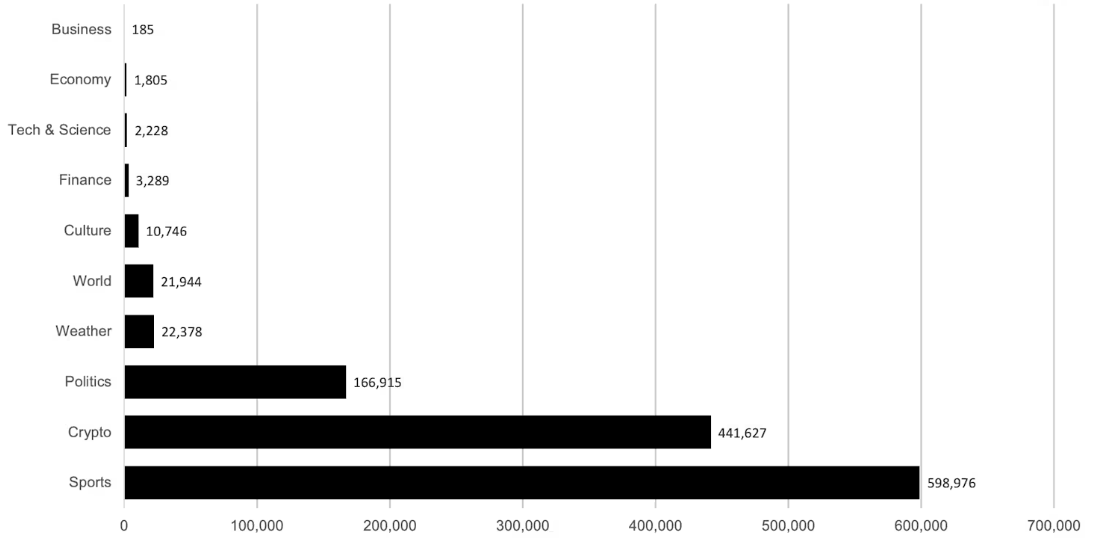
Finance specialists performed better, with 36.8% recording profits. Technology and science specialists led at 41.2%, although Galaxy noted that this category had a smaller sample.
The report suggested that expertise or better interpretation of public information could explain stronger results in some subjects. It did not establish that specialization itself causes profitability.
The comparison also has a methodological limitation: accounts with fewer than five categorized markets were assigned to the generalist group.
Specialists traded a median of 18 markets, versus four for generalists, making the groups different in activity as well as focus.
Losing Traders Retreat While Fees Raise the Hurdle
Losses were associated with a greater likelihood of inactivity.
After a losing position, 15.2% of accounts opened no new position within 30 days, compared with 6.1% after a win. Losing accounts were therefore approximately 2.5 times as likely to stop trading during that window.
However, inactivity does not necessarily mean a person has quit. Someone switching wallets would appear to leave one account behind.

Profitable traders also placed larger typical positions: $13.96 versus $10 among unprofitable traders. Galaxy found no consistent relationship between longer holding periods and profitability after controlling for activity.
Fees add another obstacle, particularly because the historical dataset includes trading before their introduction.
Galaxy’s conclusion separates trading returns from forecasting value: prediction markets can aggregate useful information even when most participating accounts lose money.


