Paradigm vs. Sequoia: Prediction Markets Become Silicon Valley’s New Battlefield


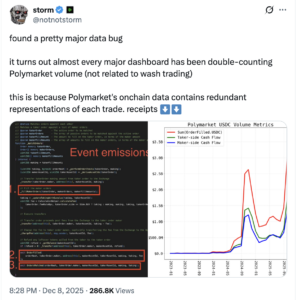
A researcher at Paradigm, the venture firm backing Kalshi, has this week claimed that Polymarket’s headline trading volumes are being overstated due to “double-counting”. The data, posted on X yesterday by Paradigm researcher Storm Slivkoff, argues that most third-party dashboards count both sides of a matched trade as separate events, inflating Polymarket’s perceived activity.
The controversy is currently raising more than a few eyebrows in the market. But it’s the identity of the source – a researcher employed by the main backer of Polymarket’s biggest rival – that has turned the tweet into a broader confrontation.
As prediction markets surge into the mainstream, venture capital firms are no longer limiting themselves to funding platforms. Instead, they are beginning to shape public narratives about market share, legitimacy and growth. This newest claim highlights how aggressive that competition has become.
Double Counting Allegation Raises Questions About Market Size
According to Slivkoff’s analysis, Polymarket’s on-chain trading emits two fill events for each executed trade: one for the maker and one for the taker. Many analytics dashboards interpret these as separate transactions. The researcher said this means “almost every major dashboard” has been reporting inflated figures.
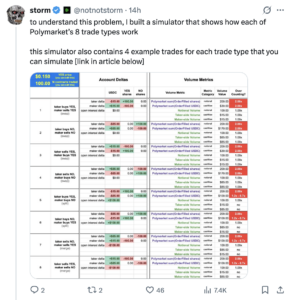
The finding challenges Polymarket’s status as the fastest-growing prediction market. Its rising volumes have been central to its public positioning, especially as media outlets cite its odds on elections and geopolitics.
Polymarket’s Primo Data was quick to reply to Slivkoff’s tweet by posting: “Our site does not double count volume. We show notional taker volume (same as Kalshi).”
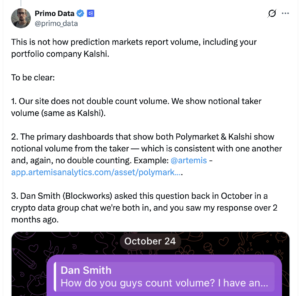
As of time of writing, the Polymarket X account has yet to publicly respond to the research to make any further clarifications.
Even so, the methodology dispute now sits second to the political context. The challenge came not from a neutral auditor, but from a competitor’s investor – a detail that shifts the meaning of the entire episode.
VC Backers Step Into the Arena
Polymarket and Kalshi represent two very different approaches to prediction markets. Polymarket is backed by crypto-native investors with ties to Sequoia Capital and prioritises global reach, rapid market creation and permissionless access. Kalshi is backed by Paradigm and operates as a regulated US exchange under CFTC oversight.
Both platforms target the same users: traders seeking real-time information and liquid markets for political and economic forecasts. Both platforms also see themselves as leaders of a new financial category.
This competition has set the stage for growing rivalry. As the sector expands, investors on each side have more incentive to defend their preferred platform and challenge the credibility of the other. This week’s research critical of Polymarket by a Paradigm employee marks the clearest public example of this growing market contention.
Market Data Becomes a Weapon
By questioning Polymarket’s figures, Paradigm has effectively challenged the foundation of the platform’s main market narrative. If volumes are lower than widely believed, user confidence may shift. This could benefit Kalshi, which reports its data through regulated disclosures.
However, Paradigm’s involvement also introduces bias. Analysts and industry participants note that any claim from a financially invested party must be evaluated with caution. In this case, separating technical critique from strategic positioning is now part of the story.
The tactic suggests that control over market perception is emerging as a competitive tool.
A Sector Growing Too Fast To Stay Quiet
Prediction markets are expanding rapidly as traders, pollsters and journalists use them as real-time indicators. Market odds have become a staple in election coverage. Capital continues to flow in, and platforms are racing to capture users before the next election cycle.
This growth has raised expectations. Investors want their platforms to lead. Users expect reliable data. Regulators monitor new products more closely.
Against this backdrop, any claims about inflated activity carry weight. They also risk triggering cycles of scrutiny as rival platforms examine and challenge one another’s methodologies.
The result is an environment where transparency becomes central to credibility — and where disputes over data may become more common.
A Proxy War Between Venture Giants
This week’s dispute underscores the influence of Silicon Valley’s largest venture firms. Sequoia-linked investors back Polymarket. Paradigm backs Kalshi. Both firms wield significant power across the broader tech ecosystem.
Their involvement raises the stakes. It means that platform competition is now intertwined with VC rivalry. Each firm has strong incentives to elevate its portfolio company while pressuring the other.
The publication of critical research — usually the job of independent analysts or regulators — marks a shift in how investors operate. Instead of remaining behind the scenes, VCs are stepping into the information arena to shape industry perception.
It’s likely that investors should expect more confrontations as both sides seek to position their platforms as the future standard.
Outlook: Expect More Direct Challenges
The confrontation over Polymarket’s trading figures is unlikely to be the last. As platforms chase liquidity and public relevance, disputes over data, market structure and regulation may intensify.
Prediction markets are no longer a fringe experiment. They are becoming central to political forecasting and financial speculation. That transition invites competition — and competition invites conflict.
This week’s confrontational research from Paradigm signals a new phase for the sector. The battle for leadership is now happening in the open, and the next move may come from either platform or their powerful backers.