Uphold Review 2026

- When you click links on this page, we may earn an affiliate commission. By using this website you agree to our terms and conditions and privacy policy.
- Participation in online gambling may be illegal in your country and is subject to age restrictions (18, 19, or 21, depending on the jurisdiction). Verify legality and age requirements before participating. Learn more
Uphold is a popular beginner-focused crypto exchange built to simplify investing. It features an intuitive interface and a straightforward tool common amongst the top crypto exchanges for buying and selling fiat and crypto. Yet, it lacks advanced features and charting capabilities, meaning Uphold is best suited to new investors or traders, while people seeking enthusiast-grade features may prefer an alternative like Coinbase.
Throughout our Uphold review, we'll break down the platform's features, security measures, payment methods, and availability. We'll also share our experience with the exchange and discuss reports from other users.
Uphold Review: Pros and Cons
Pros
- Regulated in several jurisdictions
- Highly transparent with audited proof of reserves
- Straightforward interface for buying and selling crypto
- Beginner-friendly
- Never been hacked in a decade of operation
- Solid user reviews
Cons
- Fees are significantly higher than average
- Limited feature set
- No advanced charting or analysis capabilities
Uphold’s Background and Reputation

Company Overview
Uphold was launched in 2015 to provide a simple way to acquire and exchange cryptocurrency. The crypto trading platform has expanded into over 140 countries and handles billions of dollars in transactions. Uphold is headquartered in New York, but has offices in London (Uphold Europe), the Bahamas (Uphold Worldwide), and Lithuania.
Uphold is a Centralized Exchange (CEX) that boasts a simple interface and makes investing/trading straightforward. It's an excellent crypto exchange for beginners. While advanced crypto trading features are lacking, Uphold's simplicity, useful features, and impressive selection of assets make it a top choice for new traders and investors.
Regulation & Licensing
Because Uphold is committed to providing a secure crypto exchange platform where users can feel safe when trading, it holds licenses in several regions. The United States FinCEN (as well as local state regulators), the UK's FCA, Canada's FINTRAC, and the Ministry of the Interior of the Republic of Lithuania regulate Uphold.
Trust & History
Trust is crucial for a platform that manages client funds. If a platform is regularly exploited, it's clear that there's a weak link in its security. Understanding how a platform responds to issues or controversies can reveal much about how it treats users and complex problems.
Chainalysis reported that an estimated $3.4 billion worth of crypto funds were lost to hackers in 2025, but Uphold has never been a victim. But it has suffered a few controversies. In July 2022, Uphold's email communication service provider, Customer.io, was exploited, leading to the provision of user email addresses to a bad actor. In response, Uphold investigated the risk to users and enhanced its security measures.
Uphold also fired an executive after allegedly misdirecting $730,000 in company and user funds via fake documents and invoices. Uphold got rid of the employee and ensured that users were not affected. From these incidents, we can see Uphold is transparent and strives to protect and make users whole.
User Reviews

Is Uphold legit? Similar to accessing a platform's history, user reviews and experiences can provide unique information not covered in general Uphold reviews, such as regional restrictions or issues with particular devices or operating systems.
On Trustpilot, Uphold holds an impressive rating of 4.5/5, indicating that most users have an excellent experience using Uphold. The company responds to 61% of negative reviews, which is lower than other mainstream exchanges, but it has a faster average reply time, 48 hours. Users state that it's easy to use and intuitive, but some say it has high fees and locks user funds.
Reddit users commonly complain about Uphold locking their accounts and requiring documents to verify their identities and finances. They also state that the Uphold customer support team is slow to respond. Yet, users unaffected by account locks praise Uphold for returning funds sent via incorrect networks and for being reliable for trading, depositing, and withdrawing.
How to Sign Up for Uphold
Wondering how to use Uphold? Our simple step-by-step guide has you covered. Check it out below.
Step 1: Create an Account
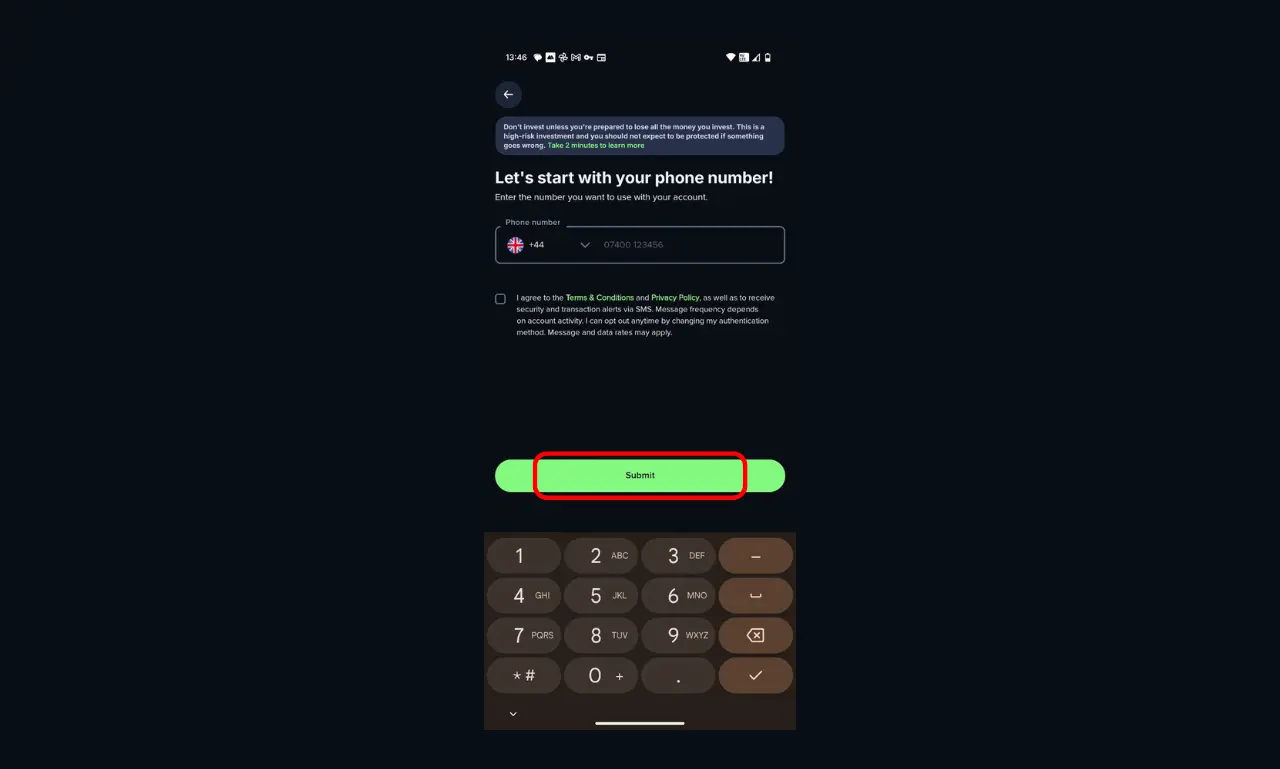
The Uphold sign-up process takes around 10 minutes. First, head to the Uphold homepage and click the green 'Get Started' button. Uphold will prompt you to enter a phone number; after doing so, you'll have to input a verification code. Then, you'll have to enter a few details, including an email address, password, home address, and country of citizenship.
Step 2: Verify Uphold Account

In certain countries, you'll be required to provide details regarding your employment status and source of funds. You may also have to declare your investor status and complete a crypto risk assessment.
Uphold requires users to complete Know-Your-Customer (KYC) verification, which involves providing photo ID (passport, driving license, national ID card) and, in some countries, proof of address (utility bill, bank statement, phone bill). You'll also need to take a selfie using a webcam or mobile device. The verification process is usually fast, but it can take a few hours.
Please note that you can choose to postpone your ID Verification time, but you will be given 60 days to complete it, or your account will be deleted.
Step 3: Deposit Funds

After Uphold has verified your account, you can deposit and start investing. Users must choose a funding source and a desired asset using the Anything to Anything tool. You can buy crypto directly or purchase a fiat currency to spend later. After entering a deposit amount, click 'Preview deposit', and confirm the transaction. Once your deposit arrives, you can start trading.
Initial Setup & User Experience
Exchanges that cater to beginners require a straightforward and approachable user experience. Uphold has ensured its platform is widely accessible, regardless of skill level.
Ease of Use
When an exchange is tailored to new investors or people without much crypto experience, it must be accessible and easy to use; otherwise, it will alienate its core audience. Uphold understands this well and has prioritized simplicity over introducing many tools and services.
All the information on Uphold is digestible, features are straightforward, and documentation is extensive, so the platform feels intuitive. The only improvement I think Uphold could make is to provide documentation directly next to each feature to prevent confusion or misunderstanding. That said, clarity and ease of use are Uphold's strong suits.
Display & Buttons/Touchscreen
Unlike decentralized exchanges, which can be slower as certain operations must be verified or processed on the blockchain, Uphold is highly responsive and loads sections quickly. The interface consists of three tiles, but only one changes, which provides a much more uniform and consistent user experience than larger cryptocurrency platforms.
My Uphold review found it one of the most intuitive crypto exchanges on the market. The primary tool, Anything to Anything, is permanently displayed, ensuring easy access. Other key sections can be found in a side navigation bar, which I found convenient and easily understandable, ideal for beginners.
Mobile App Review

Uphold offers a sleek and intuitive mobile app for Android and iOS devices. Key features are available on a persistent bottom navigation bar, while settings and less crucial sections are in another menu that users must toggle open. One notable difference is that staking has a dedicated place on the navbar, but is hidden behind 'More settings' on the web platform.
The mobile app is well-designed and loads quickly. Unlike the desktop site, users don't have to re-login after a few minutes of inactivity, as it's protected by biometric security. All features available on the web are on mobile. Staking, third-party integrations, and the Anything to Anything tool are present, enabling a seamless experience when switching over to mobile.
Uphold commands an excellent rating across the iOS App Store (4.7/5 based on 3,800+ reviews) and Google Play Store (4.5/5 based on 66,000+ reviews). According to genuine Uphold app reviews, users praise its reliability and ease of use, but complain of excessively high trading fees and lackluster customer support, which our findings back up.
Uphold Key Features & Services

Any of the best crypto exchanges offers certain features centered around trading and investing, but not all platforms are equal. Some provide subpar services or lack versatility. Here are my findings from our Uphold review.
Buying & Selling Crypto

Any beginner-friendly exchange must allow users to cash out or buy Bitcoin and other cryptos conveniently. There are 259 Uphold-supported coins, including significant assets like Bitcoin or XRP and smaller projects like Alchemix and Aergo. It offers an impressive variety of less popular projects, making Uphold ideal for novice altcoin investors.
Users can fund their accounts using 11 stablecoins, including USDT, USDC, PYUSD, and EURC, as well as any of its supported cryptos. Alternatively, people can fund their accounts or cash out with 15 fiat currencies. Uphold's deposit methods include credit/debit cards, bank transfers, and Google Pay.
Our Uphold crypto exchange review found the buying and selling interface particularly simple and intuitive. Dubbed 'Anything to Anything,' the tool acts as a fiat on/off-ramp and a crypto-to-crypto conversion tool in one. It supports repeat transactions and does away with complex order books in favor of a more visual interface suited to novices.
Trading Platform
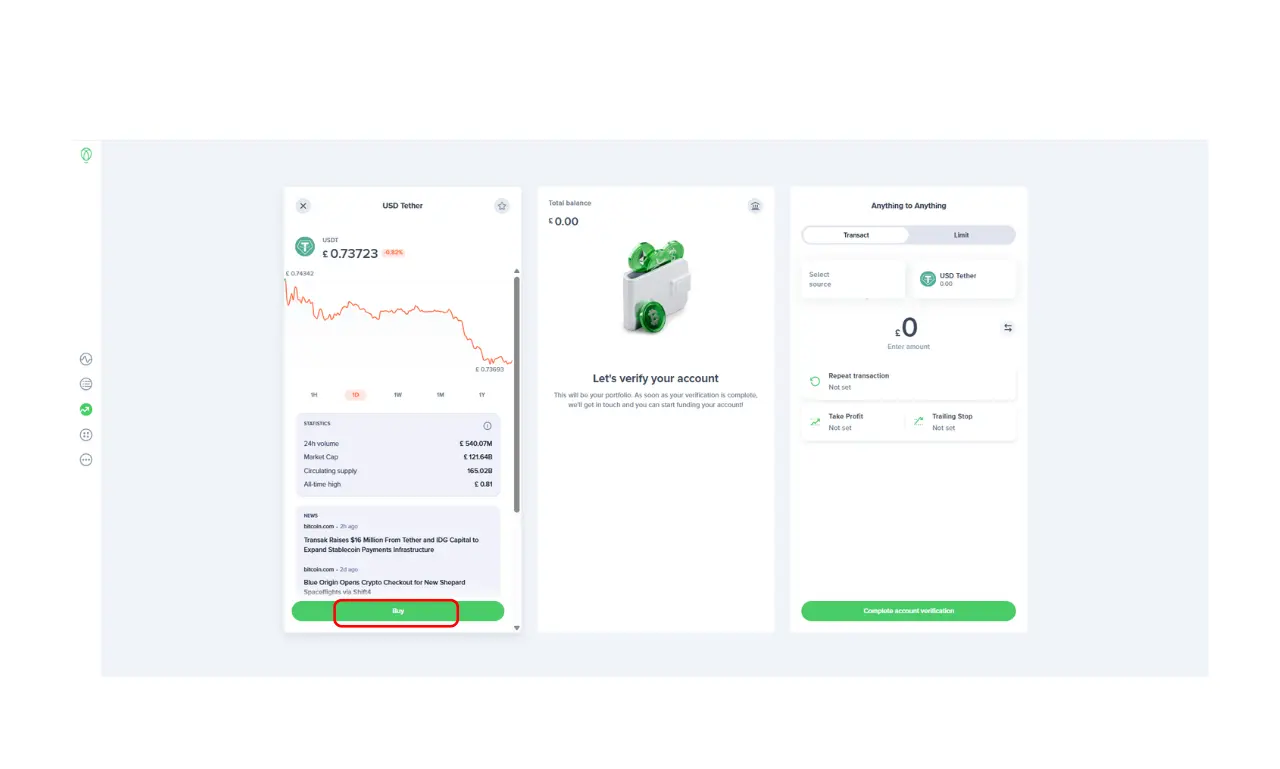
Uphold is among the top cryptocurrency platforms for beginners, partly due to its intuitive system for buying and selling crypto. It requires users to select a funding source and a destination asset, eliminating complex terminology. The Uphold app utilizes the same interface, although it's slightly more convenient on mobile devices due to styling and button placement.
Users can access a few crypto trading order types to help them enter positions at better rates or when desired. Uphold offers market (executes at current prices), limit (executes at a specific price, take profit (sells position when a price is hit), and trailing stop (adjusts as prices change) orders. Users can set the duration of limit orders, allowing them to expire on a specific date.
While Uphold makes trading simple, it lacks advanced crypto trading capabilities, so experienced traders looking for TradingView integration, in-depth charting, or technical indicators should consider another platform. Uphold is limited to a basic line chart displaying price over 1-hour, 1-day, 1-week, 1-month, and 1-year periods.
There are no derivatives on Uphold, so users cannot buy Solana with leverage even if significant news is released that causes SOL to rise. Moreover, there is no order book to gauge Uphold's liquidity or daily volume, and the exchange isn't tracked on CoinMarketCap or other platforms. However, it limits purchases to $19,997.40, indicating reasonable liquidity.
Supported Wallets & Custody
Because Uphold is designed for beginners, it has implemented a custodial wallet, enabling people to store any asset supported by the trading platform. With custodial wallets, the issuer (in this case, Uphold) controls the private key and recovery code. This can be safer for new crypto enthusiasts as they're not at risk of losing access or exposing their recovery code.
In contrast, more advanced wallets, like MetaMask, are non-custodial, which means the user controls the private key and recovery code, granting them true ownership over their assets. Our crypto wallet review found that although Uphold's is basic, it's an easy-to-use and intuitive custodial exchange wallet.
Earning & Lending

The best crypto exchange will help you get more from your investments, not just enable buying and selling. To this effect, Uphold has established a crypto staking program that pays out up to 16.1% APR. In total, 20 assets can be staked, including Ethereum (2%), Solana (6.05%), Polkadot (8.6%), Cosmos (16.1%), Near Protocol (7.35%), and Hedera Hashgraph (0.023%).
Other than earning interest on crypto, Uphold offers rewards on USD balances. There are no fees or lockup periods, and all funds are stored in insured bank accounts. Uphold's interest rate is 4.5%, over 700% higher than the United States average savings rate (0.59%). However, it only pays 2% on balances below $10.
Uphold offers no other interest-bearing products to ensure it doesn't become too complex for people new to cryptocurrency or those desiring a straightforward platform. There are no Bitcoin mining pools for users to contribute to, trading bots for automatically executing specific strategies, or a copy trading system for mirroring experienced users.
Security Measures

Two-Factor Authentication (2FA) is a standard security measure that requires users to input a code to access their accounts. Uphold lets users set SMS 2FA or use a dedicated authenticator app, like 2FAS. The latter is recommended as SMS 2FA can leave you vulnerable to SIM-swap attacks, where bad actors gain access to your mobile number.
Uphold's security involves storing around 90% of its crypto in cold storage away from the web. The funds Uphold keeps in hot wallets are used for its day-to-day operations. Uphold discloses its proof of reserves in an in-depth transparency page. It's regularly audited and shows that Uphold is always over 100% collateralized across all its assets.
One thing we noticed while testing the platform for our Uphold review is that the exchange will automatically log you out after a few minutes of inactivity. Although this is great for protecting your privacy or keeping you secure if you leave your computer unattended, it's inconvenient for general use, as users must re-enter their login credentials and a 2FA code.
While Uphold doesn't have an insurance policy that protects users' crypto assets, funds in its USD interest accounts are stored across 10 FIDC-insured banks, providing up to $2.5 million in protection. Uphold is subject to regular audits from various US State authorities. Moreover, its proof of reserves is independently audited for accuracy and transparency.
Uphold doesn't offer withdrawal allowlists, which let users delegate safe crypto addresses to which they can withdraw, protecting accounts in case they're compromised. Despite bad actors targeting Uphold users with phishing attacks, the platform doesn't have a system for setting anti-phishing codes to help users recognize legitimate communications.
Payment Methods & Fees
Nobody wants excessive fees to eat into their profits, especially when buying crypto with a debit or credit card. Paying extra doesn't benefit users, so always aim to minimize fees. For advanced exchanges like Binance or Bybit, trading fees of 0.1% are typical, while beginner-friendly platforms, like Coinbase (0.60% / 1.20%) or eToro (1%), are typically more costly.
Having cryptocurrency fees explained is essential before deciding whether to use a particular platform. On Uphold, fiat deposits are free in the UK and Europe, while ACH deposits and wire transfers over $2,000 in the US are free. However, debit/credit cards incur a 3.99% charge, while wire transfers below $2,000 cost $10. There is no additional fee for depositing crypto.
Withdrawals are mostly free, but there are a few Uphold fees to be aware of. Although there is no charge for standard ACH withdrawals, instant ACH withdrawals cost 1.75% ($1 minimum). SEPA and FPS withdrawals are free in Europe and the UK. However, debit card or Apple Pay withdrawals cost 1.75%.
Crypto withdrawals incur a variable fee. Based on our research, Uphold's withdrawal fees are comparable to the average. Below, we compare Uphold's rates with Kraken and Binance, two other leading exchanges.
| Cryptocurrency | Withdrawal Fee Uphold | Withdrawal Fee Kraken | Withdrawal Fee Binance |
|---|---|---|---|
| Bitcoin | 0.00004 BTC ($4.60) | 0.00001500 BTC ($1.72) | 0.00003 BTC ($3.45) |
| Ethereum | 0.0001 ETH ($0.36) | 0.00036 ETH ($1.31) | 0.0002 ETH ($0.73) |
| XRP | 0.001 XRP ($0.0029) | 0.05 XRP ($0.15) | 0.2 XRP ($0.60) |
Regarding trading, Uphold uses a tiered fee structure that differs based on the asset being bought and sold. It charges 1.4% to 1.6% for BTC and ETH and 2.5% to 2.95% for altcoins. Stablecoins cost below 0.25%. Forex pairs cost 0.30%, while precious metals are 1.9% to 2.95%.
Uphold is transparent about its fees and other financial details. However, users may not be aware that the trading platform charges a 20% to 25% commission on crypto staking. Uphold also charges a variable spread fee that differs by asset and market conditions, but a notification is displayed when the spread is abnormally high (4% or more).
Uphold's withdrawal limits vary by payment method and region. For US customers, the minimum deposit amount is $10 and the maximum is $15,000. In the UK and Europe, there is no minimum or maximum deposit (although debit/credit cards have a €/£15,000 maximum).
Customer Support

Users will find that Uphold has created extensive documentation on features and general topics like 2FA, opening/closing accounts, and managing their accounts. This information is stored in a help center. Unfortunately, there is no live chat for users to speak to a human support advisor quickly.
If you want to contact Uphold, you're limited to submitting a ticket. No estimated response time is shown on the request page, but I found a page in the FAQ center stating replies could take up to 24 hours. I tested the Uphold customer support team by submitting a request regarding a funding issue and received a response within six hours, which is reasonable.
Customer support is available 24/7, but there may be delays in responding during busy periods, holidays, or weekends. The lack of live chat support makes getting assistance with time-sensitive issues challenging and is a notable disadvantage compared to other platforms.
Geographical Availability
Although Uphold is a global crypto investment platform, it's prohibited in 30 countries. Additionally, users from 68 regions, including New York, India, and Germany, cannot create new Uphold accounts, severely restricting access in developing countries and a handful of crypto-friendly regions.
Uphold follows Anti-Money Laundering (AML) and Know-Your-Customer (KYC) guidelines to ensure compliance with local regulations. It also follows European data protection guidelines and closely adheres to Office of Foreign Assets Control (OFAC) regulations, which involve complying with US trade sanctions.
Other Uphold Products and Services
We've covered Uphold's core features, but the exchange offers a few other valuable services. They include:
Uphold Card

If you’ve ever wished you could spend your crypto, cash, and even commodities directly from one card, the Uphold Card might be the solution you’ve been waiting for. Powered by Mastercard and paired with the Uphold multi-asset platform, it lets you use over 50 different assets at millions of merchants worldwide.
But how does it actually perform day-to-day? Here’s my take after diving into its features, fees, limits, and user feedback.
One of the biggest draws is cashback rewards. Spending from a traditional currency balance nets you 1% cashback in GBP, while selected crypto purchases sometimes earn even more. Rewards are credited monthly, making it a simple, passive perk.
Acceptance isn’t an issue; it works anywhere Mastercard is honoured and supports Apple Pay and Google Pay for contactless spending. The app is equally convenient, with instant asset switching, freeze/unfreeze controls, real-time alerts, and in-depth spending breakdowns.
There are no annual or foreign transaction fees, which is a win for travellers and global shoppers alike.
Getting the physical card costs $9.95, which is non-refundable, though you can always stick to the free virtual version if that bothers you. Cash access isn’t ideal either: ATM withdrawals come with a $2.50–$3.50 fee and have daily and per-transaction caps.
Customer service can be hit-or-miss, with response delays during busy periods. Some users have also reported compliance checks that temporarily restrict funds, something to be aware of if you need uninterrupted access.
Retail spending tops out at $10,000 per day (and per transaction), with a 50-purchases-per-day maximum. Certain categories, such as gambling, government payments, and some financial services, don’t earn cashback.
For anyone juggling multiple assets, the Uphold Card is a strong option. It’s flexible, travel-friendly, and integrates perfectly with the Uphold app.
Third Party Integrations

One of the most significant advantages of using Uphold over other, more advanced exchanges is the ability to connect to 10 third-party services, which expands Uphold's potential. Users can connect to the Kryptos, Blockpit, Recap, and CoinTracker tax software, and a few other platforms, as well as a couple of rewards/survey sites to earn extra rewards.
Asset-Specific Data

When you buy Ethereum or any other cryptocurrency, Uphold displays asset-specific data to help you decide whether to invest. The statistics include 24-hour trading volume, market capitalization, circulating supply, and an all-time high. Uphold also shows news articles about the asset and a brief overview of the crypto and its history.
Brave Rewards Hub
Brave Browser is a popular web browser that integrates crypto by rewarding users with a portion of the advertising revenue generated by their searches. The rewards are distributed directly to linked Uphold accounts for simple ownership, trading, and selling. Rewards are sent out monthly, offering another way for Uphold users to add to their holdings passively.
Uphold vs. Other Crypto Exchanges
Here is how Uphold stacks against other top crypto exchanges in the market
| Crypto Exchange | Top Choice For | Trading Fees (Maker / Taker) | Products and Offerings | Standout Features |
|---|---|---|---|---|
| Uphold | People seeking a beginner-friendly exchange | 1.4% to 1.6% (BTC & ETH), 2.5% to 2.95% (atlcoins) | Simple trading interface, fiat on-ramp, crypto staking, third-party integrations | Intuitive system for buying and selling crypto, integrations with tax software |
| Coinbase | New traders seeking a simple but robust exchange | 0.60% / 1.20% | Standard and Advanced modes, derivatives, staking, TradingView | The ability to switch between a simple interface and advanced trading tools |
| Binance | A robust international exchange | 0.1% | P2P, derivatives, high leverage, crypto loans, staking, trading bots, structured earn products | Customizable crypto bots for automated trading |
| OKX | Minimizing trading fees | 0.08% / 0.1% (varies by country) | Spot, margin, futures, P2P, crypto loans, staking, crypto bots, TradingView | Features are tailored to users' locations for regulatory compliance |
| ByBit | A variety of staking and structured earn products | 0.1% | Crypto debit card, loans, structured earn products, smart leverage, liquidity mining, futures, options | A diverse variety of staking / earn products, many ways to trade crypto |
Who is Uphold Best Suited For?
Uphold is a beginner-focused exchange with minimal advanced features. It's easy to use, has straightforward navigation, and an intuitive buy/sell interface, making it suitable for those without much crypto or trading experience. A good range of cryptos is available, making it best suited for people wanting to buy Cardano or other assets easily.
While ideal for novices or new traders, Uphold lacks advanced charting or analysis capabilities and has higher-than-average fees, so people looking for an all-in-one or low-fee crypto exchange may prefer alternatives like Bybit, Bitget, or Binance.
Conclusion
Uphold is a well-known exchange that makes crypto accessible to everyone, regardless of experience or trading proficiency. Based on research for our Uphold review, the platform is secure and has never been hacked. Most users agree that Uphold is a legitimate, easy-to-use exchange, but some have had issues with assets being locked until they provide proof of funds.
Users can access features core to any crypto exchange: conveniently buying, selling, and storing digital assets. Uphold also offers a basic crypto staking program and interest on USD. Yet, it lacks in-depth charting or derivatives trading, and has fees higher than most exchanges, so it caters exclusively to beginners seeking a simple crypto investing platform.
FAQs (Frequently Asked Questions)
How does Uphold make money?
Like most exchanges, Uphold features require a fee to use. The platform charges 1.4% to 2.95% for trading crypto and applies a small spread, providing additional revenue. Uphold also earns money by taking a 20% to 25% commission on users’ staking earnings, providing multiple avenues of revenue.
Can I earn passive income on Uphold?
Uphold offers several ways to earn passive income. Its crypto staking program pays up to 16.1% APR and distributes rewards weekly. Staking is flexible, so there are no long-term commitments. The trading platform also pays rewards on USD balances, with Uphold’s interest rates being 4.5% APY.
What are the tax implications of using Uphold?
Profits earned from cryptocurrency are taxable. Whether trading, investing, staking, or mining, you’ll have to pay a portion of your earnings above a certain threshold. The rates, applicable deductions, and tax filing methods differ by country, so you should consult a tax professional who’s informed about your local regulations to ensure everything is above board.
What is KYC/AML, and why is it required on Uphold?
Know-Your-Customer (KYC) guidelines require exchanges to gather information on users’ identities to prevent criminal use. Similarly, Anti-Money Laundering (AML) regulations require platforms to determine users’ financial status and source of funds to combat money laundering and terrorist financing.


