TokenTax Review 2026

- When you click links on this page, we may earn an affiliate commission. By using this website you agree to our terms and conditions and privacy policy.
- Participation in online gambling may be illegal in your country and is subject to age restrictions (18, 19, or 21, depending on the jurisdiction). Verify legality and age requirements before participating. Learn more
Cryptocurrency can be confusing; it’s an emerging market with many moving parts. With country-specific rules, various income classifications, and harsh penalties for inaccuracies, taxes are another daunting subject. Crypto taxes are particularly difficult to wrap your head around, so there’s significant demand for software that makes it easier, like TokenTax.
Throughout this TokenTax review, we’ll take a detailed look at the crypto tax software, exploring its features, including platform integrations, error reconciliation, report generation, and pricing, to help our readers determine whether it’s suitable for their needs. Let’s get started.
TL;DR:
- Core Strength: TokenTax is a strong option for businesses and high-net-worth individuals with high transaction volume who may require bespoke assistance.
- Compliance Status: While TokenTax supports IRS Form 8949, it offers no automated Form 1099-DA reconciliation, and error reconciliation is locked to its $3,499 VIP plan
- Pricing Value: While TokenTax offers affordable plans, its best features are available only in its top-tier plan, which costs $3,499.
- Best For: US investors whose activity is relatively straightforward and concentrated on one or two exchanges (higher-volume users should size up to the VIP plan).
What is TokenTax?
TokenTax is a leading crypto tax software with an interesting history. Initially created in 2017 by Alex Miles to import transaction data from Coinbase, TokenTax won the Product Hunt Global Hackathon that same year, before co-founder Zac McClure joined the company.
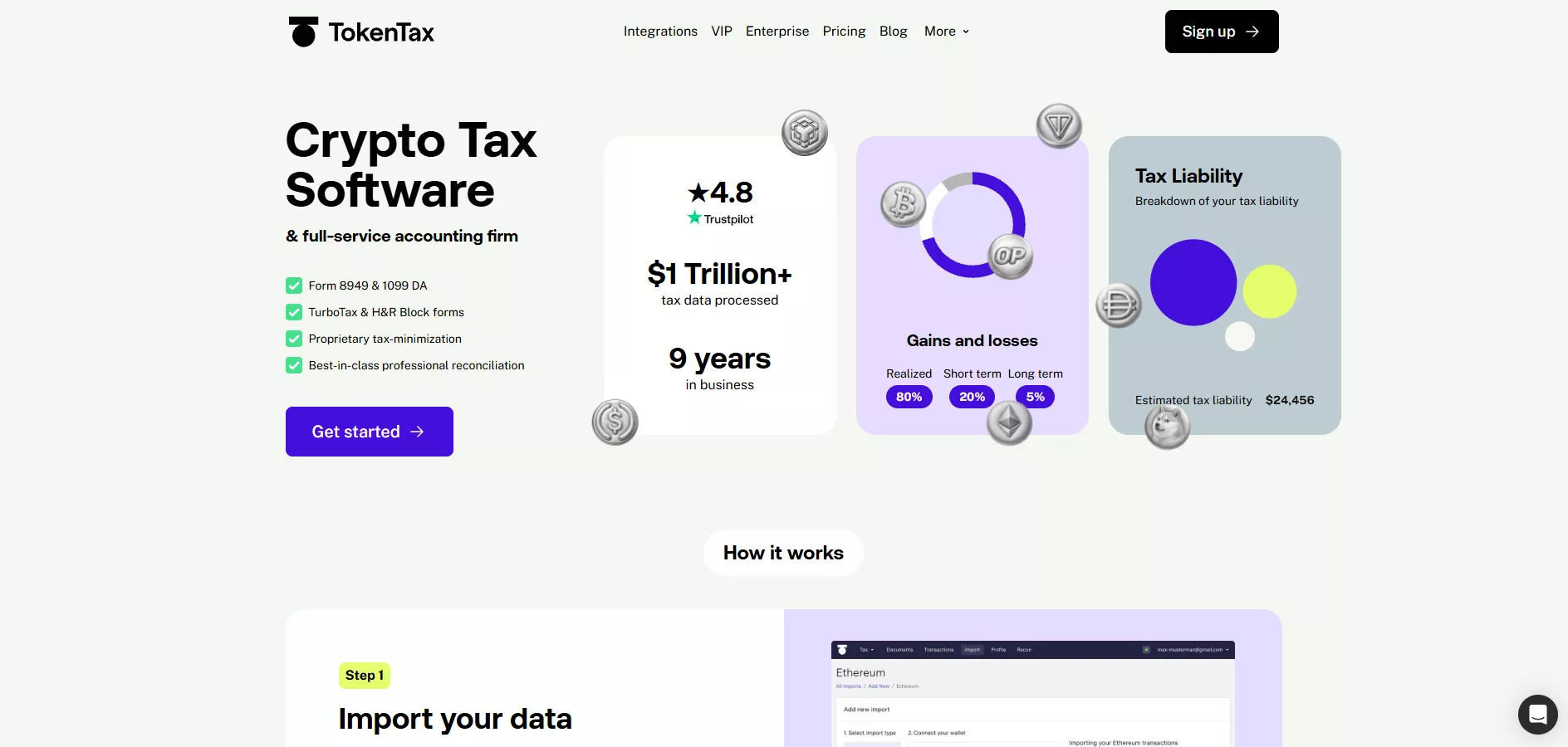
Later in 2019, TokenTax acquired the cryptocurrency tax firm Crypto CPAs (led by CPA Andrew Perlin), which helped fuel its evolution into the current iteration, which can import transactions from many exchanges/wallets, automatically categorize data, and generate accurate tax reports. The company built a strong reputation, commanding a 4.8/5 Trustpilot rating.
Ease of use is one of the biggest hurdles to cryptocurrency adoption; even taxes are more difficult in crypto, so simplicity is important. TokenTax’s core goal is to reduce the complexity of crypto tax filing by integrating with leading service providers and offering automated filing tools.
While some TokenTax alternatives boast over 3,500 integrations (Summ), TokenTax itself supports a more modest range of just over 100 exchanges, wallets, and blockchains. So, while it supports a good variety of popular platforms, such as Coinbase, Ethereum, Solana, and MetaMask, some less-used exchanges and wallets may not be directly integrated.
TokenTax lacks widespread integrations, so we recommend making a list of any wallets, exchanges, or blockchains you’ve transacted on and searching them using TokenTax’s ‘Import’ tool. If the software doesn’t support the platform you use, then your tax report could be inaccurate. However, you can import data via CSV if needed.
Key Features for the 2026 Tax Year
If you haven’t previously filed taxes involving cryptocurrency transactions, it’s challenging to know which features to look out for. Below, we outline the most impactful tools that crypto tax software typically offers and explain how TokenTax handles them.
Form 1099-DA Reconciliation
IRS Form 1099-DA is a significant new hurdle for crypto investors and traders in 2026. If you’ve split activity across multiple wallets, exchanges, or blockchains, then it’s likely that your 1099-DA will be inaccurate. With exchanges required to report profits to tax agencies, filing correctly is essential to avoid penalties.
While other crypto tax software either lets users upload their own copy of Form 1099-DA (Koinly) or automatically generates the report from transaction data (Summ), TokenTax lacks this functionality, a significant disadvantage in the current cryptocurrency tax ecosystem.
Although a minor issue for international traders/investors, Form 1099-DA is crucial to US residents. Moreover, it’s one of the most challenging forms to file because it requires cross-platform data, which can be difficult to manage. So, US-based users may want to consider an alternative with better 1099-DA capabilities.
DeFi & NFT Support
Decentralized Finance (DeFi) is extremely popular among crypto enthusiasts because it expands the utility of tokens. However, activities like staking, cross-chain bridging, yield farming, and trading on Decentralized Exchanges (DEXs) are difficult to track because they span multiple networks, platforms, wallets, and smart contracts.
Because there are different tax rules for capital gains and income, correctly classifying your DeFi transactions is essential. Failure to do so will result in incomplete records and missing data, which could lead to penalties from your tax authority or you paying more tax than is necessary.
Due to the challenges in tracking your DeFi transactions, it can be tempting to report lower-than-actual earnings. However, blockchains are publicly traceable, and tax authorities use special analytical tools to track activity and link it to a specific person.
TokenTax simplifies DeFi tax reporting significantly. When you import transactions from various networks or DEXs, TokenTax can automatically match them to exchange records to properly identify transactions and determine gains/losses. However, you’ll have to manually upload CSV files for most DeFi platforms because TokenTax’s integrations are limited.
TokenTax is solid for DeFi. It can match transactions across multiple platforms and automatically categorize activities such as yield farming, helping ensure tax reports are as accurate as possible. However, while testing for this TokenTax review, I was disappointed by its lack of integrations.
DeFi enthusiasts will have to manually import most transactions via CSV, which is less convenient than on platforms with broader support. So, if you’re a DeFi enthusiast, it’s worth carefully considering whether TokenTax is right for you before buying a subscription.
Error Reconciliation Tools
If you’re a high-frequency trader, regularly switching exchanges/wallets, or often use Decentralized Applications (dApps), then error reconciliation is crucial when filing your taxes. If you do not reconcile your transactions, your data will be incomplete or fail to show the full story.
TokenTax lacks automated error reconciliation or a manual review system. However, it can serve as a fully-fledged accounting firm for subscribers to the $3,499 VIP plan.
TokenTax VIP users can process 30,000 transactions and receive two 30-minute consultations with a tax professional. A good strategy to maximize value involves using one meeting to discuss initial requirements/approach, and using the other before filing. TokenTax also features a boutique error reconciliation system:
Users fill out a questionnaire and upload their transaction history. The TokenTax reconciliation team then reaches out with questions about trading history, exchanges, presales, and other details to reconcile your crypto transaction data and prepare it for filing.
So, while TokenTax’s error reconciliation system is excellent, it’s unavailable to most people. When you compare TokenTax vs Summ or other crypto tax software with more accessible reconciliation, lower-tier plans seem basic; TokenTax better suits high-volume traders who want to balance convenience with 1:1 assistance.
Ease of Use & User Experience
Cryptocurrency is a complex industry with many moving parts and unique concepts. As such, companion platforms, like tax software and exchanges, should be intuitive and easy to use.
Accurate reporting is essential when filing crypto taxes. Incomplete or incorrect figures can lead to harsh penalties. Therefore, we recommend avoiding overly complex platforms. If using tax software is challenging, there’s a greater likelihood of errors, since there are more opportunities for mistakes.
During this TokenTax review, I found that creating an account takes just a couple of minutes, and navigating the platform is straightforward. The interface is basic: text-based, with no images or dynamic widgets. While easy to navigate, it’s much less visually appealing than modern TokenTax competitors such as Koinly and Summ.
You can quickly and easily import transactions to TokenTax via its integrations with popular exchanges and wallets. Processing times vary depending on the number of transactions, typically ranging from a few minutes to around an hour.
Unfortunately, TokenTax has fewer integrations than alternatives. As a result, there’s a much higher chance that you’ll have to upload transactions via a CSV file, or, if unavailable, manually upload them, which is unviable for large transaction volumes and inconvenient and time-consuming for lower volumes.
Moreover, when I tested Summ and Koinly, I was able to import my transaction data and see an overview before purchasing a subscription, which made it far easier to judge which subscription was right for me based on transaction limits. However, a paid subscription is required to import transactions to TokenTax.
TokenTax has a beginner-friendly interface that’s intuitive and easy to operate. However, because it offers limited integration support and requires a paid plan with no preview options, it’s difficult to recommend TokenTax over alternatives if you value simplicity, ease of use, or value.
Pricing & Plans
As of September 2026, TokenTax’s pricing is expensive. Its plans are billed per report and per tax year, and they cost more than most alternatives, especially given the limited integrations and lack of automated Form 1099-DA support.
| Plan Name | Basic | Premium | Pro | VIP |
| Price | $49 | $199 | $1,999 | $3,499 |
| Transactions | Up to 100 | Up to 5,000 | Up to 20,000 | Up to 30,000 |
| Platform Support | Every CEX | Every CEX | Every CEX | Every CEX + Every DeFi/NFT Platform |
| TurboTax Integration | Yes | Yes | Yes | Yes |
| Tax Loss Harvesting Dashboard | No | Yes | Yes | Yes |
| Advanced Crypto Reconciliation | No | No | Optional | Yes |
| FBAR Form | Optional | Optional | Yes | Yes |
| IRS Inquiry Review | No | No | No | Yes |
| 1:1 Consultation | No | No | No | Yes |
| TokenTax Filing | No | No | No | Yes |
TokenTax 2026 offers a $49 plan tailored to beginners. However, it lacks most of the features available on higher-tier plans, including error reconciliation and tax loss harvesting, meaning it’ll likely generate less complete and accurate reports, potentially impacting your tax liability.
With the ‘Pro’ plan costing 10x as much as the ‘Premium’ plan and offering relatively few improvements, it’ll be unsuitable for most people. However, the VIP plan provides bespoke assistance, making it a solid option for businesses or individuals with significant capital and high transaction volumes.
Pros and Cons
Pros:
- TokenTax offers multiple plans at different price points, so there are options for all budgets.
- Users can import transactions via TokenTax’s integrations, by uploading a CSV file, or by manually entering the required transaction information, so they can include all their transactions.
- TokenTax can automatically generate IRS Form 8949 and international gain/loss reports.
- Live chat customer support is available with every TokenTax plan, ensuring people can receive prompt assistance if they have an issue.
- TokenTax integrates with TurboTax, enabling a relatively seamless flow between report generation and filing.
Cons:
- You cannot import transactions without subscribing to a paid plan, so you cannot view your total transactions to gauge which plan is right for you, making it difficult to choose.
- Error reconciliation on TokenTax requires a $3,499 VIP subscription, which puts it out of reach for the vast majority of users.
- TokenTax lacks robust support for Form 1099-DA, which is essential for American crypto investors and traders
TokenTax vs. Competitors
If you’re reading a TokenTax review, it’s also worth considering TokenTax alternatives and other crypto tax software for 2026. There are plenty of options, each offering unique features and catering to different audiences.
Summ, Koinly, CoinTracker, and Awaken are among TokenTax’s primary competitors. CoinTracker leans toward mainstream investors who want a polished, portfolio-first experience, while Awaken targets DeFi and on-chain power users who need deep smart-contract coverage. The platforms offer similar capabilities: importing transactions from wallets/blockchains/exchanges; identifying missing data; generating tax reports; and properly categorizing transactions.
Some key areas of comparison include:
- Transaction limits
- Pricing
- Error reconciliation
- Multi-platform support
While TokenTax requires a VIP subscription for error reconciliation (handled manually by you and the TokenTax team), Summ offers error reconciliation as standard via a convenient error review checklist tool; however, it also requires manual input to check and fix transaction data.
Support for Form 1099-DA is crucial for US-based crypto enthusiasts who have used multiple platforms throughout a single tax year. While Summ and Koinly both let you reconcile errors against your 1099-DA, TokenTax has no equivalent self-serve 1099-DA tool.
Koinly and Summ are both self-service crypto tax platforms. Users complete actions themselves, while the platform handles the complex background processes. However, TokenTax is part tax software, part accounting firm. It can file on behalf of VIP users, who also receive access to a human error-reconciliation team and multiple 1:1 consultations.
While TokenTax is a solid option for general use, it’s relatively ineffective for enthusiasts who stake, bridge tokens, mint NFTs, or conduct other DeFi activities, rather than simply buying and selling on a single Centralized Exchange (CEX), due to its lack of error reconciliation and 1099-DA support.
Key Takeaways
- Given its limited error-reconciliation capabilities, TokenTax is best for US investors whose activity is relatively straightforward and concentrated on one or two exchanges.
- While TokenTax can handle IRS Form 8949 and international gain/loss reports, it doesn’t currently support 1099-DA.
- The 100-transaction ‘Basic’ plan is suitable for investors with low transaction volume, while businesses or high-net-worth individuals that need to process large volumes of data may prefer the 30,000-transaction VIP plan.
- TokenTax is effectively part tax software and part accounting firm. It’s self-serve for Basic, Premium, or Pro plan subscribers, but VIP users receive bespoke assistance from TokenTax’s team.
FAQs
Is there a free version?
While some crypto tax software offers a free subscription that supports a handful of transactions so users can try out the platform, TokenTax requires users to subscribe to a paid plan before even importing their transactions. This can make it difficult to choose a plan, as the transaction limits are tight.
Can I use this for international taxes?
TokenTax is primarily geared toward users residing in the United States and supports IRS Form 8949 and FBAR reporting. While it enables you to generate an international gain/loss report (with average-cost-basis accounting for UK and Canadian users), it cannot automatically generate other international tax reports.
Can I sync my hardware wallet (Ledger/Trezor) directly?
While TokenTax offers integrations with Ledger and Trezor hardware wallets, the integration didn’t function as intended. During my TokenTax review testing, it got stuck on a loading screen and continually looped. I didn’t have a premium subscription, but other exchange and wallet integrations loaded, signaling potentially broken integrations.
Will the IRS see my on-chain (DeFi) activity if I use this software?
TokenTax is a tool for generating reports and analyzing data. The company does not send your financial information or tax obligations to the IRS, although TokenTax can file on behalf of VIP subscribers. However, the IRS uses advanced software to track on-chain activity, so filing your taxes accurately is essential.
How does TokenTax work?
If you’ve not used crypto tax software, it can be difficult to understand how it can generate accurate tax reports. TokenTax cannot magically find your transaction data. You import it from the exchanges, wallets, and DeFi platforms that you’ve used, while the software organizes it before generating a report.
Is TokenTax legit and safe to use?
Yes. TokenTax is an established US crypto tax provider that launched in 2017, won the Product Hunt Global Hackathon, and later acquired the accounting firm Crypto CPAs. It currently holds a 4.8/5 ‘Excellent’ rating on Trustpilot, so it is a legitimate tool rather than a scam. As with any tax software, review the reports you generate before you file.
How secure is my data with TokenTax?
TokenTax imports your transaction history through exchange and wallet integrations and uses it only to generate your tax reports. It does not file anything with the IRS on your behalf unless you are a VIP subscriber who has authorized it. Where an exchange offers read-only API access, use it, and revoke your API keys once your reports are complete.


