XM.com Review 2026: Spreads, Fees & Safety

- When you click links on this page, we may earn an affiliate commission. By using this website you agree to our terms and conditions and privacy policy.
- Participation in online gambling may be illegal in your country and is subject to age restrictions (18, 19, or 21, depending on the jurisdiction). Verify legality and age requirements before participating. Learn more
XM.com has been operating for over 15 years and is a leading global CFD and MT4/MT5 broker with over 15 million clients worldwide. It's regulated, powerful, and versatile, making it an excellent choice for a wide range of traders, particularly those seeking advanced features, high leverage limits, and low minimum deposit and withdrawal amounts.
Like some of the best crypto exchanges in the world, XM also serves as a crypto exchange/wallet, helping users store their funds in cryptocurrencies. They have one of the best customer services and fast deposit and withdrawal times.
Throughout this XM.com trading review 2026, we'll break down the broker's fees, available instruments, trading capabilities, educational resources, and customer support system. Ready to learn more? Let's get started.
Summary
- XM is a global broker split into several entities that are regulated by multiple authorities, enhancing security.
- Traders can experience zero deposit and withdrawal fees, making it easy to move funds on and off XM.
- XM offers traders over 1,000 instruments across the forex, stock, commodity, index, and cryptocurrency markets, providing many trading opportunities.
- Users have access to multiple trading accounts and a wide range of educational material, making XM approachable and user-friendly.
- There are low minimum deposit and withdrawal limits, making XM accessible regardless of trading capital.
XM.com: Pros & Cons
Pros
- Regulated globally
- High leverage (up to 1:1000)
- Educational resources for new users
- Low minimum deposits and withdrawals
- Fee-free deposits and withdrawals
- Excellent MetaTrader 4 and MetaTrader 5 support
- Standard, zero commission, and zero spread accounts
Cons
- Wider spreads on standard accounts than true ECN brokers
- Monthly $5 fee after 90 days of no inactivity
- Features and client protection vary by location
XM Group Safety and Regulation: Is XM a Trusted Broker?

When conducting an XM broker review or analyzing any other financial platform, security and regulation should be your foremost considerations. Reputable platforms will adhere to specific local guidelines to ensure legal compliance and enhance trust.
Regulatory Oversight (The Key Difference)
Brokers like XM handle sensitive information and user funds, so security and regulatory status are essential. XM understands this well and provides a safe, licensed environment for traders and investors. It is licensed across many jurisdictions, ensuring XM adheres to region-specific rules while enhancing accountability and user trust.
For Europe, XM's regulation is handled by Cyprus's CySEC, with its registration passported into various countries and regulators, including BaFIN (Germany), CNMV (Spain), CONSOB (Italy), and ACPR (France).
To help manage its global operations, XM is split into multiple entities that operate under the Trading Point Holdings Ltd brand and are regulated by various authorities. These regulators dictate the products, maximum leverage, and investor protections that users receive. For example, clients under the CySEC cannot trade Turbo Stocks.
Below, we highlight each of these entities and their respective regulatory authorities:
| Brand | Regulatory Authority | Country | License Number |
|---|---|---|---|
| Trading Point of Financial Instruments Ltd | Cyprus Securities and Exchange Commission (CySEC) | Cyprus | 120/10 |
| Trading Point MENA Limited | Dubai Financial Services Authority (DFSA) | Dubai | F003484 |
| XM (SC) Limited | Financial Services Authority (FSA) | Seychells | SD190 |
| XM International MU Limited | Financial Services Commission (FSC) | Mauritius | GB23202700 |
| XM ZA (Pty) Ltd | Financial Sector Conduct Authority (FSCA) in South Africa | South Africa | 49976 |
Fund Security and Protection
Keeping users safe is perhaps XM's most significant responsibility. It has implemented a robust selection of broker safety measures, which include:
- Company and Client Fund Segregation: To prevent XM from using customer funds and to ensure it can always cover withdrawals, the broker keeps customer funds in tier-one banks entirely separate from company funds.
- Negative Balance Protection: XM has a special protection policy that ensures maximum losses from CFD trading do not exceed the funds in the user's trading account.
- Automated Risk Management: XM utilizes a special system for monitoring suspicious activities and managing high-risk transactions.
- Encrypted Deposits and Withdrawals: XM utilizes Secure Socket Layer (SSL) technology to ensure the security and privacy of deposits and withdrawals.
- Internal Controls: XM adheres to MiFID II guidelines in the EU and local regulatory guidelines worldwide, enhancing market transparency and accountability.
XM's regulation and safety measures are first-rate. The broker employs strict measures to protect users and keep their funds safe. As such, it's an excellent option for security-conscious CFD traders.
Trading Costs: XM Spreads, Commissions, and Fees

Nobody wants to pay excessive fees for trading. If a platform is too expensive, it can erode your earnings and make it more challenging to turn a profit. Brokers charge multiple fees, so it's essential to take the time to understand them thoroughly to prevent unexpected charges.
Comparison of XM Account Types (Table)
Users have access to a variety of XM account types, catering to a diverse range of use cases. They're tailored to various kinds of traders and have different XM spreads and fees, so choosing the correct account is essential.
1. Standard Account
The XM Standard Account is suitable for most users. It provides balanced trading capabilities and full eligibility for bonuses. There are zero commission fees, and spreads are relatively tight.
2. Ultra-Low Account
So, XM Ultra Low Accounts vs. Standard: Which is best? The Ultra Low Account offers low spread, swap, and commission fees, making it great for people conducting a high volume of trades.
3. Micro Account
People with Standard or Ultra Low accounts can open a special Micro Account, which reduces trading risk by lowering lot sizes. One standard lot equals 100,000 units, while one micro lot is just 1,000, thereby reducing risk and creating a favorable environment for beginners and those developing new strategies.
4. Zero
The XM Zero Account has commission but offers spreads as low as zero pips. It is not swap-free, so interest is charged/paid for holding positions overnight. It suits people who like to maintain control over their trades.
| Account Type | Min Deposit | Spreads from | Commission | Best For |
|---|---|---|---|---|
| Standard | $5 | 1.6 pips | None | A balanced trading environment |
| Ultra Low | $5 | 0.8 pips | None | High-volume traders |
| Micro | $5 | 1.6 pips | None | Beginners and people developing strategies |
| Zero | $5 | 0 pips | Varies by volume at a rate of $7 per $100,000 | Trading with fixed commission fees and low spreads |
Non-Trading Fees
While trading fees constitute the majority of the costs on XM, there are several non-trading-related charges to be aware of. They include:
Swap/Rollover Fee:
Positions that are held overnight incur swap and rollover fees.
When you open a forex trade, you borrow one currency to buy another. National interest rates determine the cost.
For example, if you open an AUD/CAD position, you borrow AUD to buy CAD. So, if Australia's interest rate is 3.60% and Canada's is 2.5%, you'll earn 0.0098% daily (3.6% / 365) and pay 0.068% (2.5% / 365).
Inactivity Fee
Accounts that record no trading activity (opening/closing positions, depositing, or withdrawing) for at least 90 days will be dubbed 'dormant' or 'archived'. Accounts falling under these categories are charged $5 a month. No fees are charged if there are no funds in the account.
Swap-Free / Islamic Account
XM offers 'Swap-Free' trading under its Ultra Low Standard and Ultra Low Micro accounts. These Swap-Free or Islamic accounts eliminate interest payments.
Unlike many brokers, XM does not widen spread fees for Islamic accounts. Moreover, Islamic accounts offer the same leverage limits as regular accounts.
Trading Platforms and Tools

Being a broker, XM's trading platforms are a core part of the platform. It is a highly popular MetaTrader broker, supporting both MT4 and MT5. However, it also offers a proprietary trading system for desktop and mobile devices, giving XM a high level of versatility.
MetaTrader 4 (MT4) & MetaTrader 5 (MT5)
There's a reason for the popularity of XM as an MT4/MT5 broker. Integration is seamless. You can download MetaTrader 4 or MetaTrader 5 directly from the XM website. Moreover, users can connect to the MetaTrader app, and XM integrates WebTrader, allowing people to use MetaTrader online without downloading it.
MetaTrader provides access to advanced technical indicators and drawing tools for detailed analysis, while 'Expert Advisors' can automate analysis and trading. Users place trades directly in MetaTrader, and XM executes them.
MetaTrader 4 is highly popular, particularly among forex traders, due to its straightforward interface, simpler scripting language, and widespread support community. MetaTrader 5 excels for trading multiple asset classes and utilizing advanced strategies, as it runs faster than MT4, offers additional timeframes/technical indicators, and has superior backtesting capabilities.
The XM WebTrader & Mobile App

XM is a highly accessible broker. While MetaTrader is popular, XM also offers a proprietary web-based trading system and a powerful mobile app for Android and iOS devices. As a result, XM is highly convenient whether you're a web or mobile user, have MetaTrader experience, or would rather avoid it.
My XM broker review found that the mobile app averages a 4.6/5 rating, highlighting its quality and performance. Users can conduct analysis, participate in copy trading, join trading competitions, and benefit from XM Live Education seminars, all from their phone.
Educational and Research Tools
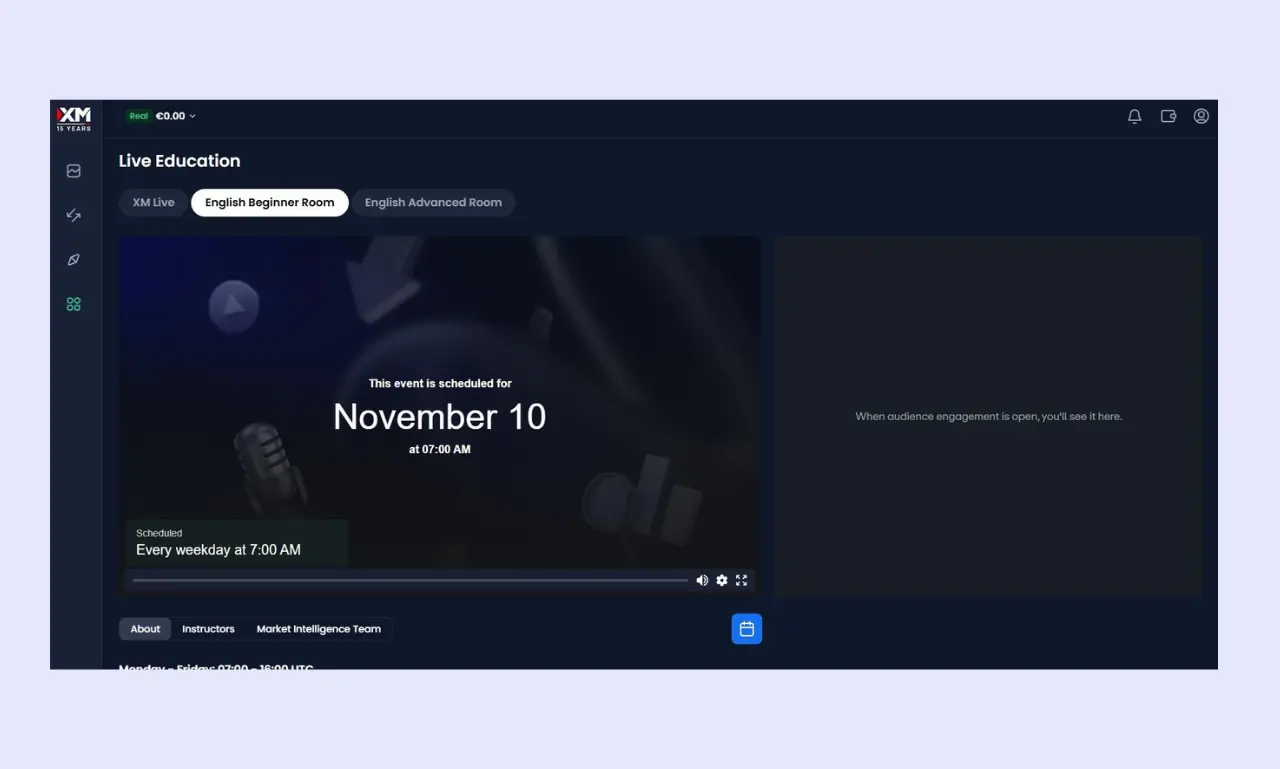
XM offers a range of educational and research tools to help users develop their analytical skills and trading experience. These resources include entirely free video content, live shows, and webinars hosted by expert instructors across 23 languages.
Live Education
XM hosts live education sessions Monday through Friday, from 7:00 am UTC. The sessions are divided into three categories: XM Live (Q&A and live interviews with industry professionals), Beginner Room (key features and the principles of analysis in trading), and Advanced Room (live trading experience and refining skills).
Tradepedia Video Lessons
XM's in-depth video course is ideal if you can't log in at a specific time each day for live sessions. XM's in-depth video course comprises 46 lessons that cover the fundamentals of financial markets, trading essentials, technical analysis, strategies to enhance win rates, and more.
My XM.com trading review found that Tradepedia educational videos range from approximately 4 to around 25 minutes. However, most videos are under 10 minutes, making them easily digestible and much more approachable than the long, multi-hour guides that are common on YouTube.
Economic Calander

Users benefit from an Economic Calendar tool that can be accessed directly within their trading accounts. It shows past, current, and future events that could have a significant impact on financial markets. It showcases the importance of each event, expected volatility, and actual volatility, enabling better decision-making and understanding.
Analysis Center
The XM analysis tool provides AI-generated summaries of key events, technical analysis, and market movements in a newsfeed-style format to enhance decision-making and keep users better informed about what's happening. For example, a report on the US-China trade deal or an analysis of the GBP/USD forex pair.
Tradable Instruments and Product Range

The instruments a broker offers directly impact the availability of trading opportunities. You should prioritize platforms that offer a large selection of instruments across multiple categories and markets, as there will be potential trades even if a particular market or sector lacks viable options.
XM is a highly versatile Contracts-for-Difference (CFD) broker offering a variety of instruments across multiple asset classes, ensuring there's always a potential opportunity to be found. XM's tradable instruments include:
Stock CFDs
Stock CFDs are contracts that enable individuals to speculate on the prices of companies such as Apple, Amazon, and Google. XM users can trade 1,313 stock CFDs from countries including the USA, the UK, and Germany, with up to 1:20 leverage.
Turbo Stocks
Turbo Stocks are a selection of seven companies that XM users can trade with additional leverage compared to traditional stock CFDs, up to 1:200. These contracts expire daily, so all Turbo Stock positions are closed at the end of the trading day. Holders do not receive dividends or voting rights.
Forex
XM offers 55 forex instruments that users can trade with up to 1,000x leverage. They let users speculate on national currencies and economic performance. Available instruments include major pairs such as USD/JPY, minor pairs like GBP/JPY, and exotic pairs including EUR/ZAR.
Indicies
Indices are collections of companies used to represent a particular market or segment. For example, the S&P 500 tracks the performance of the 500 largest publicly traded companies in the United States.
XM provides two categories of indices:
- Equity Indices: XM offers 34 tradable equity indices. They represent specific markets, regions, or sectors. For example, the Nikkei 225 tracks the top Japanese companies.
- Thematic Indicies: There are six thematic indices available on XM. They track specific themes or trends. For example, the Crypto 10 tracks the performance of the 10 largest cryptocurrencies by market capitalization.
Commodities
Commodities are physical goods or raw materials commonly used in manufacturing and day-to-day life, such as oil, wheat, or iron. XM offers three types of commodities: eight standard commodities (Cocoa, Coffee, etc), three precious metals (gold, silver, and a gold/Euro pair), and three energies (oil, crude oil, and natural gas).
Cryptocurrencies
Cryptocurrencies are digital assets that exist on the blockchain. Examples include Bitcoin or Ethereum. Users can trade 58 cryptocurrencies on XM, which are primarily denominated in US dollars. Some of the pairs XM offers include BTC/USD, XRP/USD, and LTC/USD.
Crypto CFD trading is only available in select jurisdictions at specific XM entities.
Deposits, Withdrawals, and Execution Speed
In trading, timing is everything. Prices can fluctuate rapidly, and any changes can have a significant impact on profits when using high leverage.
XM adheres to a specific execution policy, with a clear focus on speed and transparency. It offers transparent policies, live quotes with real-time execution, a 100% order execution rate, and no requotes. Moreover, 99.4% of all trades placed on XM have been executed in under one second.
Funding Methods
A global broker needs to provide a variety of funding options. Doing so ensures that users have a suitable deposit method for their local currency, that is convenient, common, and cost-effective. Without viable deposit methods, you can expect higher fees, slower processing times, and possibly being unable to fund your account.
XM offers three primary deposit methods: bank transfers, credit/debit cards, and e-wallets (Skrill, Neteller, and others, depending on the country). XM also supports local payment solutions, such as MayaWallet, MoMo, DuitNow, and Viet QR, depending on the user's country of residence.
Deposits are lightning fast on XM. Although bank transfers can take two to five working days to be credited, credit/debit cards and Skrill are processed immediately, making them ideal for time-sensitive deposits. The minimum deposit is $5 for all XM payment methods.
It's important to note that while XM accepts funds in any currency, all deposits will be automatically converted to your account's base currency. As a result, deposits can be subject to either XM or the payment processor's exchange rates.
Withdrawal Speed and Policy
The XM withdrawal process is straightforward, efficient, and generally well-thought-out. XM offers instant withdrawals, processing requests within 24 hours, and automatically approving the vast majority of them. Users report fast, efficient withdrawals, which contribute to an excellent user experience.
XM will process all withdrawals. It doesn't reject withdrawals for arbitrary reasons. However, withdrawals must be made in your name and follow the closed-loop rule, meaning they're sent back to the original funding method. For example, if you deposit via credit card, you must withdraw to the same card.
While testing for this XM broker review, I found that, unlike most brokers, which can charge substantial fees, XM covers all costs associated with withdrawals, lessening the burden on clients and significantly contributing to XM's phenomenal user experience.
Customer Support and Ease of Use

A robust customer support system is an essential aspect that contributes to a positive user experience. Fast responses and a knowledgeable customer service team are crucial. XM's customer support team is efficient, available across multiple channels, and available 24/7. Moreover, they're trained in-house, giving them deep platform knowledge.
Support Channels
XM is a global broker, so it must cater to users worldwide. A significant aspect of this is providing customer support in users' native languages. Our XM.com trading review found that support is available in over 30 languages, which is critical to ensuring that international clients receive competent support.
Having access to multiple support channels helps ensure you get prompt support that's proportionate to your issue or question. There are four ways for people to contact the XM customer support team:
Live Chat
If you need assistance quickly, the 24/7 live chat tool is available to help. It consists of a chatbot that can provide highly detailed responses and information about XM, far superior to most live chat systems we've looked at. You can also reach out to a human support agent.
I reached out to the XM support team and was connected to an advisor within a few seconds. They read through my chat history and provided a knowledgeable response, resulting in a great overall support experience.
Phone
If you prefer to speak to someone directly instead of sending digital messages, XM operates a phone support line weekdays, between 8 am and 10 pm. The team answers quickly and provides an excellent level of support.
For general questions or non-time-sensitive issues, you can contact the XM customer support team via email. There are no set hours of availability, but the team responds as soon as possible.
Help Center
You don't always have to contact the support team to resolve your issue. If you just need a question answered, require some basic troubleshooting tips, or need to understand how a particular feature works, the XM help center contains all the answers you need.
It's relatively comprehensive, covering topics like account creation, the trading platform, and common technical issues or errors. It doesn't cover everything, but the vast majority of common questions are answered, making it an invaluable tool for self-support.
Final Verdict
XM is a leading broker for trading forex pairs and CFDs across multiple markets, including stocks, commodities, and cryptocurrencies. It has more than enough instruments for traders of all levels to capitalize on. Moreover, it takes a user-first approach, providing educational resources and waiving withdrawal fees.
With multiple account types, regulated entities in various global jurisdictions, and a range of funding options and trading methods, XM is one of the most robust and versatile brokers available. It's an excellent option for professionals, day traders, and first-time CFD traders, thanks to its powerful features and low minimum deposit requirements.
Even though they can't be compared to top crypto exchanges like MEXC, Binance, Bybit or Kraken or even some of the best crypto wallets, Xm.com safely stores cryptocurrencies for traders, accepting over 50 different crypto.
FAQs
Does XM offer an ECN/Zero spread account?
Some people prefer to trade with predictable commission fees instead of variable spreads, which can be challenging to track, particularly when trading multiple instruments. XM offers spread fees from zero pips via its ‘Zero’ account. The commission is fixed at $7 per $100,000, so fees are straightforward.
Which regulatory body protects my account?
XM is divided into multiple entities, each serving a particular region and offering different features, instruments, and limits. CySEC regulates the European segment, and the DFSA handles the MENA region. The FSA, FSC, and the FSCA
How long do XM withdrawals take?
To ensure users have access to their funds as needed, XM has established a rapid withdrawal system, processing withdrawal requests within 24 hours on business days. Withdrawals to Skrill are often faster. However, the time it takes to receive funds after the withdrawal is processed can vary by payment method or region.
What is the maximum leverage offered by XM?
The maximum leverage traders can attain on XM is 1000x or 1:1000. However, the limit differs based on the asset class you are trading and the entity regulating XM in your region. For example, forex is 1:1000, while cryptocurrencies are 1:500, and commodities are 1:200.


