- BitMart Review: Pros and Cons
- BitMart Background and Reputation
- How to Sign Up for BitMart: Step-by-Step
- Initial Setup & User Experience
- BitMart Key Features & Services
- Other BitMart Products and Services
- BitMart vs Other Crypto Exchanges
- Who is BitMart Best Suited For?
- Conclusion & Final Verdict
- FAQs (Frequently Asked Questions)
BitMart Review 2026

- When you click links on this page, we may earn an affiliate commission. By using this website you agree to our terms and conditions and privacy policy.
- Participation in online gambling may be illegal in your country and is subject to age restrictions (18, 19, or 21, depending on the jurisdiction). Verify legality and age requirements before participating. Learn more
This BitMart Review covers firsthand experiences using this platform. BitMart is an established, unregulated cryptocurrency exchange serving customers globally. It's highly versatile, boasting low fees, diverse trading tools, and multiple methods for buying or selling crypto. They also offer tokenized stocks (xStocks) on its DEX platform.
Unfortunately, it lacks simple conversion tools, which could cause beginners to become overwhelmed, so it's best for experienced traders seeking an all-in-one exchange. Throughout this BitMart review, we thoroughly test the exchange and discuss its features, user suitability, security measures, and trading fees. We also explain how users can create and verify an account, while comparing BitMart to a range of other popular trading platforms.
BitMart Review: Pros and Cons
Pros
- Competitive trading fees
- Provides a DEX and CEX
- KYC is not a strict requirement
- Solid selection of large and small assets
- All-in-one crypto platform
- Fiat on/off ramps
- Multiple way trade (spot, margin, futures, P2P)
Cons
- Unregulated exchange
- The FCA warned against BitMart
- No insurance or investor protection
BitMart Background and Reputation

Company Overview
BitMart is a Centralized Crypto Exchange (CEX) founded in 2017 by Sheldon Xia to provide a secure, fast, professional-grade crypto exchange. It quickly gathered traction, becoming moderately popular and growing to serve around 12 million users in 2025.
BitMart is based in the Cayman Islands but has offices worldwide, highlighting its use as an international crypto trading platform.
Regulation & Licensing
BitMart's regulatory status and licenses are somewhat clouded. The exchange holds a Hong Kong TCSP license but has given up its Virtual Asset Service Provider (VASP) registration efforts in the region. Unlike many other exchanges, BitMart doesn't offer a page showing its licenses transparently.
The exchange was registered as a Money Services Business (MSB) with the USA's FinCEN in 2018, but I could not find current records on the FinCEN website. Moreover, the UK's Financial Conduct Authority (FCA) has warned against BitMart because it offered financial services without authorization.
Trust & History
BitMart has enjoyed a relatively positive history over recent years, but has suffered from some controversies.
In December 2021, attackers successfully used stolen private keys to steal roughly $150 to $200 million from BitMart's hot wallets. In response, the exchange was forced to temporarily suspend customer withdrawals. Within a few days, BitMart re-enabled withdrawals and fully reimbursed users.
In June 2021, bad actors tricked BitMart into crediting them with 91,000 Bitcoin Satoshi Version (BSV) tokens, worth over $6 million. The attack was relatively minor compared to BitMart's holdings, so users weren't at risk. In 2022, BitMart won an arbitration, with the attackers having to pay roughly $5.25 million.
BitMart was also at the center of an unconfirmed data breach in July 2025. Hackers on a criminal forum were allegedly selling a BitMart exploit, and a few days later, security researchers found the exchange's supposed database containing 1.2 million user records for sale online. BitMart hasn't confirmed the incident.
Users seeking a highly transparent crypto investment platform may prefer an alternative to BitMart. While it's forthcoming with its fees (although they have an odd structure), its proof of reserves system is lackluster, and the lack of response to the database breach situation indicates an opaqueness in its customer communications.
User Reviews

Looking at the experiences of BitMart's users can help prospective customers understand whether the platform is right for them. Generally, positive BitMart reviews highlight the aspects users are most happy with, while negative examples underscore the platform's most significant issues.
BitMart commands a roughly average score of 3.1/5 based on nearly 3,000 reviews. In contrast to some exchanges I've looked at, like WEEX, which have poor response consistency, BitMart replies to 99% of negative reviews within 24 hours, helping people receive prompt assistance where needed.
Recent BitMart reviews are overwhelmingly negative. Users complain of issues receiving sign-up bonuses, difficulties swapping tokens efficiently, platform outages, frozen accounts, and problems recovering crypto not withdrawn before BitMart delisted it. The few positive reviews were almost entirely from users BitMart had invited to review it.
Users on Reddit share discontent with BitMart. While there are no complaints about basic actions like buying Bitcoin, users have faced issues surrounding withdrawals being blocked until they complete level 2 KYC, and the exchange listing fraudulent or scam tokens.
The sentiment around BitMart is primarily negative. While users agree it's a genuine exchange, they're unhappy with its moderation practices and communication. This is evidenced by the exchange's lack of response to the potential data breach and its operating in regions where it's not authorized.
How to Sign Up for BitMart: Step-by-Step
Learning how to use BitMart doesn't have to be challenging. Follow the steps below to create an account, verify it, and deposit.
Step 1: Create a BitMart Account

The BitMart sign-up process only takes a couple of minutes. Head to the exchange's homepage, and click the turquoise 'Get Started' button in the upper right. You must enter an email address and password, or register via Google, Apple, or Telegram.
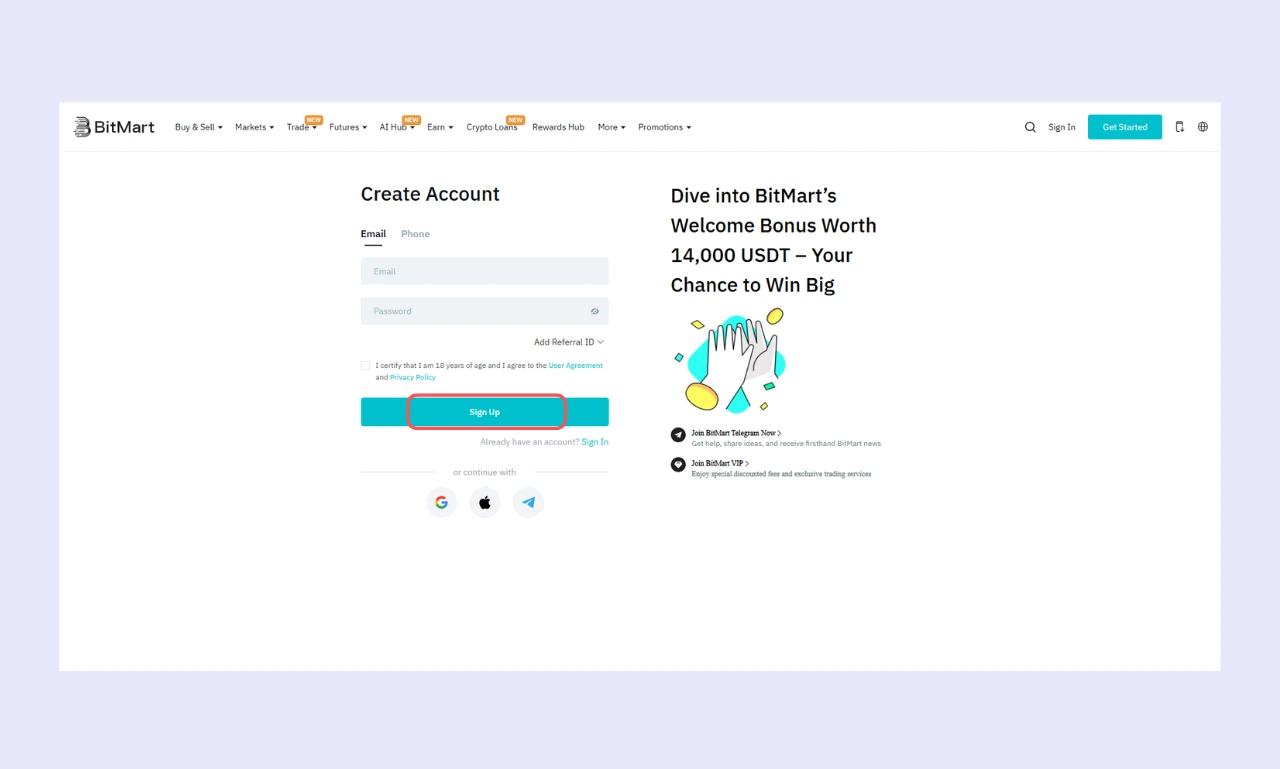
Afterward, you must enter a six-digit code sent to your email. It will be from “do_not_reply@emx.BitMart.com”. Technically, you can deposit crypto and start trading now. However, completing verification to access staking and credit/debit card purchases can be beneficial.
Step 2: Verify Your BitMart Account

If you've chosen to verify your BitMart account, hover on your profile icon in the top corner, then click 'Verification', followed by 'Verify Now'. The process takes place on mobile. I had to increase the QR code size, which BitMart prompts users to scan before my phone could pick it up.
The actual verification process is quick and straightforward. You must scan a photo ID (passport, driving license, national ID card) and then take a selfie to verify your identity. BitMart usually takes a few minutes to process your documents, but wait times can climb to 24 hours. UK IDs are unsupported.
Step 3: Deposit Funds and Start Trading

After your account is verified, you'll have complete access to BitMart. Under 'Assets', click 'Overview', then the turquoise 'Deposit' button. Choose an asset, ensure the correct network is selected, then send a transfer to the provided address. Wait times vary by asset, and BitMart doesn't show an estimate.
Alternatively, if you don't own crypto, access the 'Credit/Debit Card' tool under the 'Buy & Sell' tab. Choose a payment currency, decide on an asset, choose how much to invest, link a card, and click 'Buy USDT'. The assets will arrive in your wallet promptly.
Initial Setup & User Experience
A straightforward user experience means that beginners can get started faster, and established traders can go about their business more easily. Here's how BitMart performed:
Ease of Use
BitMart is relatively straightforward. The exchange is similar to other platforms, like Binance or OKX. As such, it will suit users with some trading experience. However, there's no easy conversion tool or fiat deposit function, so beginners must interact with the Peer-to-Peer marketplace or pay high fees to on-ramp.
Display & Buttons/Touchscreen
During my testing, I found BitMart's interface and color scheme particularly clear. Key sections are highlighted in turquoise, contrasting nicely with the white background. Features are where you'd expect them, and the menu bar is understandable, making navigation intuitive.
Regarding speed and efficiency, the spot trading interface took a few seconds to load, slowing down user actions. Moreover, the futures interface opens in a new tab, which could cause some confusion. Once loaded, features operate consistently, but responsiveness could be improved.
Mobile App Review

The BitMart mobile app is available on iOS and Android devices. However, due to recent changes, certain countries' app stores, such as the UK, do not support/list the app. This could limit use for iPhone users, but BitMart offers a global APK for people with Android.
The BitMart app's user experience is stellar for the most part. Key features can be accessed easily via a bottom navigation bar, while additional settings are available on a hamburger menu in the top corner. My only issue was a promotional pop-up with no close button.
The BitMart app offers almost every feature of the web platform. Users can trade futures, set up grid bots, or apply for crypto loans. However, the Peer-to-Peer marketplace is missing, so decentralization enthusiasts will need a computer.
BitMart app reviews are mixed. Based on 52,500 reviews, the exchange holds a 3.5/5 rating on the Google Play Store but scored 2.8/5 on the App Store. Some users report that the exchange works perfectly, while others complain that tokens are delisted without ample warning.
BitMart Key Features & Services
The top cryptocurrency platforms provide vital functions, like enabling trading, providing analysis tools, and securely storing user assets. Here are the findings from our BitMart review:
Buying & Selling Crypto
The Chainalysis crypto adoption index indicates that over $4 billion was swapped for cryptocurrency on centralized exchanges from June 2024 to June 2025. As such, there's a significant demand for fiat on-ramps on exchanges.
There are 1,358 BitMart-supported coins available, ensuring that traders can find opportunities regardless of their preferred assets. There are three on-ramps for buying Ethereum and other cryptos with fiat on BitMart:
- P2P Marketplace: The Peer-to-Peer (P2P) platform lets users buy Ethereum and six other assets directly from other users, without relying on a central intermediary. It supports more BitMart deposit methods than other options, including local providers like PIX, bKash, and Paysera. There are no fees, but users set asset prices.
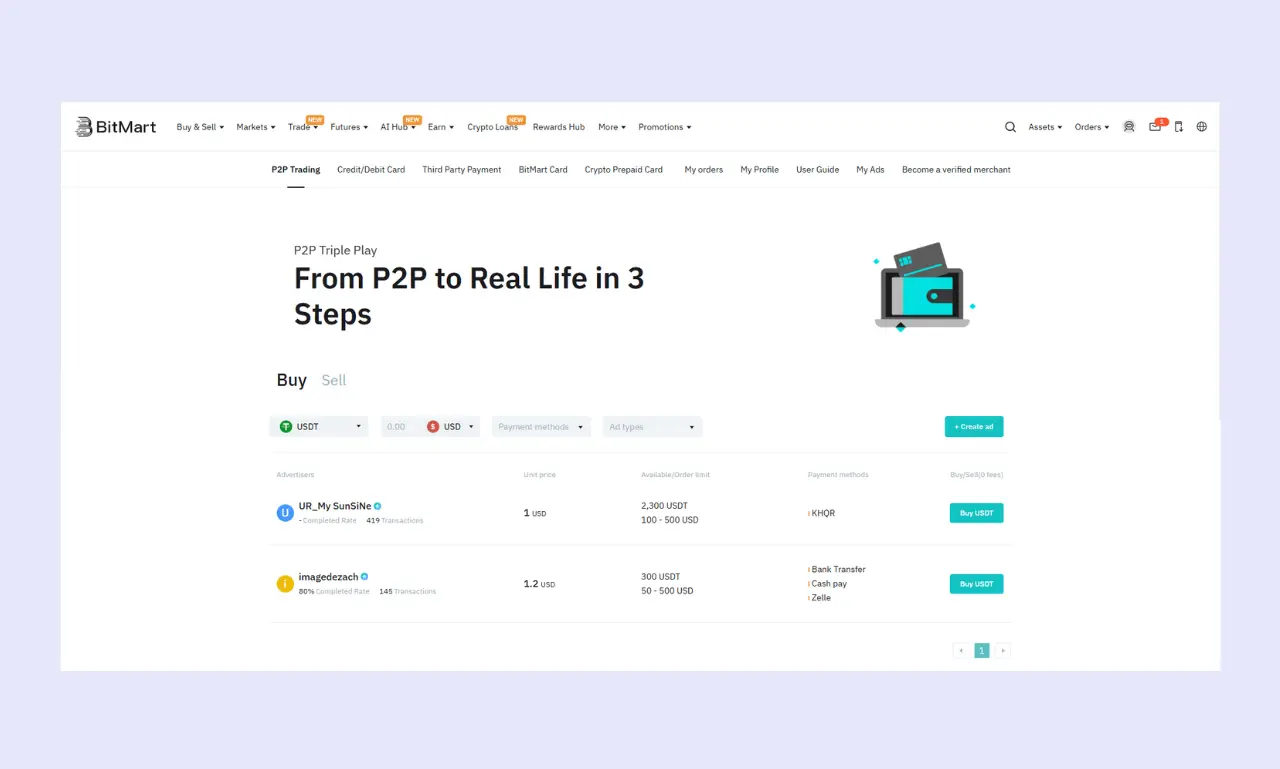
- Credit/Debit Card: Users who value convenience can use BitMart's credit/debit card purchase tool to almost instantly buy crypto. Visa and MasterCard are supported, and users can purchase up to $9,403, making it a strong choice for mid-sized purchases where speed is essential.

- Third-Party: The best crypto exchanges will provide an alternative on-ramp via third parties like Simplex, as they support many countries and payment currencies. Over 300 payment methods are available on BitMart, and limits are high (up to $573,390), but there is a 3.91% price premium.
BitMart is not the best crypto exchange for beginners. It has many advanced and unique features, making getting to grips with the platform challenging. However, its various buy/sell tools ensure that even novices can purchase crypto with relative ease.
Trading Platform
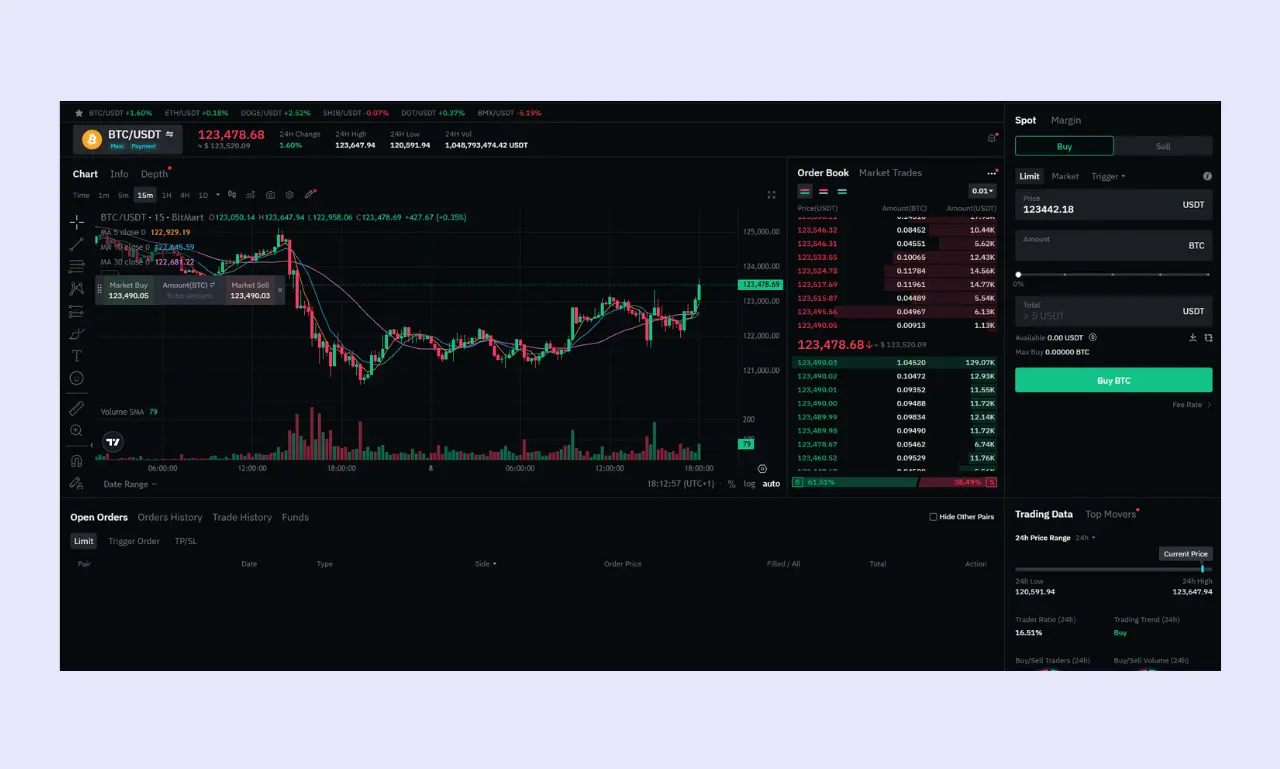
While it offers some other features, trading is BitMart's core offering. The exchange has built a streamlined trading interface that will feel familiar to those with crypto experience. There is no conversion tool for beginners, so everyone must interact with the order book.
The trading interface is similar on mobile and desktop. Users can access multiple trading methods (P2P, spot, futures, bots) and a robust charting system, so BitMart can be tailored to various strategies. Unfortunately, its lack of crypto trading order types impacts its performance for advanced users. Only five are available:
| Order Type | How It Works |
|---|---|
| Limit | Order executes at a specific, user-defined price |
| Market | Order executes at the best current price |
| Trigger | Enters a limit or market trade into the order book once a certain price is hit |
| Take Profit / Stop Loss | Partially closes a position at a set price to secure profits or minimize losses |
| Advanced Limit (Post Only) | Orders only execute as makers, so users pay lower fees |
| Advanced Limit (Immediate or Cancel) | Executes immediately, canceling any unfilled portion |
BitMart has integrated TradingView, granting it a powerful but familiar trading interface. Users can access a treasure trove of technical indicators and charting tools, enabling in-depth analysis. Moreover, BitMart provides live data on the ratio of buyers to sellers across all of its supported coins, but multi-screen charting is unavailable.
While it handles significant spot volume ($3.5 billion daily), derivatives are BitMart's primary segment. The exchange supports futures trading with up to 200x leverage. People can also use margin to enhance their positions by up to 5x, providing significant opportunities from small movements, ideal for day traders.
BitMart is a relatively large crypto exchange. As mentioned, it regularly handles several billion dollars in daily volume. It's roughly on par with OKX's $3.4 billion. BitMart has a strong CoinMarketCap liquidity score of 719, comparable to Bybit at 713, so users can make large trades without price impact.
Supported Wallets & Custody
There are two main types of crypto wallets. It is essential to understand the differences and how they could benefit or disadvantage you, depending on your preferences.
Custodial wallets are the most commonly offered by advanced crypto trading platforms. The issuer (e.g., BitMart) controls these wallets' private keys and recovery codes. Users can access or recover their wallet by logging into the platform.
| Custodial Wallet Benefits | Custodial Wallet Drawbacks |
|---|---|
| Easier setup process | Less secure for experienced users who understand seed phrase storage |
| No risk of losing or exposing your recovery code or private key (the most common way crypto is lost) | Requires more personal details, sacrificing privacy |
| Significantly more beginner-friendly | Not your keys, not your coins (doesn't provide actual asset ownership) |
| Often integrated directly within exchanges or crypto platforms | The issuer can manage or control the wallet |
On the other hand, non-custodial wallets, like MetaMask, give the user complete control over the private keys and seed phrase. As a result, users have complete ownership over the assets, and no third party can access or control the wallet. However, it increases the risk of compromise via exposed seed phrases.
| Non-Custodial Wallet Benefits | Non-Custodial Wallet Drawbacks |
|---|---|
| Superior security for knowledgeable users | Can be less secure if users are unfamiliar with proper seed phrase storage methods |
| Less personal information is required during the wallet creation process | No way to recover crypto if the seed phrase is lost |
| Users have greater control over their assets | More time-consuming setup process |
| Cannot be managed, accessed, or controlled by third parties | In-built exchange services tend to be costly and inefficient |
BitMart provides users with a custodial wallet. It supports all the assets available on the exchange, but no additional assets. My BitMart crypto wallet review found that users can access three wallets: spot, futures, and copy trading, to help manage their funds.
While users cannot link a hardware wallet to their BitMart accounts or use a specialized security key to add a layer of protection, the exchange's wallets are suitable for general, short-term asset storage.
Earning & Lending

Features for earning interest on crypto, such as staking and other similar mechanisms, are among the most popular aspects of a crypto exchange. They let people boost their portfolios with minimal effort. BitMart offers multiple products for this purpose:
- Savings: The most straightforward tool is BitMart Savings. It lets people earn up to 15% APY on flexible terms and 8.25%% APY on fixed terms between 7 and 180 days. BitMart also runs promotions where people can earn higher APYs (up to 200%) for using smaller or new altcoins.
- Staking: BitMart's crypto staking system is ideal if you want to contribute to network security while earning rewards. In total, 47 cryptos can be staked for up to 10.25% APY. Most assets are flexible, but some offer fixed terms of between 3 and 30 days.
- Wealth Management: If you have significant holdings, then wealth management might be the right tool for you. It has high limits (up to 1,000 BTC) and provides a fixed yield for 14 days. The asset management team controls these products, theoretically providing safer returns.
- VIP Exclusive Earn: BitMart also offers a special earning program for its VIP clients. The APYs are higher than those of other programs for the same level of flexibility. The highest rate is 11% (SOL), while USDC is the highest-yield stablecoin at 9.25%.
While there's no auto-earn feature to earn rewards on non-delegated holdings, like Kraken offers, BitMart has created a crypto loans system. Users can receive a loan using their digital assets as collateral, enabling temporary cashouts without triggering a taxable event. BitMart's interest rates are competitive; BTC is just 0.20%.
BitMart's loan terms are flexible. There's no specific repayment date, and Loan-To-Value (LTV) ratios start at 65%, significantly higher than Nexo (BTC has a 50% LTV ratio). It also has clearly defined limits: 80% LTV results in a margin call, while 90% is liquidation. BitMart's loan system is excellent for novices.
Some exchanges focus on passive income, introducing features like Bitcoin mining pools or lending systems. BitMart has omitted these aspects, but has included tools like crypto bots and copy trading, which can provide additional, mostly passive revenue streams.
Security Measures

Most traders agree that having a secure crypto exchange is equally important as having a diverse selection of features. BitMart has experienced a few significant hacks, so robust security is necessary.
BitMart's protective measures are relatively strong. It supports Two-Factor Authentication (2FA) via email, SMS, or a dedicated authentication app, such as 2FAS. We recommend using a dedicated authenticator app, as it will keep your account safe if your email or phone number is compromised. However, there's no security key support.
Unfortunately, BitMart has not created a page discussing security measures, as is common on other platforms. As such, it's difficult to understand how it protects users and their assets. Some sources state that BitMart holds most of its assets in cold storage (as is typical), but I couldn't find confirmation.
BitMart operates without approval, so it's not protected by polices like the Financial Services Compensation Scheme (FSCS), which gives users recourse if something goes wrong. The exchange also lacks a criminal insurance policy for hack protection, and I could find no evidence that it operates a liquidation fund to protect futures traders.
While most top cryptocurrency platforms are audited to enhance security, find vulnerabilities, and better protect customers, BitMart isn't regularly reviewed by third-party firms such as CertiK or SolidProof. While not a strict requirement for an exchange, a lack of audits can leave customers more vulnerable than otherwise.
My BitMart review found that it lets users set up anti-phishing codes to be displayed on genuine communications. This helps to prevent phishing attacks, the most common type of internet scam, according to IC3. However, there's no withdrawal address whitelist to prevent bad actors from withdrawing funds if they compromise accounts.
Some platforms don't back assets 1:1, meaning they cannot cover mass withdrawals and could face serious consequences from a market downturn. As such, it's typical for trustworthy platforms to release proof of reserves. BitMart is currently working on a verifiable system and has revealed its BTC, ETH, and BSC wallets.
BitMart's security measures are reasonable for users to protect their accounts. However, it's not forthcoming with its platform-level measures and has suffered a couple of considerable breaches. As such, while BitMart should be safe, it's best to withdraw long-term investments to a secure external crypto wallet, such as a Trezor.
Payment Methods & Fees
If you want to deposit crypto to buy Solana or trade any of BitMart's hundreds of assets, you must be aware of the costs. Thankfully, there are no fees for depositing crypto. However, withdrawals incur a charge that varies by asset. We've included examples of BitMart's fees for withdrawals below:
| Asset Name | Withdrawal Fee |
|---|---|
| Bitcoin (BTC) | 0.0001 ($11.86) |
| Ethereum (ETH) | 0.0007 ETH ($3.06) |
| Tether (USDT) via Ethereum | 3 USDT |
| Solana (SOL) | 0.005 SOL ($1.13) |
| Cardano (ADA) | 0.8 ADA ($0.68) |
BitMart has no option to deposit or withdraw fiat directly. However, users can buy Cardano and hundreds of other assets with fiat via the P2P and credit/debit card purchase tools. P2P trading is free, but there's roughly a 5.26% premium on credit/debit card purchases.
Unfortunately, BitMart has a complicated fee structure, which could cause trouble for beginners. The exchange divides assets into four tiers, each with different rates, which we highlight below. A 25% discount for paying fees with BitMart's $BMX token and a range of volume-based discounts are available.
| Trading Fee Type | Trading Fee Amount |
|---|---|
| Class-A | 0.1% |
| Class-B | 0.25% |
| Class-C | 0.40% |
| Class-D | 0.60% |
| Futures | 0.02% (maker) / 0.06% (taker) |
It can be easy to miss that BitMart charges different rates for buying and selling crypto via third parties. I checked BitMart's fee structure and determined that a 10.63% spread (sell price: $110,161.37, buy price: $121,880.66) applies, rendering the service unusable for most trades.
Specific minimum BitMart withdrawal limits are in place to prevent users from sending excessively small or large transactions. Some exchanges, like WEEX, have low deposit minimums but high withdrawal requirements to keep funds on the platform. BitMart's rates are as follows:
| Asset Name | Minimum Deposit | Minimum Withdrawal |
|---|---|---|
| Bitcoin | 0.00000001 BTC ($0.0012) | 0.0003 ($35.59) |
| Ethereum | 0.00000001 ETH ($0.000044) | 0.00342246 ETH ($15) |
| Tether | 0.001 USDT | 14.99 USDT |
| Solana | 0.00099 SOL ($0.22) | 0.111 SOL ($24.79) |
| Cardano | 0.00000001 ADA ($0.0000000085) | 2.8 ADA ($2.39) |
It's time to have BitMart's cryptocurrency fees explained. While its minimum withdrawals are significantly higher than its deposit requirements, they're not extreme or prohibitive. Its trading fees for Class-A assets are competitive and become substantially lower than average when paying with $BMX. Yet, Class-D assets are expensive.
Customer Support

Is BitMart legit? Reviewing an exchange's customer support system can reveal much about its trustworthiness and commitment to users. Ideally, you should have access to a help center covering common topics, a chatbot to assist users in finding relevant information, and a human support team for handling complex issues.
BitMart features a help center that covers updates, basic information, and common questions about the platform's core features. Users can speak with a chatbot to receive AI-generated answers or be directed to helpful articles. For this BitMart review, I tested the service, and it answered my support availability question correctly.
I contacted the BitMart customer support team and received a response in seconds. They answered my questions, responded quickly, and provided helpful information. The team is available 24/7, ensuring prompt assistance. The only issue is that the system requests your BitMart ID number, but doesn't explain where it's found.
Geographical Availability
BitMart is a global exchange for people to buy Shiba Inu and hundreds of other assets. However, there are a few geographical restrictions to be aware of before signing up. Users from the following regions are prohibited from using BitMart:
- New York
- The Netherlands
- The Balkins
- Mainland China
- And a handful of other sanctioned or developing countries
During my BitMart review, I used a VPN to simulate access from various countries and found that the platform's features are not geo-restricted. For example, UK users can access futures trading, which is banned in the country. However, it mostly complies with Know-Your-Customer (KYC) rules and may respond to government requests.
Other BitMart Products and Services
BitMart is a powerful crypto trading platform. It offers many features beyond the standard. For example, it provides API access, enabling the seamless import of transactions for crypto tax software like Blockpit. Some of the exchange's more in-depth features include:
Copy Trading

The BitMart copy trading platform is among the exchange's most valuable tools. It lets people mirror the positions of experienced traders (dubbed 'Masters' on BitMart). Users can browse 'Masters' to find traders they like. BitMart shows 24-hour profits, assets under management, and one-month performance.
Copy trading is also beneficial for established traders. Masters set the profit-sharing amount and receive some of their followers' profits. This provides additional revenue with minimal effort and incentivises traders to perform at their best. A leaderboard gamifies the experience and fosters stronger competition.
BitMart offers 'Copy Trading Classic' and 'Copy Trading 2.0'. Both provide similar data points and trade the futures markets. The main differences are that the classic platform is more active, while 2.0 provides some AI insights that break down performance.
BitMart DEX

Some people prefer to trade without relying on central intermediaries. If this sounds like you, then BitMart's Decentralized Exchange (DEX) could be ideal. It lets users trade smaller assets unavailable on the standard CEX, a significant benefit for altcoin traders.
BitMart's DEX is more powerful than the average. It supports a large selection of assets and offers a copy trading system dubbed 'Smart Money,' which expands its use case. It can only be funded with Solana and is accessible directly on BitMart, under the 'Trade' tab.
BitMart also offer tokenized stocks and ETFs (xStocks), giving users the ability to trade stocks on-chain.
BitMart Card

Users can take advantage of the BitMart Card to spend their crypto in everyday establishments as if it were cash. Visa issues the card, which has a $100,000 monthly limit and free ATM withdrawals up to $200.
The most significant benefit of the BitMart card is the ability to earn up to 1.2% cashback on spending, which is much higher than most traditional bank cards. The BitMart card is available as a free virtual card, a $30 plastic version, or a $120 metal edition.
BitMart vs Other Crypto Exchanges
Here is how BitMart stacks against other top crypto exchanges in the market
| Crypto Exchange | Top Choice For | Price | Products and Offerings | Standout Features |
|---|---|---|---|---|
| BitMart | Trading without KYC | 0.1% / 0.1% | Spot/margin/futures, DEX, loans, staking, fiat on-ramp, crypto card, copy trading, tokenized stocks | Users can deposit and trade without KYC and utilize the DEX and P2P marketplace |
| Coinbase | New traders or investors | 0.60% / 1.20% | Derivatives, TradingView, staking, fiat on-ramp, simple interface | Toggle for swapping between standard and advanced platforms |
| Youhodler | Cashback crypto debit cards | 0.02% hourly rollover fee | Crypto loans, 70x leverage, Web3 wallet, spot exchange, cloud mining | Crypto card with up to 2% cashback |
| OKX | Low-fee crypto exchange | 0.08% / 0.1% | Trading bots, staking, structured earn, futures trading, high leverage, P2P, crypto options | Multiple ways to buy and trade crypto with low fees |
| Bybit | Staking and structured earn products | 0.1% / 0.1% | P2P, fiat on-ramp, convert tool, loans, crypto card, futures, OTC desk, tokenized stocks | Advanced staking/earn products and a large selection of assets |
Who is BitMart Best Suited For?
After testing the platform for this BitMart crypto exchange review, I found it well-rounded and a valid choice for many use cases. It offers a reasonable selection of assets, expanded by the DEX, which makes BitMart an excellent option for traders, regardless of whether they trade mainstream assets or little-known altcoins.
It has low minimum deposit/withdrawal limits, making it accessible to those without significant capital. BitMart covers the major aspects of an exchange well, making it a strong choice for people seeking an all-in-one platform. However, its lack of regulation and history of hacks mean it's not great for security-conscious users.
Conclusion & Final Verdict
If you're looking for a comprehensive crypto exchange without strict KYC requirements, BitMart could be perfect. Users can deposit crypto without completing verification, then verify to access additional tools.
While it's not tailored to beginners like Coinbase or geared toward a particular service, BitMart is a versatile trading platform. It supports spot, margin, futures, copy, and demo trading, covering all experience levels. Although it has faced security difficulties, BitMart remains a well-rounded, unregulated crypto exchange.
FAQs (Frequently Asked Questions)
How does BitMart make money?
BitMart generates most of its revenue by charging fees for opening and closing positions. Spot and futures trades both incur these charges. Other services, like the BitMart loans service and fiat on-ramp, can also generate fees. However, BitMart charges no commission for using the P2P marketplace or staking crypto.
Can I earn passive income on BitMart?
BitMart offers multiple ways for people to earn passive rewards. Users can participate in the exchange’s staking or savings programs, which are the most straightforward and streamlined. More experienced users can set up trading bots or utilize the copy trading function to earn extra money outside their typical trades.
What are the tax implications of using BitMart?
Cryptocurrency profits are subject to tax, varying depending on the country, earnings amount, and income type. Failing to pay the correct amount can lead to fines or criminal proceedings. Contracting a tax professional ensures you pay the proper amount and take advantage of applicable deductions.
What is KYC/AML, and why is it required on BitMart?
Know-Your-Customer (KYC) and Anti-Money Laundering (AML) regulations are requirements that financial platforms like crypto exchanges must follow to operate legally. They involve gathering and providing information like customer identities and financial details to combat terror financing, money laundering, and criminal activity.


