
Key Takeaways
- Betting on criminal cases raises concerns about access to confidential information and influence over verdicts.
- Polymarket prohibits trading by people who can affect an event’s outcome.
- No evidence presented establishes that wagers influenced either proceeding.
Polymarket’s criminal case markets are putting its safeguards under scrutiny. How does the platform stop people inside a courtroom from betting on its decisions?
An Oct. 12 Wall Street Journal investigation reported more than $500,000 in additional wagers following Lindsay Clancy’s September mistrial.
While more than $300,000 was wagered on the case against Tyler Robinson, accused of killing conservative commentator Charlie Kirk.
Criminal Cases Become Tradable Markets
Polymarket’s Clancy market offers contracts tied to whether she will be convicted of murder by specified deadlines, while its Robinson market concerns a homicide conviction.
A contract tied to a conviction before a deadline does not simply measure whether traders believe a defendant is guilty.
Their positions can also reflect expectations about scheduling and whether proceedings will produce a qualifying judgment in time.
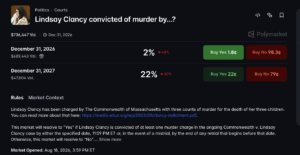
- Lindsay Clancy was charged with three counts of murder for the death of her three children. | Source: Polymarket
Polymarket users buy and sell outcome shares, with winning shares redeemable for $1 following resolution.
For ordinary participants, the opportunity is to interpret public evidence and court developments.
But for someone with privileged access, the potential advantage could be information unavailable to everyone else.
Polymarket Already Bans Trading by People Who Can Influence Outcomes
Polymarket’s published market-integrity policy prohibits trading on confidential information when doing so breaches an existing duty of trust or confidence.
A separate provision bars people whose influence could affect the underlying event from trading on it. Trading at their direction is also prohibited.
On that wording, a juror trading on a verdict they help decide would fall within the outcome-influence restriction.
The enforcement question is how the platform identifies those connections before a contract settles.
Polymarket says it monitors unusual trading, works with surveillance specialists, and can ban wallets.
However, its public integrity page does not explain a dedicated process for matching court-market participants against jurors, lawyers, or court staff.
Crypto Transparency Does Not Automatically Identify Court Insiders
The crypto connection is central to that challenge.
Polymarket’s documentation describes an infrastructure using Polygon and the dollar-pegged stablecoin USDC.
Blockchain records make transaction activity publicly visible.
Although that visibility can support investigations, identifying the person controlling a wallet — and establishing their access to a case— is a separate task.
Court Betting Adds to Existing Integrity Scrutiny
The issue joins a broader debate over confidential information in prediction markets.
It was previously reported that three Polymarket insider-trading investigations were disclosed through records obtained by WIRED.
They are concerned about contracts involving Biden pardons, Iran-related events, and Google search rankings.
Many other allegations of manipulation have also come to light, including weather-market manipulation, highlighting the risk that traders could interfere with the events underlying their bets.
But court-outcome markets raise a flurry of new questions.
Can participants profit from information they are required to keep confidential? And can someone with a financial position influence the decision itself?