

As the crypto market endures a sharp correction, digital asset trading companies (DATCOs) are facing mounting pressure on their balance sheets. During Bitcoin’s run to over $126,000 late last year, these companies were seen as a great way to receive extra exposure to the market.
Today, they are struggling. Bitcoin has fallen about 40% to roughly $75,000, and Ethereum is down to $2,280. The strategy of loading up on debt to buy crypto looked genius on the way up, but now it’s amplifying the losses. Institutional investors are bailing, NAV discounts are widening, and people are starting to question if this business model can actually survive a long bear market.
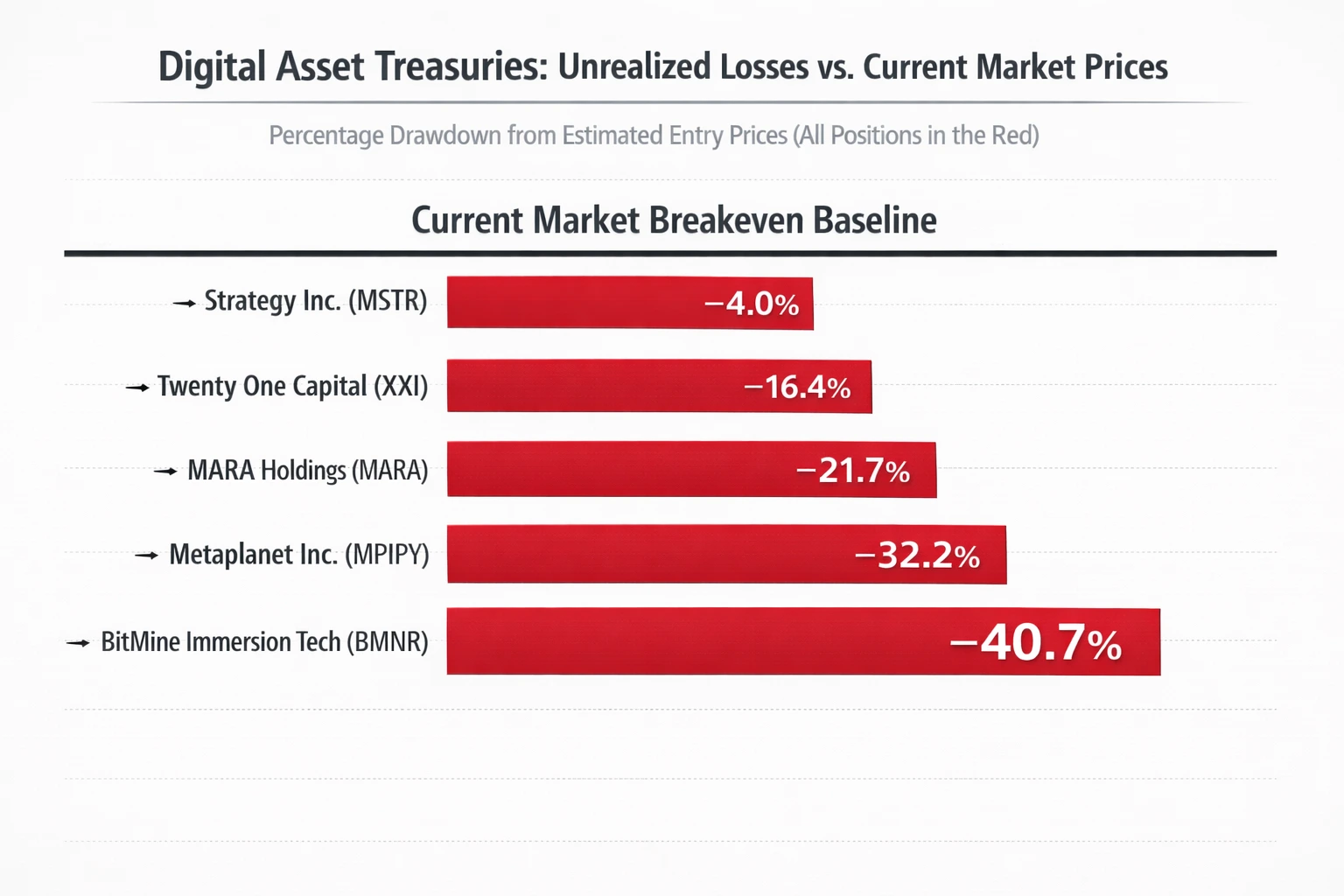
Digital Asset Treasuries – Performance Breakdown
The following data captures the current financial standing of leading firms during this February 2026 downturn. Each entry shows how the market price of a company relates to the actual value of its digital holdings.
| Company | Primary Holdings | NAV (Estimated) | mNAV | Approximate Value Paper Loss (%) |
|---|---|---|---|---|
| Strategy Inc. | BTC | $51.96 Billion | 1.13 | 1.4% |
| BitMine Immersion Tech | ETH | $9.08 Billion | 0.83 | 40% |
| MARA Holdings | BTC | $3.88 Billion | 0.77 | 21.4% |
| Twenty One Capital | BTC | $3.17 Billion | – | 14.1% |
| Metaplanet Inc. | BTC | $2.56 Billion | 1.19 | 10.2% |
| Bitcoin Standard Treasury Company | BTC | $2.3 Billion | 0.12 | 17.8% |
| Bullish | BTC / Diverse | $1.82 Billion | 2.46 | 17.4% |
*Note: NAV, mNAV, and the value paper loss are subject to change based on the market prices of the digital assets held by these DATCOs.
1. Strategy Inc. (MSTR)
Strategy Inc. remains the most prominent entity following the digital asset treasury model. The Bitcoin treasury firm holds 712,647 BTC, making it the largest corporate holder globally. Recent filings show an average acquisition cost of $76,037 per coin. With Bitcoin trading below the acquisition cost, its position has dipped into a paper loss for the first time in years.
- NAV: $51.96 Billion
- mNAV: 1.06
- Current value loss from initial investment: -1.3%
2. BitMine Immersion Technologies (BMNR)
BitMine Immersion Technologies focuses heavily on Ethereum and staking activities. It holds over 4.28 million ETH. The drop in Ethereum prices toward $2,300 has impacted its treasury value. BitMine generates revenue through staking, which helps offset some of the price volatility, but the overall market cap still reflects the broader sector pain.
- NAV: $9.08 Billion
- mNAV: 0.83
- Current value loss from initial investment: 40%
3. MARA Holdings (MARA)
The company combines its mining operations with an aggressive purchase strategy to build its reserves. MARA holds over 53,250 Bitcoin. The current downturn has pressured its equity valuation because its mining costs are rising while the value of its holdings falls.
- NAV: $3.88 Billion
- mNAV: 0.92
- Current value loss from initial investment: 21.4%
4. Twenty One Capital (XXI)
Twenty One Capital entered the public markets via a merger in late 2025 with high expectations. It holds roughly 43,500 Bitcoin. XXI faces a difficult environment as it tries to prove its business model during its first major market slide. Investors are closely watching its ability to manage debt while its primary asset, BTC, trades below its purchase price.
- NAV: $3.17 Billion
- mNAV: –
- Current value loss from initial investment: -14.1%
5. Metaplanet Inc. (3350.T)
Metaplanet is a key player in the Japanese market. It adopted a treasury model similar to Strategy Inc. to hedge against currency weakness. Metaplanet holds approximately 3,100 Bitcoin. While its regional influence is strong, the global price drop has compressed its net asset value significantly.
- NAV: $2.56 Billion
- mNAV: 1.19
- Current value loss from initial investment: -10.2%
6. Bitcoin Standard Treasury Company (CEPO)
As a relatively new entry, BSTC focuses on holding Bitcoin as its primary reserve. It holds about 30,000 Bitcoin. BSTC is currently adapting by seeking more efficient ways to manage its capital while waiting for a market recovery.
- NAV: $2.2 Billion
- mNAV: 0.12
- Current value loss from initial investment: -17.8%
7. Bullish
Bullish operates with a diverse treasury that includes Bitcoin and other digital assets. The company recently adjusted its corporate strategy to better handle the 2026 downturn. Its diversified approach has kept its paper losses slightly lower than pure-play Bitcoin firms.
- NAV: $1.8 Billion
- mNAV: 2.46
- Current value loss from initial investment: -17.4%
What Are Digital Asset Treasuries (DATs)?
The digital asset treasury model involves a company using its balance sheet to hold Bitcoin or Ethereum instead of cash. DATCOs believe that digital assets offer better long-term protection against inflation than traditional currencies. Most DATs start by using their existing cash reserves to buy assets. Later, they often issue new shares of stock or take on debt to buy even more. This creates a cycle where the stock price becomes a proxy for the digital asset itself.
Investors often prefer buying shares in DATCOs over buying the assets directly. This is because public stocks fit easily into traditional brokerage accounts and retirement plans. The success of the DATCO model depends on the stock trading at a higher value than the assets it holds.
NAV Vs. mNAV Explained
NAV, or Net Asset Value, is just another way of saying ‘how much is their crypto actually worth?’ For example, if a firm is sitting on 1,000 Bitcoin at $75k each, the NAV is $75 million. It gives you a baseline number for what the company is worth if they sold it all today.
Market Net Asset Value (mNAV) is a ratio that compares the market cap of the company to its NAV. When the mNAV is above 1.0, the company trades at a premium. This means investors are paying more for the stock than the assets are worth. When the mNAV falls below 1.0, the stock is trading at a discount. During downturns, these premiums often vanish as investors become more cautious about the risks of leverage and debt.
Paper Losses Vs. Real Losses
It is vital to understand that the losses shown in the performance table are paper losses. Paper losses are unrealized figures that exist only on a balance sheet. A real loss only happens if the company decides to sell its holdings at low prices. As long as the firms hold their assets, they can wait for prices to rise again in the future.
Mark-to-market accounting forces DATCOs to adjust their books quarterly, which means reported earnings take a massive hit during a drawdown, regardless of their actual cash flow. Institutional watchers are less worried about red ink on a balance sheet than the looming threat of forced liquidations to cover mounting debt obligations.
What This Downturn Means For DATs
The 2026 market correction has placed almost every major digital asset treasury in an underwater position – their aggressive accumulation strategies of 2025 are now facing their greatest test. Market skepticism regarding the short-term future of the DATCO model is evident with mNAV ratios contracting below 1.0.
Whether DATCOs recover depends entirely on how the next market cycle unfolds. If Bitcoin and Ethereum return to their previous highs, these paper losses will turn back into gains. For now, the key risks involve the debt DATCOs carry and whether they have enough cash to survive a long period of low prices. The DAT model remains a bold financial experiment that is currently navigating a stormy sea.