

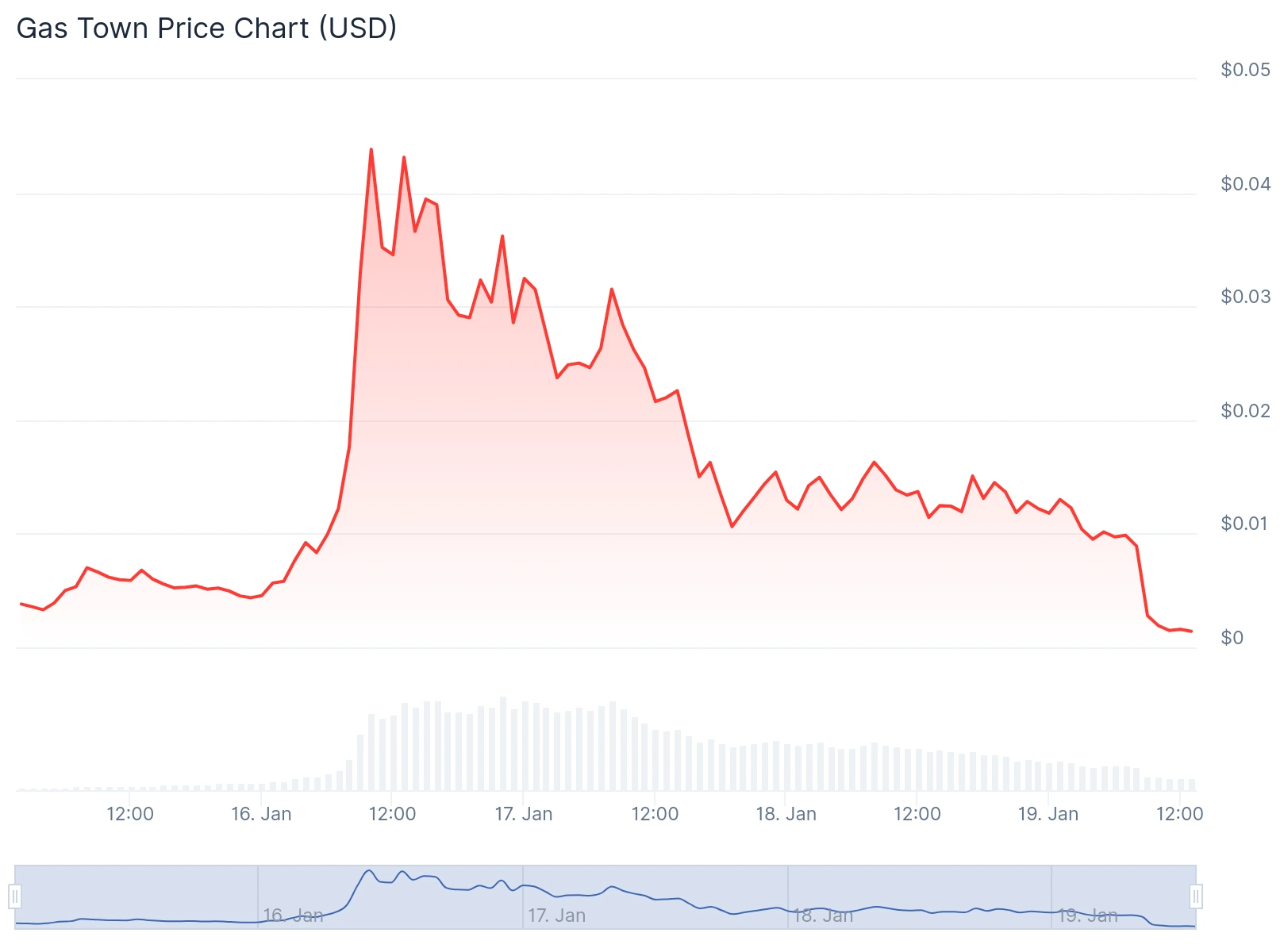
A quiet open-source launch exploded into a financial rollercoaster as the GAS token rocketed from $10 million to $60 million in market value within 24 hours, only to collapse just as quickly. On January 13, 2026, veteran engineer Steve Yegge discovered an anonymous user had tokenized his AI tool, Gas Town, on the Solana blockchain. This event generated over $100,000 in immediate royalties for Yegge without him writing a single line of blockchain code.
However, the narrative took a sharp turn when the market realized the founder prioritized software development over community engagement, causing speculators to flee the project they had just capitalized.
The token launched on Bags.fm, a platform that directs trading fees to project creators, which allowed Yegge to claim the project and receive the accumulated royalties. These funds were intended to support the development of Gas Town, an ambitious tool designed to manage armies of AI coding agents. The market initially responded with euphoria, driving trading volumes to $7 million in a single session. Traders viewed the token as a proxy bet on the future of automated coding, but the misalignment between crypto, culture, and software engineering timelines quickly soured the sentiment.
Gas Town Brings Industrial Thinking To AI Coding
Gas Town functions as a factory floor supervisor for artificial intelligence. Yegge released the tool on January 1, 2026, to coordinate 20 to 30 coding agents simultaneously. The project focuses on coordination rather than novelty, handling task assignment, version control, monitoring, and automated merges across parallel agents.
In his Medium article, Yegge, who previously worked at Google and Amazon, framed Gas Town as a way to bring factory-style order to AI-assisted software creation. The tool builds on the Go-based Beads framework and treats AI agents as specialized workers rather than solo generalists. Developers can track progress in real time while the system resolves conflicts that often slow multi-agent workflows.
Bags.fm Revives A Familiar Solana Rhythm
Bags.fm sits at the center of the $GAS episode. The launchpad routes 1% of trading volume to verified project owners, tying token activity directly to creators. That model gained traction late in 2025 and reached a new level of visibility through $GAS.
Last year’s memecoin cycle on Solana created its own economy, complete with launchpads, bots, and viral symbols. Tokens such as $BONK, $WIF, and $POPCAT turned humor into liquidity, while thousands of smaller experiments appeared daily. More than 11.6 million tokens were launched across platforms, even as only a fraction reached wider trading venues.
The Crash Reveals A Brutal Conflict Between Attention And Development
The momentum shattered quickly on January 17, when Yegge posted that he would devote his energy to Gas Town, leaving limited time for engagement with the crypto community. A follow-up birthday Medium post reinforced this builder-first stance, and community enthusiasm evaporated almost instantly. From its January 16 peak, $GAS plunged over 83%. The market cap collapsed to the low millions as traders accused the developer of “abandoning” the narrative, despite his commitment to building the actual product.
This collapse exposed a core tension in the Web3 AI track, which remains a PVP battlefield ruled by the attention economy. Capital moves in seconds via trades, but quality products demand months or years of slow building. Speculators bought “expectations” and “emotional fluidity” – viral stories, founder tweets, and constant engagement. When Yegge chose silence to focus on delivery, it severed the flow of attention that sustains token price, suggesting that for many traders, the hype matters far more than the code.