

Hyperliquid is a decentralized derivatives exchange that enables traders to take long and short positions through perpetual futures contracts. The platform operates on its own Layer 1 blockchain and facilitates on-chain order execution. Based on publicly available analytics dashboards, Hyperliquid ranks among the leading decentralized venues by perpetual futures trading volume.
In recent months, Hyperliquid’s utility token HYPE has declined in price while activity on the Hyperliquid platform has remained elevated. Trading volume and user participation have continued during the same period in which the token has traded lower. That contrast raises important questions: does the pullback signal deeper stress, or does it mark a reset that clears supply before the next growth phase?
5 Reasons Behind HYPE’s Price Drop
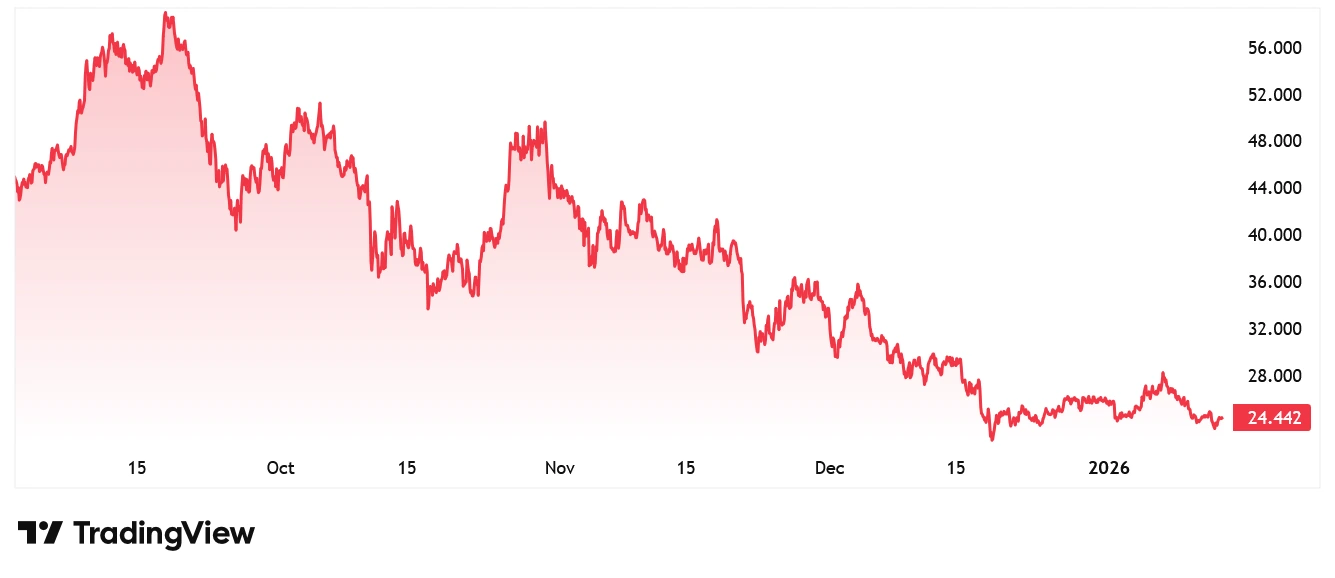
Multiple factors have coincided with the recent decline in HYPE. On-chain data and publicly available market commentary indicate that changes in circulating supply, capital movement between assets, and derivatives positioning have occurred during the same period. These developments have taken place alongside broader shifts in market risk conditions.
1. Team Token Unlocks Increasing Circulating Supply
Scheduled releases of team-allocated tokens have increased HYPE’s circulating supply. These releases are predetermined and occur according to publicly disclosed schedules. Periods preceding token unlocks have coincided with changes in trading activity and liquidity conditions in the HYPE market.
In September 2025, Arthur Hayes disclosed that he had sold his entire HYPE position. In public statements at the time, he referenced upcoming token unlocks totaling approximately 237 million HYPE, scheduled over a two-year period beginning on November 29, 2025. He also stated that protocol buybacks were expected to offset roughly 17% of the newly released supply.
On-chain data indicate HYPE trading activity increases around token unlock periods, with some holders reducing exposure or adjusting positions as additional tokens enter circulation. At the same time, platform usage metrics on Hyperliquid have remained active during these periods, indicating that changes in token supply and token price have occurred alongside continued exchange activity.
2. Large HYPE Holders Unstaking And Selling
On-chain dashboards shared via X threads and Telegram updates often capture instances when large HYPE holders unstake and move balances to venues that support active trading. That behavior usually follows strong price advances, as early participants lock in gains after moves from single digits into higher ranges. Wallets holding $50 million or more carry significant weight, shaping short-term market candles during periods of thinner liquidity.
A prominent whale wallet, identified as a top 20 airdrop recipient, has recently unstaked a substantial HYPE position. Despite aggressive liquidations, the entity retains approximately $73 million in HYPE. Analysts are monitoring the next 5–7 days, as the market attempts to absorb this supply overhang. In many cases, market participants frame this behavior as distribution tied to profit-taking rather than fading belief. Regardless, it affects the token price in the short term.
3. Capital Rotation Toward New DEX Launches Lighter LIT
The launch of new tokens may coincide with shifts in trading activity across decentralized derivatives platforms. During these windows, participants often sell parts of existing positions to free capital for the new release. An example of capital rotation was during the LIT token launch on December 30, 2025.
Lighter, a zero-knowledge-powered perpetual DEX on Ethereum Layer 2, surged in trading activity leading up to and immediately after the launch event. The platform hit nearly $200 billion in 30-day perpetuals volume, briefly surpassing Hyperliquid’s figures according to DeFiLlama data. This spike drew traders seeking points-based rewards, airdrop eligibility, and early incentives from other decentralized venues, including Hyperliquid.
4. Broader Digital Asset Market Downturn
When major cryptocurrencies like Bitcoin and Ethereum ease lower, traders often scale back risk across their portfolios. Bitcoin currently trades at approximately $90,000 to $91,000, exhibiting modest stability but occasional 1-3% declines in recent sessions. Ethereum trades between $3,130 and $3,140, with similar small pullbacks tied to broader market sentiment.
The HYPE token mirrors these changes, sitting at about $23.40 to $24.40. It has declined 2.7% to 4.6% over the last 72 hours, aligning closely with the major cryptocurrencies. Often, traders reduce leverage and exposure during these phases, selling accessible positions, including strong performers like HYPE, to manage overall risk. This creates uniform price pressure, even when Hyperliquid’s perpetual DEX continues to deliver high volumes.
5. Short-Term Derivatives Positioning And Funding Resets
Recent price movements in HYPE have coincided with changes in derivatives positioning and funding rates on the Hyperliquid perpetual DEX. Data from platforms such as Coinglass shows that long positions had accumulated prior to the decline, resulting in positive funding rates for leveraged long positions. When funding rates adjusted, some positions were reduced through liquidations and stop-loss orders, contributing to short-term price volatility. These adjustments in funding and leveraged positions occur regularly on perpetual futures markets and are reflected in on-chain trading data.
Why HYPE Could See Strength In Late January And Early February
Seasonal liquidity often returns after year-end positioning is cleared, and traders tend to reopen risk as new monthly and quarterly cycles begin. That timing can matter for tokens with strong trading communities, because those users often re-engage once markets stabilize and funding conditions improve. Social media sentiment often reflects a renewed flow of trading ideas early in the year, which can help attention shift back to established platforms.
Supply-driven selling linked to team releases or large-holder flows can also run through a completion phase. Once that pressure fades, steady demand can support firmer price action. Traders frequently rotate back into protocols that show consistent product usage, especially when DEX competition headlines cool and the market focuses on execution quality again.