

Key Takeaways
- Democrats won control of both chambers of Congress, matching the broad outcome favored by prediction markets.
- Markets were more confident about a Democratic victory than Decision Desk HQ’s pre-election model.
- Reported election trading activity exceeded $1.48 billion.
Kalshi and Polymarket traders strongly favored a Democratic takeover of Congress before voters delivered a midterm setback to President Donald Trump.
After a dramatic night of closely watched midterm elections, Democrats seized control of both the House and Senate, delivering a blow to Trump and confirming the outcome prediction-market traders had favored.
However, traditional election forecasts also favored the party, raising the question of how much useful information prediction markets actually added.
With over $1.48 billion in reported election trading activity, the midterms offered an interesting case study in the accuracy of prediction platforms’ forecasts.
Prediction Markets Backed Democrats Before the Results
On Monday, Nov. 2, prices aggregated by analytics firm BetInt implied Democrats had a 95% probability of winning the House and a 76% probability of taking the Senate, according to Reuters.
After a historic sweeping night, those national calls held up.
Decision Desk HQ’s results board showed Democrats with 241 House seats against Republicans’ 149 when checked Wednesday morning.
Its Senate tally stood at 54 Democratic seats and 44 Republican seats.
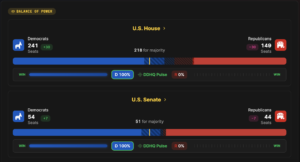
The emerging nationwide vote also showed a substantial Democratic advantage.
On Nov. 4, Polling Desk’s aggregation recorded 65.4 million Democratic House votes against 50.6 million Republican votes.
That represented 55.6% and 43.0%, respectively, with the site estimating that 92% of the expected vote had been counted.
Were Traders More Accurate Than Election Forecasters?
Both platforms strongly favored Democrats before voting concluded, although their House probabilities differed slightly.
Election-day snapshots published by StealthEX recorded the following market-implied probabilities.
Decision Desk HQ’s separate forecasting model also favored Democrats, with lower confidence.
| Democratic victory | Kalshi | Polymarket | Decision Desk HQ | Outcome |
|---|---|---|---|---|
| House control | 93.6% | 95% | 84% | Democrats won |
| Senate control | 76% | 76% | 64% | Democrats won |
All three favored the eventual winners.
However, Kalshi and Polymarket expressed greater confidence.
A well-calibrated forecasting system should see events assigned a 75% probability occur approximately three-quarters of the time across a sufficiently large sample.
Kalshi and Polymarket Were More Bullish on Talarico
Meanwhile, Texas provided a clearer comparison between prediction-market confidence and conventional election forecasting.
Early on Nov. 3, Kalshi priced Democrat James Talarico’s chances of defeating Republican Ken Paxton at around 73.5%, while Polymarket put them at 74.5%, according to StealthEX.
Decision Desk HQ’s pre-election model also favored Talarico, but assigned him a lower 60% probability of victory.
Talarico subsequently won.
By early Wednesday morning, Talarico had won, with DDHQ’s count showing him with 5.28 million votes, or 54.95%, against Paxton’s 4.14 million, or 43.15%.
Although all three favored the eventual winner, traders on Kalshi and Polymarket expressed greater confidence.
What the $1.48 Billion Figure Shows
Reuters reported a total combined $1.33 billion in Kalshi midterm trading volume, with around $145 million across Polymarket congressional markets, citing the Anti-Corruption Data Collective.
Ahead of the result, Vanderbilt University Law School associate dean Yesha Yadav told Reuters:
“Tuesday does, in fact, represent a real test for the new wave of prediction markets.”
As CCN previously explained, Kalshi’s headline contract volume can reflect potential payout value rather than buyers’ purchase costs.
Repeated trading can also count the same capital multiple times.