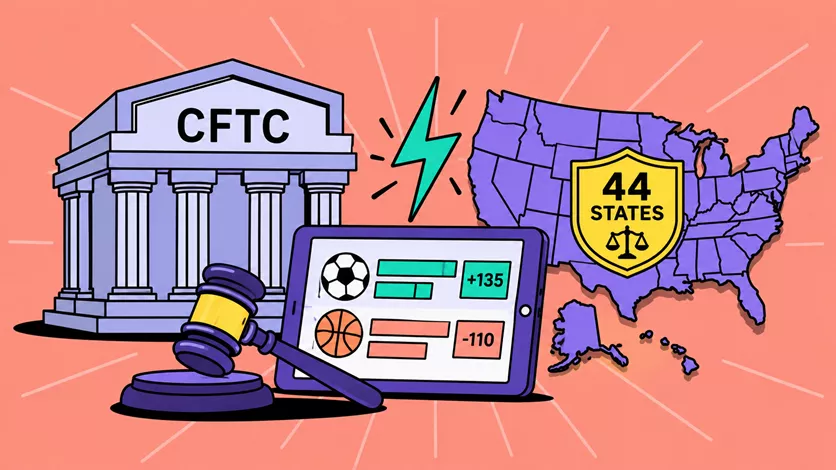
44 State Attorneys General Challenge CFTC’s Authority Over Sports Prediction Markets

Key Takeaways
- Forty-four state attorneys general say the CFTC lacks authority to regulate sports prediction markets.
- The coalition argues sports event contracts should remain under state gambling laws, not federal commodities rules.
- The CFTC maintains that prediction markets are derivatives under its exclusive jurisdiction, fueling multiple legal battles.
- The growing dispute could ultimately be decided by the US Supreme Court.
A coalition of 44 state attorneys general has intensified the legal battle over prediction markets, urging the Commodity Futures Trading Commission (CFTC) to withdraw its proposed rule governing sports-related event contracts and arguing that the agency lacks the authority to regulate what they view as sports gambling.
The bipartisan coalition submitted its comments on the final day of the CFTC’s public consultation, calling the proposal an overreach that conflicts with both federal law and state authority. Led by Ohio Attorney General Dave Yost, the group argued that sports event contracts offered by platforms such as Kalshi and Polymarket fall under state gambling laws rather than federal commodities regulation.
The attorneys general wrote that the proposal exceeds the CFTC’s statutory authority and urged the agency to restart the rulemaking process with language explicitly confirming that sports betting contracts cannot be traded on federally regulated derivatives exchanges.
States Say Sports Contracts Belong Under Gambling Laws
The dispute centers on whether sports prediction markets should be treated as financial derivatives or as sports betting.
The coalition argued that many contracts available on prediction platforms mirror wagers already offered by licensed sportsbooks, including bets on game outcomes, point spreads, and player performances. Because states already regulate those activities through gaming commissions, the attorneys general said allowing federally regulated exchanges to list similar contracts creates an uneven regulatory framework that bypasses state consumer protections and tax systems.
Not every state joined the letter. Attorneys general from Florida, Georgia, Missouri, New Hampshire, and Texas were absent from the coalition.
The comments add to growing resistance from sports leagues, tribal gaming groups, and consumer advocates, many of whom have also argued that the CFTC’s proposal stretches the agency’s authority beyond its intended role.
Federal Regulators Defend Exclusive Jurisdiction
The CFTC maintains that event contracts traded on registered exchanges are commodity derivatives governed by the Commodity Exchange Act rather than gambling products. Chair Michael Selig has repeatedly argued that Congress granted the agency exclusive authority over these markets to avoid a fragmented state-by-state regulatory system.
That position has already led to multiple lawsuits between the federal government and states attempting to restrict prediction market operators. The CFTC has filed actions against states, including New York, Minnesota, Arizona, Connecticut, Illinois, and Rhode Island, seeking court rulings affirming its jurisdiction over registered prediction markets.
The debate has also divided the industry. CME Group has sued Chairman Selig and argued that the CFTC’s proposed definition of “gaming” risks preempting state sports betting laws, while newer prediction market operator Rothera supported the agency’s broader interpretation, saying definitions based solely on wagering could inadvertently capture nearly every event contract.
With prediction market volumes surging after the 2026 FIFA World Cup and litigation continuing across several states, the battle over who regulates sports event contracts is increasingly headed toward the courts.
Notably, the issue will ultimately require a Supreme Court decision to settle the jurisdictional dispute between federal regulators and state gaming authorities.