Playing Kingmaker? CZ Ranks Hardware Wallet Security Approaches, Endorses OneKey


Binance founder Changpeng ‘CZ’ Zhao has made one of his clearest stances on self-custody yet. In a December 6 post on X, CZ stated that only one type of hardware wallet deserves user trust: devices that never allow private keys to leave the chip.
In reply to OneKey intern Yishi, presumably pictured at the Binance Blockchain Week in Dubai last week, CZ described the product as “good”, writing: “My requirement for a hardware wallet is: the private key must never leave the device under any circumstances.”
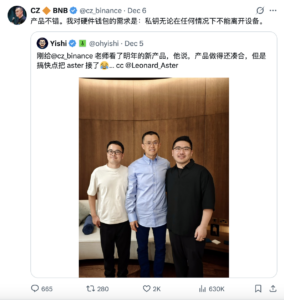
The timing of the post matters. Hardware wallets are facing renewed scrutiny as users shift assets off exchanges and into self-custody. Yet product designs differ sharply in how they manage backups and account recovery.
A Subtle Reference?
In 2023, leading hardware wallet brand Ledger angered users by infamously introducing ‘Ledger Recover’, a feature that encrypted recovery phrase information, split the data into shards, and stored them with external partners.
Users felt the feature challenged years of Ledger’s own core messaging. The company had long insisted that private keys could never leave its devices, in any state. Ledger’s Recover feature suggested otherwise. Critics warned that the system expanded the attack surface and added third-party risk, a controversy that still follows Ledger today. Zhao’s comments on X echo many of those earlier concerns by highlighting the risks of any design that exports keys, even in encrypted form.
OneKey Gains A Public Endorsement
OneKey is an open-source wallet maker that has grown quietly but until now lacked the global recognition of Ledger and Trezor. CZ’s reply on X now draws attention to OneKey’s leading business model: that keys remain on-device at all times.
CZ is, of course, a long-time advocate of self-custody and has previously warned about the pitfalls of poor key management. He believes that a device must never allow keys to be backed up, recovered, or transmitted outside the secure element.
As Zhao remains one of the most influential voices in crypto, his backing of OneKey is a massive boost for the company and adds credibility in a market where trust is central and mistakes are irreversible.
Shifting Hierarchies in Hardware Security
The hardware-wallet sector has expanded in the past two years. Demand has grown after several high-profile exchange failures and renewed regulatory pressure. Users have moved assets to physical wallets, seeking stronger control of private keys.
However, this shift exposed a tension between security and convenience. Some companies have added recovery features aimed at mainstream users, while others argued that such tools weaken the purpose of offline storage.
Zhao places himself firmly in the latter camp. He frames convenience features as risks, not upgrades. He said that allowing any off-device backup creates opportunities for compromise.
This position places OneKey as a happy beneficiary of Zhao’s public intervention. It now stands as the most prominent example of the ‘good wallet’ model following CZ’s public endorsement.
Why Private Key Design Matters
Private keys control ownership of crypto assets. When a key is lost, so are the funds. When a key is copied or exposed, attackers can drain accounts instantly. These risks make wallet design a central issue for the industry.
Keeping keys offline protects users from malware, phishing, and remote attacks. Hardware wallets isolate signing operations from internet-connected devices, limiting exposure.
Problems arise when wallets introduce backup paths. Even encrypted key fragments stored off-device create new vectors for exploitation. They also introduce trust dependencies on cloud partners, identity services, and customer-support mechanisms.
Zhao’s stance prioritises the original philosophy of cold storage. It removes third parties from the equation and keeps users fully responsible for their security. This approach appeals to experienced self-custody advocates. It also reflects the view that simplicity reduces risk.
A Subtle But Significant Power Shift
CZ’a remarks suggest a shift in influence within the wallet market. Ledger and Trezor have dominated the sector for nearly a decade. Their products define the mainstream understanding of hardware wallets.
Now, Zhao has elevated a much smaller competitor in OneKey. His intervention signals that reputation alone is no longer enough. Instead, adherence to strict security principles may become the new differentiator.
This shift also reflects broader trends. Regulators are examining custody models closely. Institutional investors demand clearer standards. Retail users want assurances that wallets behave as advertised.
Looking Ahead
Zhao’s endorsement of OneKey and his criticism of recovery-based designs may reshape future wallet development. Firms may feel pressure to publish clearer security guarantees and reduce reliance on third-party services.
As consumers begin to reconsider what they expect from hardware wallets, they may start to weigh convenience against risk more carefully. As awareness increases, wallet companies may respond by simplifying architectures and emphasising transparency.
For now, CZ’s OneKey comment on X marks a turning point. It introduces a new divide in the hardware-wallet sector and placed OneKey at the centre of the debate. Zhao’s influence ensures the conversation will continue.
The industry now faces a choice: double down on convenience or recommit to strict offline principles. How companies respond may define the next chapter of private key security.