

The global cryptocurrency market slid sharply on November 4, 2025, with total market value falling by roughly 3.9 % to about $3.54 trillion, wiping out more than $156 billion in less than 24 hours.
Within this decline, Bitcoin dropped about 2.8 % to around $104,577, while Ethereum fell 6.4 % to roughly $3,493. Altcoins were hit harder: Solana down about 11 % to $157, BNB fell 8.3 % to $946, and XRP slipped 6.7 % to $2.25. At the same time, trading volume rose to around $223 billion, signalling elevated activity amid the sell-off.
Equity Markets Wobble Drives Crypto Down
The broader U.S. stock market, particularly the S&P 500 (SPX), has entered a correction phase after a prolonged run-up. Historically, when the S&P 500 corrects, crypto markets often follow. The correlation between Bitcoin and the S&P 500 has become more meaningful in recent years: rolling correlations of 0.0 – 0.6 over the last five years, with a reading around 0.48 in early April 2025, according to the CME Group’s analysis.
In times of market stress, that positive relationship thickens. The weakness in the stock market appears to have triggered broader risk-off sentiment, affecting cryptos along the same fault lines.
Macro Pressures And Institutional Flows
Several interlinked triggers compounded the crypto slump.
- First, the Federal Reserve signalled a more cautious stance on rate cuts, reducing odds of December easing and reinforcing a “higher for longer” policy path. This pushed investors toward safer assets and out of riskier ones such as digital currencies.
- Second, institutional flows turned negative: U.S. spot Bitcoin ETFs saw outflows, and major whale wallets reportedly dumped nearly $600 million in Bitcoin, adding to the cascade of selling.
- Third, a stronger U.S. dollar and rising 10-year Treasury yields (real yields near 2.32 %) made yield-free assets like Bitcoin less attractive.
These layered pressures fed into heightened liquidations: over $1.3 billion in leveraged trades were wiped out within 24 hours, thin liquidity magnifying the move.
Post-Rally Weakness And Liquidity Strain
Although good news had arrived in recent weeks, such as interest rate relief potential and talks between Donald Trump and Xi Jinping on trade, the market failed to rally, which signals weakness rather than strength. That suggests the correction phase had been brewing: since an October peak of about $4.22 trillion, crypto had already shed nearly $790 billion (≈18 %).
Investors appear to have taken profits from earlier gains, particularly after Bitcoin’s high in late October, while liquidity dried out, partly due to U.S. governmental belt-tightening and broader economic softness, leaving fewer buyers to support the market.
What This Means For Investors
The heightened correlation between crypto and equities means that crypto is behaving more like a risk asset than a diversification tool. The pull from the S&P 500 decline, alongside institutional outflows and macro headwinds, suggests the market entered a correction cycle rather than a brief dip.
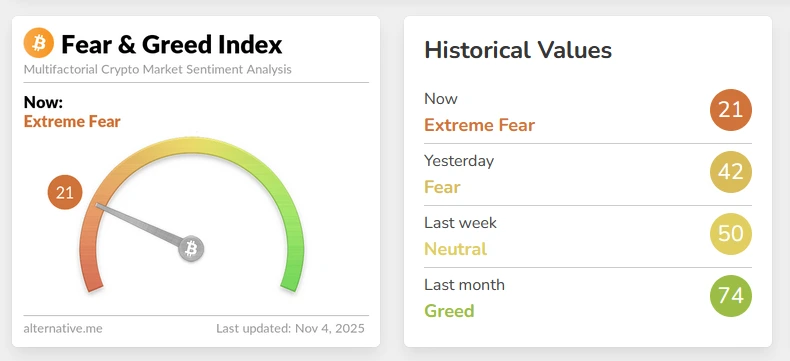
This downturn, driven by global policy signals, institutional selling, and post-rally fatigue, marks a distinct pause after months of strong performance earlier in 2025. While key support levels for Bitcoin and Ethereum remain intact, the episode highlights how digital assets increasingly mirror movements in traditional financial markets.