
- Bitcoin Whale Liquidity on Binance Hits Post-2024 Low
Key Takeaways
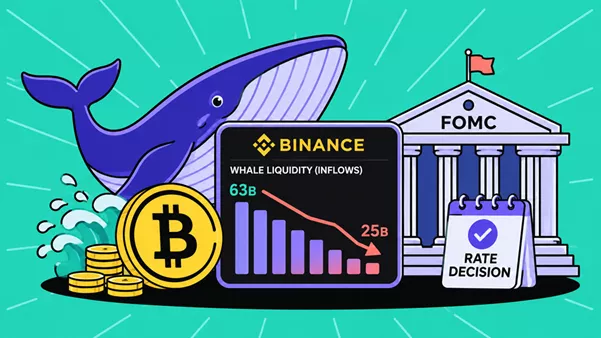
- CryptoQuant analyst Darkfost says monthly whale stablecoin inflows to Binance have fallen from $63 billion to $25 billion since late 2025.
- Large investors accumulated when Bitcoin tested $60,000 in February and June, but participation has since dropped to its lowest level since late 2024.
- Analysts say Wednesday’s FOMC decision could determine whether institutional liquidity returns to the crypto market.
Bitcoin’s ability to sustain a recovery may depend less on retail enthusiasm and more on whether large investors return to the market after the Federal Reserve’s interest rate decision, according to new on-chain analysis from CryptoQuant contributor Darkfost.
The analyst reported that monthly stablecoin inflows into Binance, the world’s largest cryptocurrency exchange by trading volume, have declined sharply from $63 billion in late 2025 to approximately $25 billion today. The drop suggests that whale participation has weakened significantly amid ongoing macroeconomic uncertainty that continues to weigh on investor sentiment.
“Currently, their participation has fallen back to its lowest level since the end of the October-November 2024 correction,” Darkfost wrote in a market update published through CryptoQuant.
The data points to a broader slowdown in crypto liquidity despite Bitcoin’s attempts to stabilize after its correction earlier this year.
Whale Demand Weakened After Defending $60,000
Darkfost noted that whale behavior changed when Bitcoin fell toward $60,000 during February and again in June 2026.
During both selloffs, monthly stablecoin inflows into Binance increased, indicating that larger investors viewed the level as an attractive accumulation zone. That buying activity helped establish what the analyst described as an important support floor for Bitcoin.
However, those inflows have since retreated again, leaving whale participation at its weakest level in nearly two years.
Because Binance remains the industry’s largest venue for spot and derivatives trading, falling stablecoin deposits from institutional-sized investors can serve as a proxy for declining buying power entering the market.
FOMC Decision Becomes the Next Catalyst
With institutional liquidity fading, traders are closely watching Wednesday’s Federal Open Market Committee meeting (FOMC).
Markets largely expect the Federal Reserve to leave interest rates unchanged, but investors will focus on Chair Kevin Warsh‘s guidance regarding inflation and the path of monetary policy for the remainder of 2026.
A more hawkish tone could keep financial conditions tight and delay the return of risk appetite, while a more accommodative outlook may encourage fresh capital to re-enter digital assets.
Darkfost said the Fed’s decision could “redefine the trajectory of demand in either direction,” making it one of the most important macro events for Bitcoin in recent weeks.
Arthur Hayes Points To AI as the Liquidity Drain
The subdued whale activity aligns with comments made by BitMEX co-founder Arthur Hayes, who argued in a June 26 interview with Bonnie Blockchain that Bitcoin has failed to rally despite expanding global liquidity because much of the market’s marginal capital has flowed into artificial intelligence.
According to Hayes, investors have prioritized AI infrastructure companies, semiconductor supply chains, and technology stocks, while newly created wealth from the AI boom has largely been directed toward hard assets or additional exposure to the Nasdaq rather than cryptocurrencies.
Hayes also warned that if AI-related equities experience a sharp correction, cryptocurrencies would likely sell off alongside them initially. Because crypto markets trade around the clock, investors facing margin calls could liquidate digital assets first to raise cash before fundamentals eventually reassert themselves.
Darkfost’s on-chain data and Hayes’ macro thesis suggest that Bitcoin’s next advance may depend not only on monetary policy but also on whether institutional capital rotates back from AI-driven investments into digital assets.