- Key Takeaways
- Best Bitcoin Mining Sites Listed
- Detailed Reviews of the Best Bitcoin Mining Sites in 2026
- How the Top Cloud Mining Sites Compare
- Are Cloud Mining Sites Legit? How to Spot a Scam
- What Is Cloud Mining and How Does It Work?
- Cloud Mining vs Buying Your Own Hardware
- How to Choose a Cloud Mining Site
- Is Cloud Mining Profitable in 2026?
- Which Coins Can You Cloud Mine?
- Conclusion
- FAQs
Best Bitcoin & Crypto Mining Sites in 2026


- When you click links on this page, we may earn an affiliate commission. By using this website you agree to our terms and conditions and privacy policy.
- Participation in online gambling may be illegal in your country and is subject to age restrictions (18, 19, or 21, depending on the jurisdiction). Verify legality and age requirements before participating. Learn more
Cloud mining lets you rent Bitcoin mining power from a remote data center instead of buying and running your own ASIC hardware. The best cloud mining sites are those that price contracts transparently, have a real reputation in the mining community, and never promise fixed or guaranteed returns. Our current picks below, led by BeMine, cover the platforms we rate most highly for beginners, budget miners, and anyone who wants flexible hash power without managing a rig.
The trade-off is simple. You avoid the upfront cost, noise, heat, and maintenance of physical hardware, but you pay a contract fee and hand a slice of your earnings to the provider. That model attracts scammers, so platform choice matters more here than in almost any other corner of crypto. To build this list, we consulted our audience, tested platforms directly, and weighed the metrics that actually move profit: pricing, contract terms, supported coins, payout rules, and provider track record.
Key Takeaways
- Cloud mining lets you rent hash power remotely, avoiding the thousands of dollars, noise, and upkeep that come with running your own mining hardware.
- Profitability is not guaranteed and is tighter than it looks. At current Bitcoin prices and network difficulty, many contracts only break even, and some lose money after fees.
- The single biggest risk is fraud. Regulators have repeatedly warned about cloud mining schemes that advertise fixed daily returns, and most “free” cloud mining sites pay next to nothing or exist to harvest sign-ups.
- The best cloud mining platforms price contracts clearly, disclose every fee, are well regarded by the mining community, and never guarantee a profit.
- Cloud mining costs are mostly front-loaded as an upfront contract fee that covers electricity, maintenance, and hosting, plus withdrawal fees.
- Your earnings depend on variables you cannot control, including the Bitcoin price, mining difficulty, and halving cycles, so treat every profit projection as an estimate, not a promise.
Best Bitcoin Mining Sites Listed

Detailed Reviews of the Best Bitcoin Mining Sites in 2026
BeMine Mining
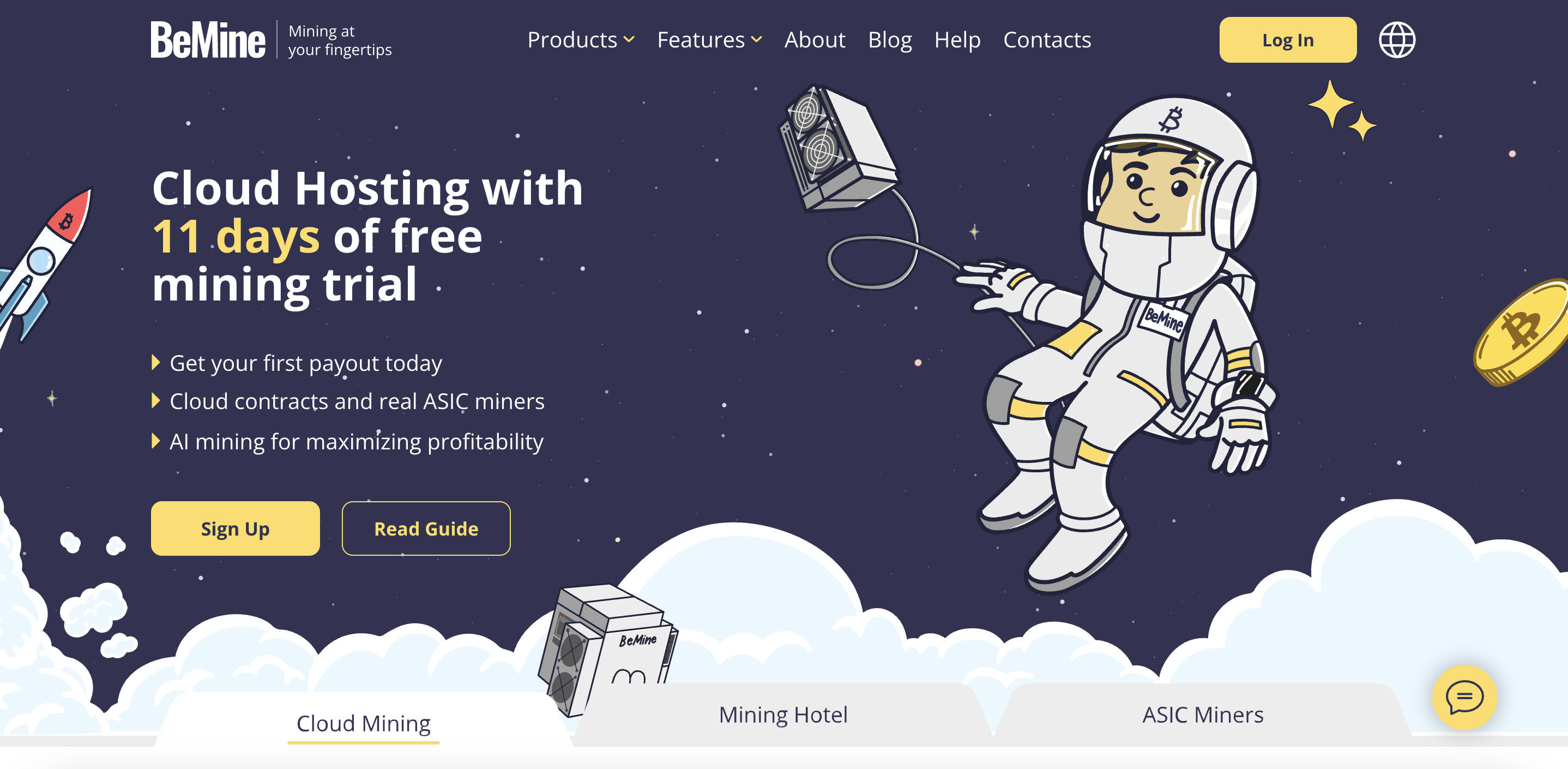
BeMine is a best-in-class cloud mining platform that also supports the hosting and sales of physical ASIC miners. Users can mine Bitcoin as well as Litecoin, Dogecoin, and Zcash, providing plenty of flexibility. Moreover, BeMine enables fractional mining rig ownership (from just 2%), resulting a low minimum investment of $270.
When purchasing a miner with BeMine, you have continual ownership. The company handles and charges for electricity, storage, and maintenance, resulting in a streamlined user experience. BeMine utilizes popular hardware, like the Antminer S23, to provide flexible hash rates ranging from 25 TH/s to 580 TH/s.
BeMine operates a gamified rewards system, and users benefit from an intuitive interface and a simple miner management system, which makes it easy to stay on top of their activities. Moreover, people who hold the platform’s PAWĀ token enjoy low minimum withdrawals, making BeMine the most flexible Bitcoin mining site.
Pros
-
Supports multiple cryptocurrencies
-
Daily rewards
-
Flexible hash rates
-
Plans for all budgets
-
Fractional miner ownership
Cons
-
Must hold PAWĀ to withdraw below 0.005 BTC
-
Maintenance and repair costs can be hard to predict
- Bitcoin
- Bitcoin Cash
-
Ethereum
9
No result
- English
- Spanish
- Russian
Hashing24
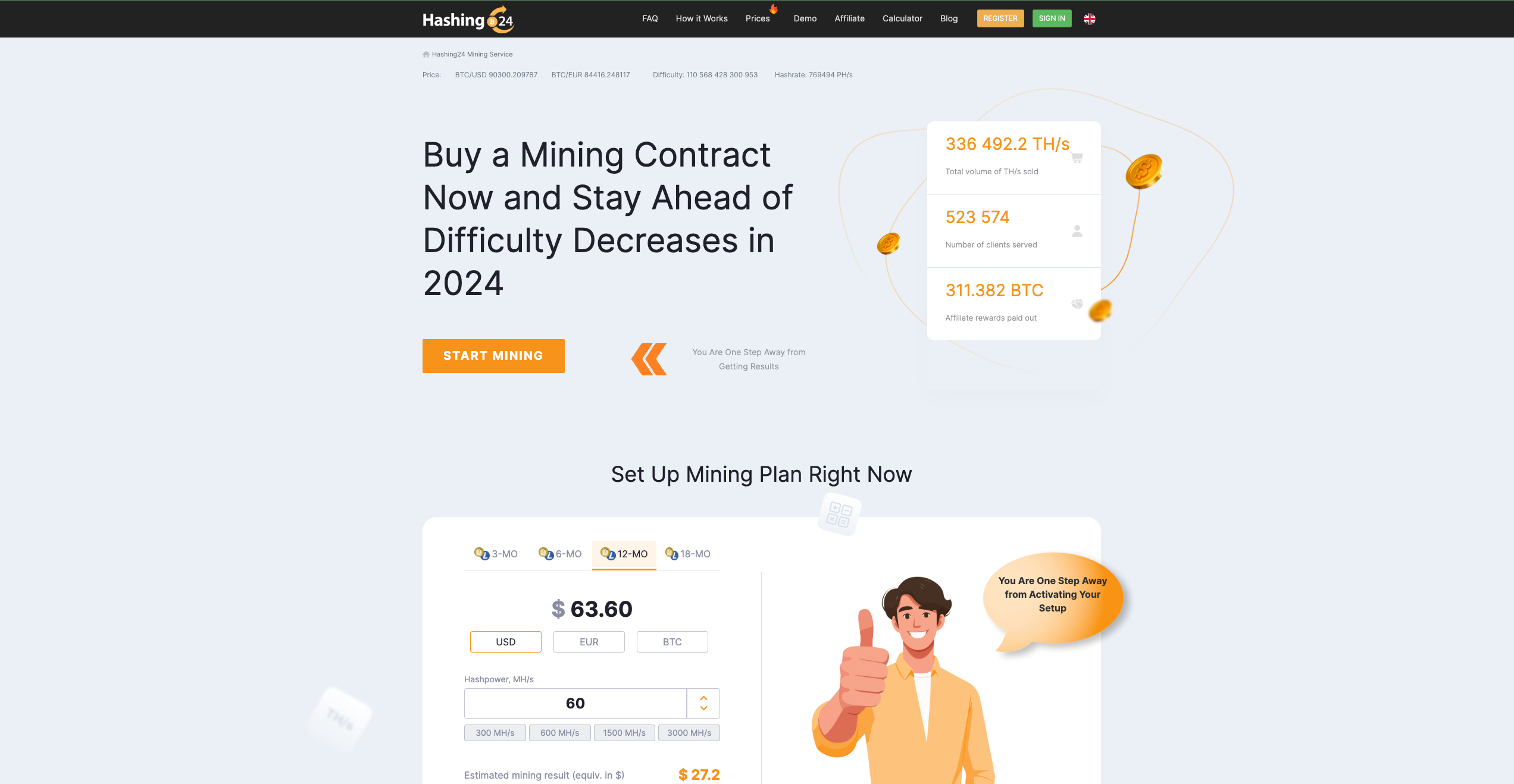
Hashing 24 is an innovative cloud mining platform that enables people to mine BTC, LTC, and DOGE without owning hardware. Users can choose from plans spanning 3 to 24 months. Pricing is based on the hash rate (which is capped at 10 TH/s) and varies from $35.20 (1 TH/s) to $344.96 (10 TH/s) for Bitcoin miners.
The plans display estimated returns at various price points and let users set mining difficulty to simulate condition changes. Users can sell plans on the Trade Desk to recoup costs if they no longer need them, providing flexibility.
Pros
-
Supports mining multiple currencies
-
Flexible plans tailored to user requirements
-
Demo mode to simulate mining
-
Marketplace for selling unneeded plans
-
Earning estimates displayed when choosing plans
Cons
-
Only the 12-month Bitcoin plan is available during our testing
-
Some plans are unprofitable at current prices/difficulties
- Bitcoin
- English
- Chinese (Mandarin)
-
German
7
No result

Mining Rig Rentals
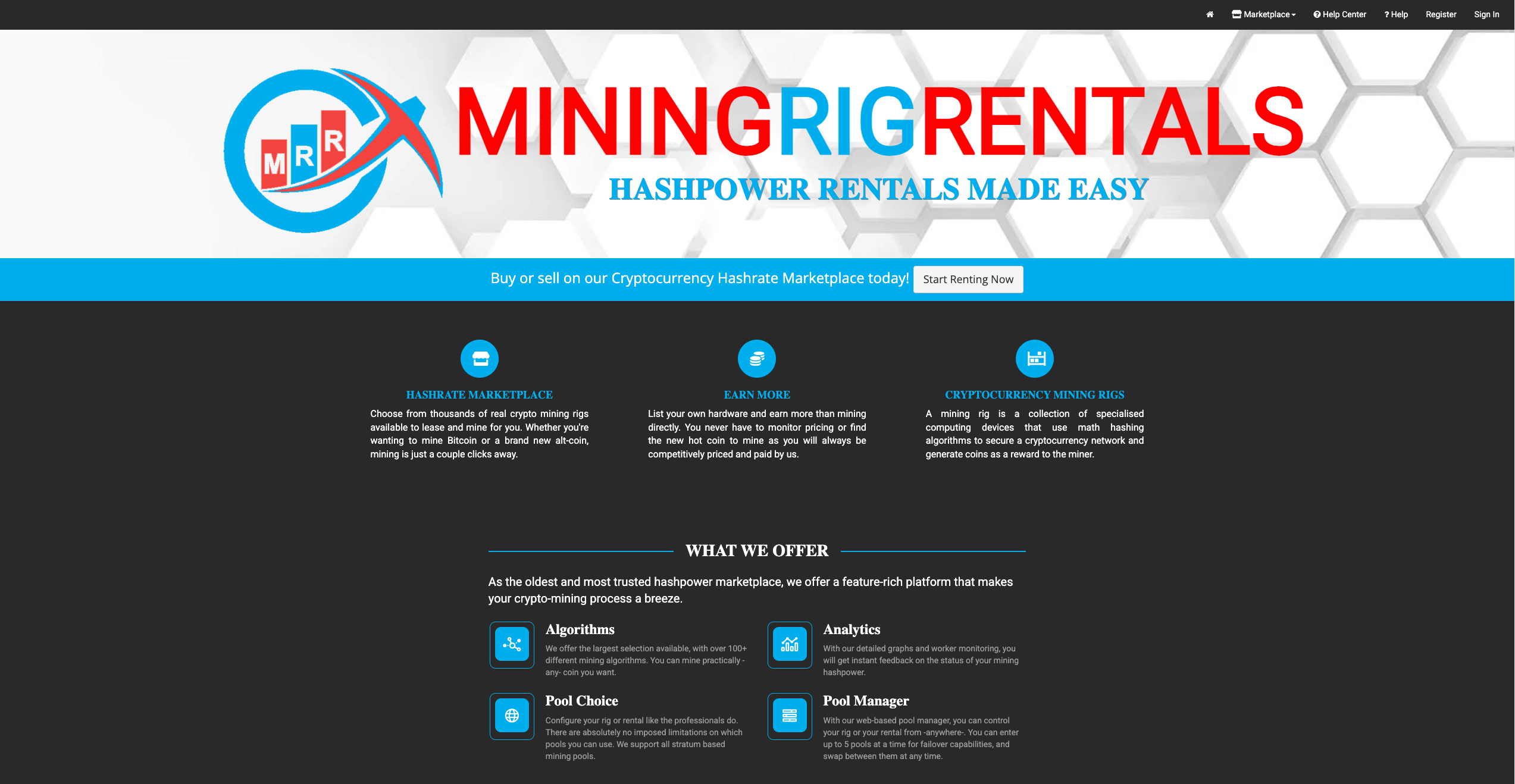
Mining Rig Rentals is an expansive Peer-to-Peer (P2P) marketplace that enables people to sell and purchase hash power across 143 mining algorithms. Markets are divided by algorithm and show available rigs, rented rigs, total hash available, live hash, and the price per MH, GH, KH, TH, or PH.
After selecting an algorithm, users can choose which rig to rent. Each rig has unique hash rates, prices, and minimum/maximum rental hours. Buyers pay with BTC, LTC, DOGE, ETH, or BCH; no fiat option is available. Due to its hosting of many algorithms and thousands of rigs, Mining Rig Rentals is the best cloud mining site for people seeking flexibility.
Pros
-
Over 140 algorithms supported
-
Users can buy or sell hash power
-
Anonymous marketplace without verification requirements
-
Works with popular mining software and pools
Cons
-
Pricing by MH, GH, KH, TH, or PH can be confusing.
-
Must perform manual calculations to determine profitability
-
No fiat currency support
- Bitcoin
- Bitcoin Cash
-
Ravencoin
8
No result
- English
ECOS
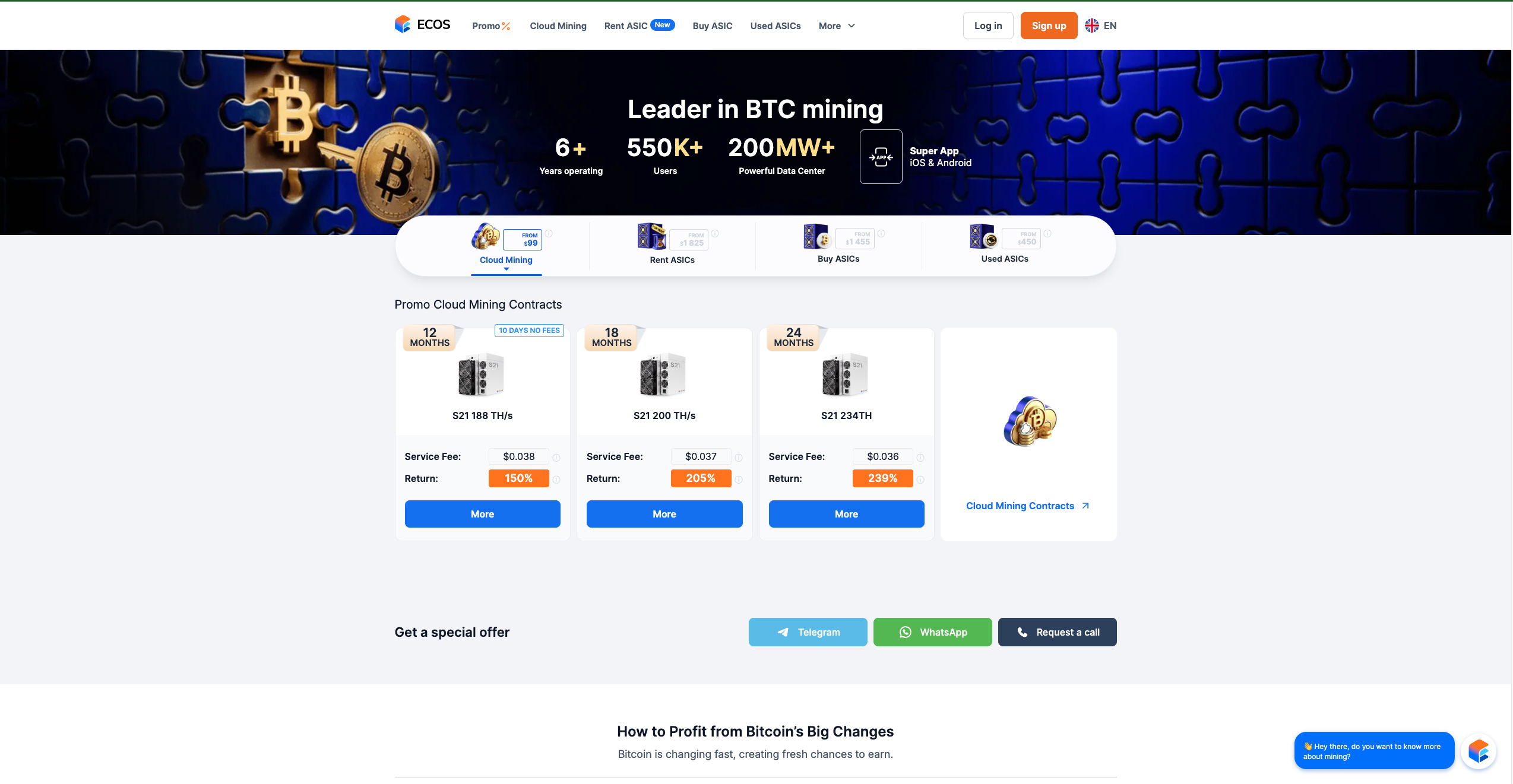
ECOS is a cloud mining platform specializing in ASIC miners. Users can buy or rent a mining rig from other users. They must pay a monthly hosting fee and a fee to acquire the rig. There are plans for all budgets. The cheapest rig we found was $470, with a monthly hosting fee of $175 (104 TH/s). Premium options cost as much as $8,344 / $210 (270 TH/s).
ECOS also offers mining rig rental for 12, 18, or 24 months. It provides a calculator showing estimated profits, but uses future BTC price forecasts. Offering whole miners and rentals makes ECOS highly customizable and flexible.
Pros
-
Users can browse various generations of mining rigs
-
Rigs are all Antminer units
-
Rental service for temporary mining
-
Users can rent a portion of a mining rig's hash rate
Cons
-
12-month minimum rental periods
-
Profit estimations use future price predictions
- Bitcoin
- English
- German
-
French
3
No result

1BitUp
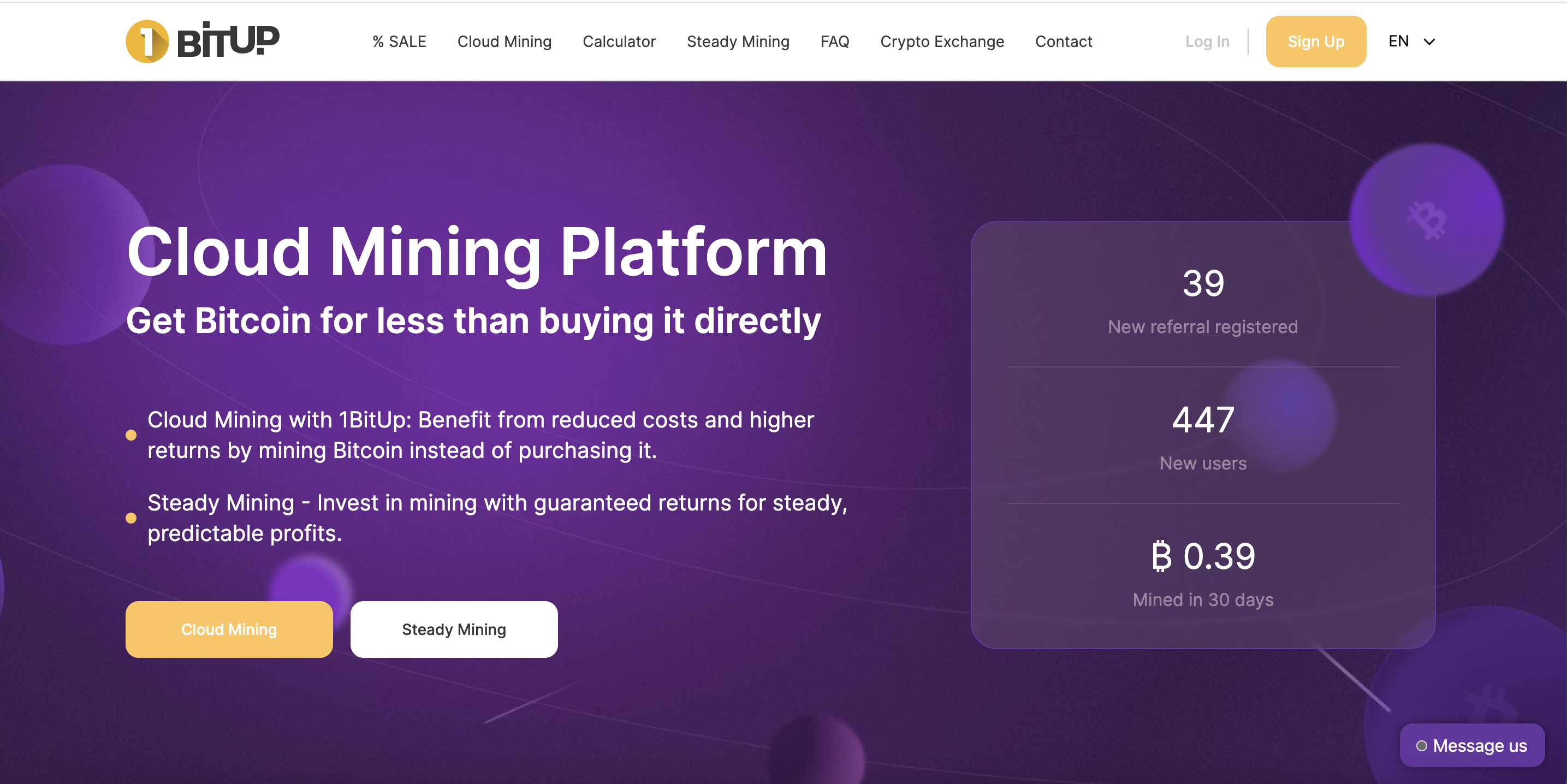
Founded in 2017, 1BitUp is a Dubai-based cloud mining company headed up by Eugen Tanase. Ideal for beginners, it offers easy-to-understand plans that provide a certain amount of hash power over a specific time frame. Prices start from $44.19 (one-month), while the longest plan is 36 months, starting at $303.26.
1BitUp offers ample flexibility. Users decide how much hash rate they need, and the platform adjusts pricing accordingly. While 6 TH/s is the lowest rate, users can attain up to 50,000 TH/s (although at a significant cost). Moreover, 1BitUp is available via browser or Android/iOS apps.
While it offers some substantial benefits and a solid TrustPilot score (4.5/5 based on 15 reviews), the profit calculator uses forecasted, not actual, BTC prices to give the illusion of greater profits. However, if you believe Bitcoin will continue rising, 1BitUp is a solid cloud mining platform.
Pros
-
Prices for all budgets
-
No service fee
-
Plans ranging from 1 to 36 months
-
Flexible hash rates
-
Public founder
-
Available on desktop and mobile
Cons
-
Profit calculator uses forecasted prices
-
Only BTC mining is available
- Ethereum
- Tether
-
Build'N'Build
90
No result
- English
How the Top Cloud Mining Sites Compare
To help you weigh the shortlist side by side, here is how the platforms compare on the details that matter most. Prices and hash rates are set by each provider and change frequently, so treat the figures as illustrative starting points rather than live quotes.
| Platform | Model | Hash rate range | Entry price | Coins you can mine | Best for |
|---|---|---|---|---|---|
| BeMine | Fractional ASIC ownership plus hosting | 25 TH/s to 580 TH/s | From ~$270 (fractional miner) | BTC, LTC, DOGE, ZEC | Flexibility and low entry cost |
| Hashing24 | Fixed-term contracts | 1 TH/s to 10 TH/s (BTC) | From ~$35 (1 TH/s) | BTC, LTC, DOGE | Beginners who want a demo mode |
| Mining Rig Rentals | P2P hash-power marketplace | Fully customisable | Varies per rig | 140+ algorithms | Experienced miners want a choice |
| ECOS | ASIC purchase and rental | ~100 TH/s and up | From ~$470 rig plus hosting | BTC | Buying or renting whole ASICs |
| 1BitUp | Fixed hash-power contracts | 6 TH/s to 50,000 TH/s | From ~$44 (1 month) | BTC | Short and long contract flexibility |
Are Cloud Mining Sites Legit? How to Spot a Scam
Yes, legitimate cloud mining sites exist, but they are outnumbered by scams, so the burden is on you to verify a platform before you pay. This is the question real users ask most often, and it is worth answering before you compare features. A great price on a fake platform is still a total loss.
The fraud is not hypothetical. In July 2026, the SEC charged the operator of Mining Automatic over a roughly $22 million scheme that advertised “consistent returns” of around 50% a year while, according to the regulator, only about 13% of investor money actually went toward mining. It paid earlier investors with later investors’ funds, the classic Ponzi structure. Financial regulators have issued repeated warnings about cloud mining offers that promise high fixed daily or annual returns, because real mining revenue is inherently variable.
Use these red flags to filter platforms quickly:
- Guaranteed or fixed returns: No honest miner can promise a daily percentage. Mining income fluctuates with Bitcoin’s price and network difficulty, so a fixed return is the clearest sign of a scam.
- Pressure to recruit: If earnings depend heavily on referring new users rather than on mining output, you are looking at a pyramid scheme.
- No verifiable company details: Legitimate providers name their team, location, and hardware. Anonymous operators with stock photos and no traceable history are a risk.
- Profit calculators are built on price forecasts: Some platforms inflate projected earnings by assuming Bitcoin will continue to rise. Judge a platform on today’s economics, not a bullish forecast.
- Withdrawal friction: Scam sites often show growing “balances” but block or delay withdrawals, or demand an extra “fee” to release funds.
Before committing, spend a few minutes checking independent reviews, mining community forums, and the provider’s track record. Two minutes of research is the cheapest insurance you will ever buy in crypto.
What Is Cloud Mining and How Does It Work?
Cloud mining is paying a provider to mine cryptocurrency on your behalf using their hardware, then keeping the resulting rewards minus their fees. You never touch a physical machine. Instead, you buy a contract for a set amount of hash power, and the provider runs the mining, handles electricity and cooling, and credits mined coins to your account.

- What is Cloud Mining?
It exists because self-mining has become expensive and technical. A competitive Bitcoin ASIC costs thousands of dollars, draws serious power, generates heat and noise, and needs maintenance. Cloud mining removes those barriers for a fee, which is why it appeals to beginners and anyone who wants exposure to mining without owning a rig. It is one of several types of crypto mining worth understanding before you start.
Here is how a typical cloud mining contract works, step by step:
- Choose a reputable provider and a plan that fits your budget and target hash rate.
- Pay the contract fee, which usually covers the hardware, electricity, hosting, and maintenance for the term.
- Get access to the agreed hash rate by pointing to a mining pool.
- Link a crypto wallet to receive payouts.
- Monitor performance as rewards accrue, and factor in any daily maintenance or withdrawal fees.
- Withdraw your mined coins to your wallet, or cash out your mining rewards to a fiat currency.
In short, cloud mining works like self-mining with the hardware and hassle outsourced. You still carry the market risk, but the provider carries the operational burden. Most providers mine into a pool for steadier payouts, the same principle behind the best crypto mining pools.
Cloud Mining vs Buying Your Own Hardware
Cloud mining wins on convenience and low entry cost. Owning hardware wins in terms of control and long-term economics. The right choice depends on how much you want to invest, how hands-on you want to be, and whether you trust a third party to run the operation.
| Criteria | Cloud mining | Hardware mining |
|---|---|---|
| Upfront cost | Low | High (thousands per ASIC) |
| Technical knowledge | Low to moderate | Advanced |
| Maintenance | Handled by the provider | Your responsibility |
| Setup time | Minutes | Days to weeks |
| Flexibility | High (pick contract size) | Low (fixed to your rig) |
| Control over hardware | None | Full |
| Counterparty (scam) risk | High | None |
| Profitability | Variable, often thin after fees | Variable, but you keep all revenue |
The honest summary: hardware mining is more work and more capital, but you own the machine and keep every coin it earns. Cloud mining lowers the barrier to entry, but you pay for convenience and take on the risk that the provider underdelivers or turns out to be fraudulent. If you want to compare the machines themselves, see our guide to the best Bitcoin mining hardware.
How to Choose a Cloud Mining Site
Prioritize trust first, then economics. A platform can have the best-looking prices on the internet, but if you cannot verify the provider, none of the numbers matter. Once a platform passes the legitimacy test above, weigh these factors before you buy.
Profitability potential
Profitability should be your starting calculation, not an afterthought. Look at the current price of the coin, its recent trend, the hash rate you are promised, the mining difficulty, and the total fees. Then weigh projected earnings against the full cost of the contract. Be skeptical of any provider whose calculator assumes a rising Bitcoin price, and judge the deal on today’s numbers. We break down the maths in the profitability section below, and cover whether Bitcoin mining is profitable in more depth separately.
Fees and total cost
Fees decide whether a contract makes money. Most providers charge an upfront contract fee that bundles the hardware rental, electricity, maintenance, and hosting. Many also apply ongoing daily maintenance charges and withdrawal fees on top. Add up all costs before comparing platforms, because a low headline price with high daily fees can be more expensive than a pricier all-inclusive contract.
Reputation and track record
The cloud mining sector is full of imitators, so a provider’s reputation is not a nice-to-have; it is essential. Favor platforms with a named team, a verifiable operating history, real user feedback, and an active presence in the mining community. Undated testimonials on the provider’s own site do not count, but independent reviews and forum threads do.
Contract terms and payout rules
Read the terms before you pay, because that is where the surprises hide. Check the contract length, whether the plan can be sold or canceled, the minimum withdrawal threshold, and any conditions attached to payouts. A “hidden” fee is only hidden if you skip the fine print, and legitimate providers clearly disclose everything. If the terms are vague or the withdrawal rules are buried, treat that as a warning.
Profitability
Since you are considering renting a cloud mining machine to make some money, the deal’s profitability should naturally be one of your main considerations.
As we will explain in a separate section below, gauging the profitability potential of any mining operation is very complex. However, you should still do your best to evaluate the key factors involved.
Look at the current value of the coin you plan on mining, its market trend over time, the hashrate you are being promised, the mining difficulty, the competition, and all the other relevant factors.
Of course, cloud mining is a paid service, so you will also need to weigh these potential profits against the expenses you will incur and determine whether or not your earnings can outpace your costs.
Fees
As we just mentioned, the fees are an important factor in determining the profitability of a cloud mining operation, so you should analyze them thoroughly.
Most providers of cloud mining services charge their customers upfront, with a fee called the contract fee, which typically covers all operational costs, including equipment rental, electricity, maintenance, repairs, upkeep, and other potential expenses.
Moreover, withdrawals and transfers are also typically charged by cloud mining providers, so be sure to keep them in mind when assessing a platform’s affordability.
The end goal is to find an app with a fee structure that will not eat away too much of your earnings and lets you make a profit you can be happy with.
Reputation
It is unfortunate, but the cloud mining industry is plagued by risks. There are countless scammers, pyramid schemers, and other malicious actors who impersonate legitimate crypto mining websites and exploit unsuspecting users.
And even though reputation is important in any business, in the cloud mining sector, checking the company’s background is absolutely imperative.
However, even though the digital era has made it easier for cybercriminals to create convincing fake platforms, the bright side is that it is just as easy to avoid them with just two minutes of research.
Reading reviews from previous users and even soliciting feedback from the wider crypto community on forums and other types of discussion boards can help you determine with certainty whether or not a cloud mining platform is legitimate.
Terms & Conditions
We know what you think: “No one reads the T&Cs”. While you may be right, this widespread customer indifference is exactly what service providers are counting on, and it’s how people end up agreeing to unfavorable terms they don’t fully understand.
Even though it may feel like a scam when a provider charges you a “hidden fee”, this is legitimate in the eyes of the law if the provider disclosed it in the T&Cs.
The fine print might be easy to miss, but it is our responsibility as consumers to read and understand the terms of use.
That said, the best and trusted cloud mining sites avoid relying on this “technique” and present their fees and conditions clearly and transparently. Try to find a provider with a reputation for transparency, and make a habit of reading all the T&Cs you agree to.
Is Cloud Mining Profitable in 2026?
Cloud mining can be profitable, but margins are thin right now, and there is no guarantee you will come out ahead. The core formula is simple:
Cloud mining profit = mining revenue − (contract fee + ongoing fees)
The difficulty is that revenue is a moving target. At the time of writing, Bitcoin trades around $64,000, network difficulty is near record highs, and hashprice (the daily revenue a miner earns per unit of hash power) is roughly $31.73 per PH/s. Mining difficulty fell by about 14% from its 2026 peak as thinner margins pushed some operators offline, underscoring how tight the economics have become.
A worked example
Say you buy a 100 TH/s Bitcoin cloud contract:
- Daily gross revenue is roughly 100 TH/s multiplied by $0.0317 per TH/s, which is about $3.17 per day, or roughly $95 per month and $1,150 per year at current prices.
- Against that, subtract the contract fee and any daily maintenance charge. If the all-in cost of a 12-month contract is around $900 to $1,100, you are close to break-even before the Bitcoin price moves.
- If Bitcoin rises over the term, the same contract becomes profitable. If it falls or the climb is difficult, you can finish underwater.
That single example explains why guaranteed-return offers are a red flag. Nobody can promise the outcome when the two biggest inputs, the Bitcoin price and difficulty, change daily. The variables that move your earnings the most are:
- Your effective hash rate, which no provider can guarantee 24/7.
- The Bitcoin price is the single biggest swing factor.
- Mining difficulty, which rises as more miners compete, cuts your share of rewards.
- Bitcoin halving events, which cut the block reward by 50% roughly every four years. The last halving in 2024 dropped the reward to 3.125 BTC, and the next is expected around 2028.
- Fees, which quietly erode returns through maintenance and withdrawal charges.
The practical takeaway is that you cannot know your profit in advance. Run the numbers on today’s economics, keep an eye on crypto market cycles, and treat any contract as a bet on the Bitcoin price rather than a fixed-income product.
Which Coins Can You Cloud Mine?
Bitcoin is the most common target, but many platforms let you mine other proof-of-work coins, and the coin you choose changes your economics. Bitcoin offers the deepest liquidity and the most stable demand, but also the fiercest difficulty. Alternatives can be easier to mine but carry more price risk.
The coins you will see most often on the platforms above include Bitcoin (BTC), Litecoin (LTC), Dogecoin (DOGE, usually merge-mined with Litecoin), and forks such as Bitcoin Cash. Peer-to-peer marketplaces like Mining Rig Rentals go much wider, supporting 140+ algorithms and therefore a long list of altcoins. If profitability, rather than a specific coin, is your goal, compare options first using our guides to the best crypto to mine and the most profitable coins to mine.
Conclusion
Cloud mining has made crypto mining accessible to people who cannot or do not want to run their own hardware, but accessibility is not the same as easy money. The two decisions that determine your outcome are choosing a legitimate provider and running the numbers honestly on today’s Bitcoin price and difficulty, rather than a hopeful forecast.
Stick to platforms that price transparently, disclose every fee, hold a real reputation, and never guarantee returns. Then monitor your performance and the wider market, and adjust as conditions change. Do that, and cloud mining becomes a calculated bet rather than a gamble on a stranger’s promise.
FAQs
How long does it take to mine one Bitcoin with cloud mining?
Far longer than most calculators suggest, and usually, it is not the right goal. With a modest cloud contract, you are earning a tiny fraction of a Bitcoin per day, so mining a whole coin could take many years of continuous payouts. Most cloud miners accumulate small amounts over time rather than target a full BTC. For the full breakdown, see our guide on how long it takes to mine one Bitcoin.
Can you cloud mine on your phone?
Yes, several platforms offer Android and iOS apps or mobile-friendly dashboards, but the app only manages your contract. The actual mining still runs in the provider’s data center, not on your handset. Be wary of apps that claim your phone is “mining” Bitcoin directly, as phone hardware cannot compete with specialized mining rigs. If you want app-based options, compare our picks for the best crypto mining apps.
Does more hash power always mean more earnings?
Higher hash power improves your odds of earning rewards, but it does not guarantee proportionally higher profit. Think of it like buying more lottery tickets. A thousand tickets beat one, but a large mining operation may hold the equivalent of a million. More hash power usually means higher fees, so what matters is revenue after costs, not raw hash rate.
Are cloud mining returns guaranteed?
No, and any platform that says otherwise is a red flag. Real mining revenue depends on the Bitcoin price, network difficulty, and your fees, all of which change constantly. Providers advertising fixed daily or annual percentages are the exact pattern regulators warn about, as seen in recent enforcement action against fraudulent mining schemes.


