

Key Takeaways
- You can still buy Bitcoin anonymously in 2026 using methods like no-KYC swap platforms, Bitcoin ATMs with low limits, peer-to-peer trading, or by swapping privacy coins like Monero into BTC.
- Setting up a non-custodial wallet is the first step to maintaining privacy, as it allows full control without linking your identity to your crypto.
- Fully anonymous cashing out of Bitcoin is difficult; peer-to-peer selling offers the best privacy, but risks remain without strong operational security.
- Despite Bitcoin’s pseudonymity, KYC laws and blockchain analytics make total anonymity hard, privacy requires continuous effort, and the right tools.
Bitcoin has a reputation for being anonymous, yet the public blockchain records transactions more transparently than cash or even banks. Consequently, it can be surprisingly hard to buy BTC anonymously. If you want to buy Bitcoin anonymously without KYC, how can you do it?
In this article, we’ll explore practical methods to buy Bitcoin with no ID requirements and whether it’s possible to cash out anonymously.
How To Buy Bitcoin Anonymously
First and foremost, set up a self‑custody wallet, you’ll need it to store your Bitcoin. Any non‑custodial wallet is technically anonymous because it stores only your private key, not your identity. Blockchain transactions will display an address, not your name, so unless someone can link you to that specific address, you’ll remain anonymous.
Non-custodial wallets give you full control over your funds and remove the need to trust a third party. Popular options include hardware wallets like Ledger and Trezor, or mobile apps like BlueWallet or Sparrow.
Once you have your wallet ready, the next step is to acquire Bitcoin without exposing your identity. This is where things get tricky due to increasing global regulations and tighter KYC enforcement on some of the most popular exchanges. However, several pathways remain available. Below are a couple of options to purchase Bitcoin privately:
- Use a no‑KYC swap platform
- Use a Bitcoin ATM
- Use peer‑to‑peer (P2P) platforms
- Buy privacy coins and swap for Bitcoin
- Mine Bitcoin
Let’s break these down further.
Use a No KYC Swap Platform
Platforms like StealthEX, Changelly and others let you buy crypto without ID verification (though there might be some limits when it comes to the amount). These services typically work by allowing users to input the crypto or fiat they want to swap and receive a different coin without signing up for an account or submitting personal documents. Usually, you can fund them with crypto or prepaid vouchers, then swap into Bitcoin, all without KYC. With regulation around cryptocurrencies getting tighter, some of these platforms have implemented some form of KYC.
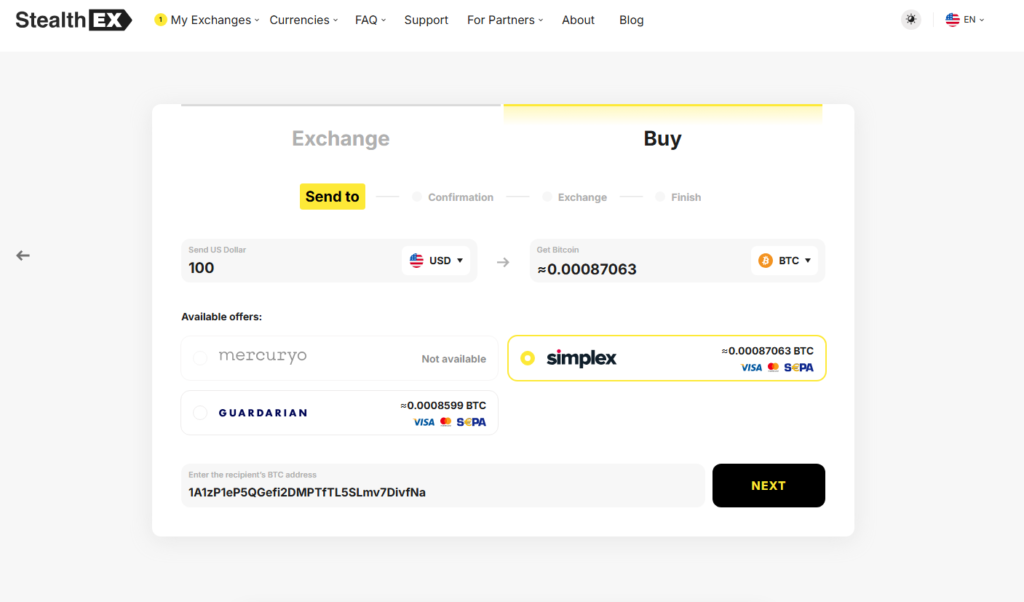
Let’s have a quick look at how you can buy Bitcoin on a platform like StealthEX:
First, select the “Buy” option, choose the type of fiat and the amount, enter your BTC address, and pick a payment option. In the example, below, we’ve used Satoshi Nakamoto‘s address.
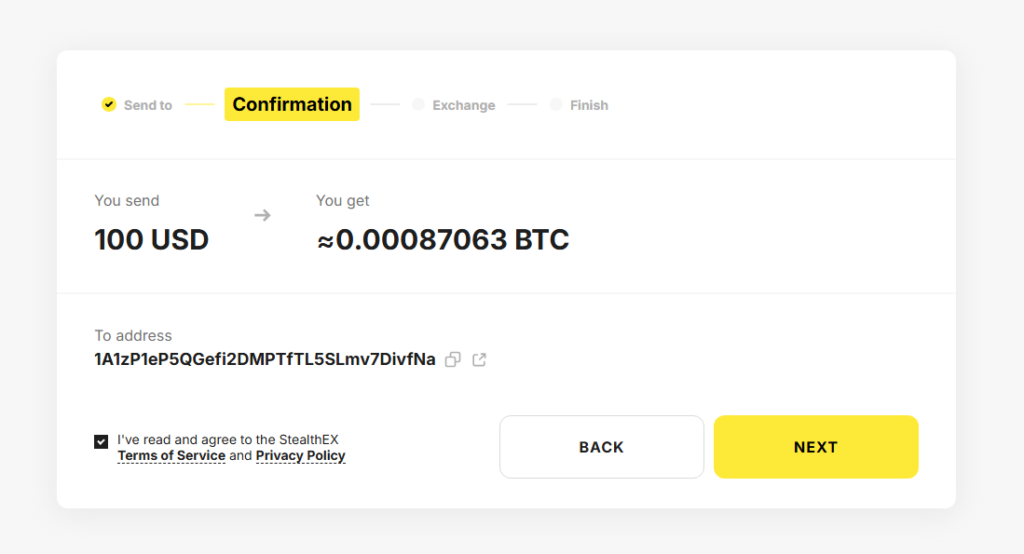
Then, confirm that the details are correct.
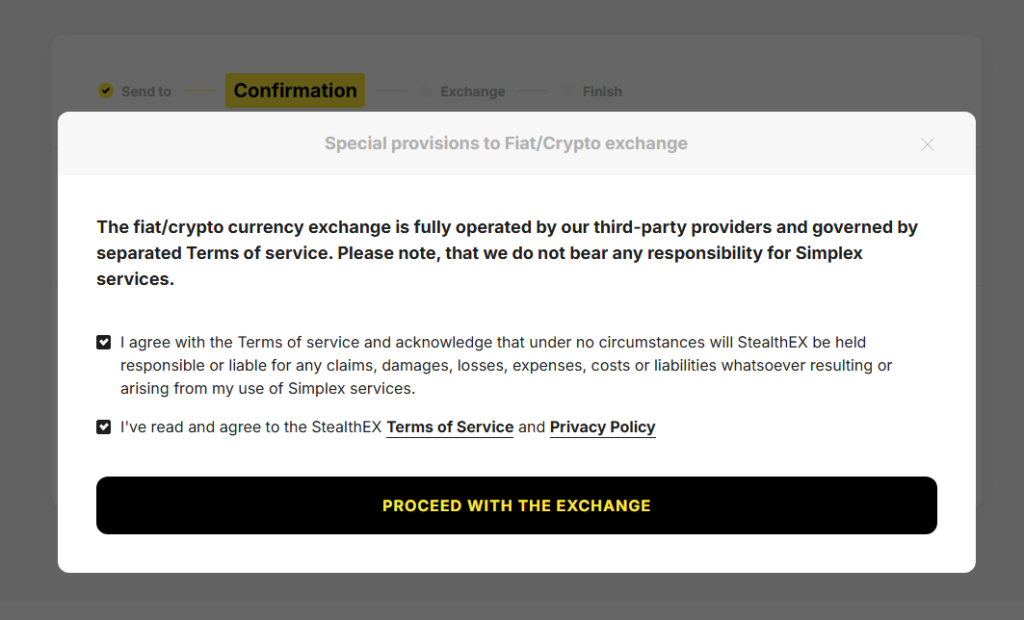
Next, agree with the terms of service and privacy policy of the platform.
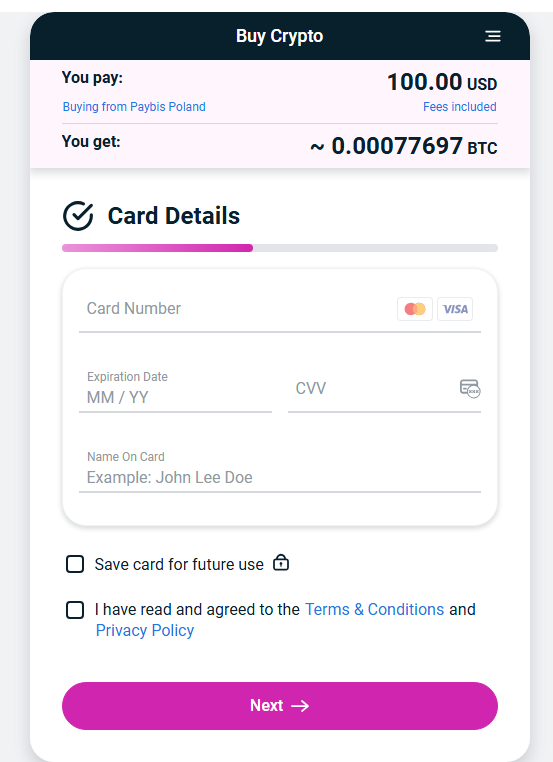
Finally, proceed with your credit card details to finalize the transaction.
Decentralized crypto exchanges work by routing trades across liquidity pools and automated market makers to match supply and demand. You’ll enter your wallet address, send a specific coin (like Monero or Ethereum), and receive BTC in return. The lack of ID checks makes the process convenient, but it comes at a cost.
Be aware that fees and slippage are higher than centralized crypto exchanges. You’ll want to check each platform’s limits and supported regions. Still, they offer fast, private trades without revealing your real identity. Remember, if you’re starting with fiat, you’ll need to convert cash into a privacy-friendly coin first before using these swaps.
Use a Bitcoin ATM
Bitcoin ATMs let you convert cash into BTC on the spot. Worldwide, there are over 39,638 machines as of January 2026. Many allow small purchases without any ID. This threshold varies depending on the region and operator.
To use a Bitcoin ATM, you typically select “Buy Bitcoin,” enter the amount, scan your wallet’s QR code, and insert cash. Within minutes, the Bitcoin is sent to your address. It’s simple and intuitive, ideal for those looking to buy crypto without an ID.
However, there are some notable downsides. Bitcoin ATM fees range from 6–10%, sometimes higher, depending on demand, network congestion, and the operator. Also, more ATMs are beginning to enforce phone verification or biometric scans, even for small amounts. You’ll need to locate a machine that allows anonymous use, which can be done using websites like CoinATMRadar.
Always check the machine’s KYC policy in advance, and avoid ATMs that require an ID scan. If done right, this remains one of the most accessible ways to buy Bitcoin anonymously using cash.
Use Peer‑to‑Peer Platforms
P2P marketplaces like Bisq, Paxful and others let you trade cash or other assets for BTC. With Bisq, no account or identity check is needed because transactions rely on escrow smart contracts, decentralized order books, and secure communication channels. It’s a true decentralized exchange with privacy baked in.
For Bisq, download the Bisq desktop client, connect it to your wallet, and then trade with others directly. The platform uses multi-signature escrow, so neither party can steal the funds without completing the trade. Security deposits are required to discourage scams.
Paxful and similar platforms also offer ways to trade Bitcoin for prepaid gift cards, bank deposits, PayPal transfers, or even in-person cash trades. Many sellers allow trades under a certain amount without requiring ID.
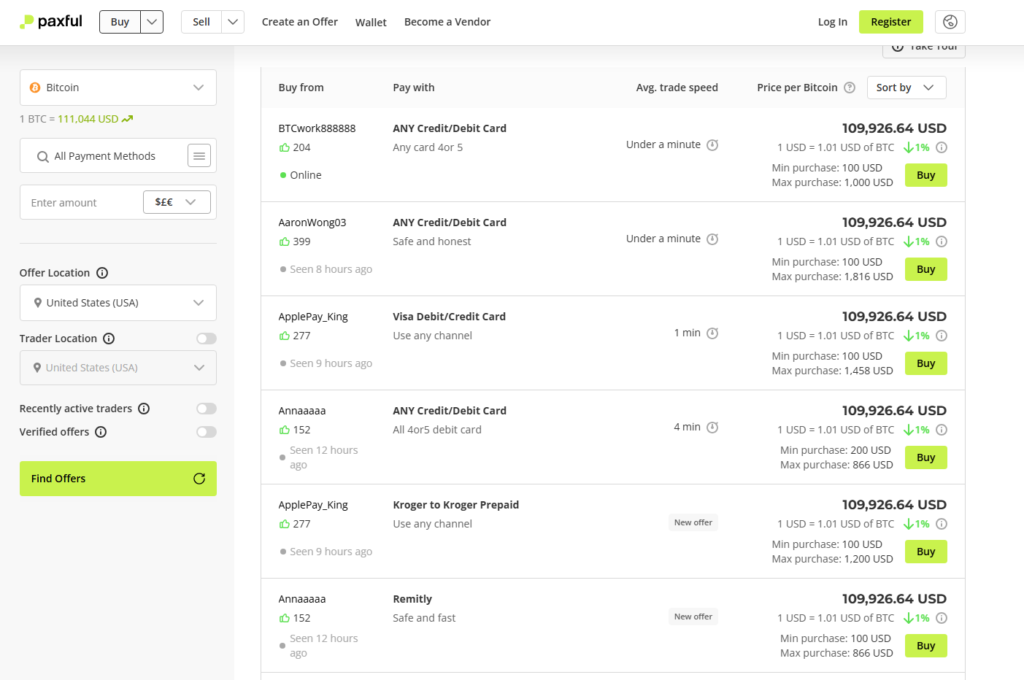
However, trust plays a larger role on these platforms. You’ll need to review seller reputations and take additional precautions before you make a decision.
It’s also worth noting that some governments are targeting P2P transactions, so local laws must be considered. Nonetheless, peer-to-peer is arguably the most flexible method for anonymous BTC purchase.
Buy Privacy Coins and Swap for Bitcoin
If you already hold coins like Monero (XMR), Zcash (ZEC), or others, which are inherently more private, you can swap them for BTC on platforms or decentralized crypto bridges.
This method offers an extra layer of privacy, as the origin of your funds becomes more difficult to trace. You might first acquire Monero through a P2P deal or mining, then send it through a privacy-enhanced chain, and finally swap it into BTC.
However, remember that once you re-enter the Bitcoin network, your transaction becomes visible on the public blockchain. If you value long-term privacy, avoid sending BTC directly to centralized exchanges or reusing addresses. Using privacy coins alongside decentralized swaps offers significantly more anonymity than relying solely on fiat-based methods.
Mine the BTC Yourself
Even though it’s not technically buying the BTC directly, mining it is another option to remain anonymous. This method avoids KYC entirely and doesn’t require interacting with third parties. However, it comes with high upfront costs, like purchasing an ASIC miner, setting up proper ventilation and electricity infrastructure, and managing software and firmware.
While joining mining pools can make mining more accessible and profitable, many pools require registration, track IP addresses, or enforce KYC, which can compromise your privacy. Lastly, even if the mined BTC is not initially linked to your identity, spending it or cashing out through centralized services may expose you to blockchain surveillance.
Mining BTC requires technical know-how, and it may take a long period to see a return on the initial costs of mining hardware. Despite that, it’s still an option worth considering in the name of anonymity.
| Method | Privacy Level | Pros | Cons |
|---|---|---|---|
| No-KYC Swap Platforms | High | No ID required, Fast and easy swaps | Higher fees and slippage, limited fiat options |
| Bitcoin ATMs | Medium-High | Easy to swap cash for BTC, Many allow small purchases without ID | High fees, Some machines require ID or phone |
| Peer-to-Peer Platforms | High | Full control and privacy, Multiple payment options | Risk of scams, Regulatory pressure |
| Privacy Coins | Very High | Strong privacy, Avoids fiat on-ramp | Requires multiple steps, BTC becomes traceable after swap |
| Mining | Medium-High | No KYC, BTC sent directly to your non-custodial wallet | Hardware and energy costs, Requires tech know-how, May expose ID/location |
Can I Cash Out My Bitcoin Anonymously?
The short answer, probably not fully. KYC rules apply to withdrawals beyond small amounts at ATMs or via centralized exchanges. In most cases, you’d use P2P platforms to sell BTC for cash outside exchanges, but even these transactions risk traceability unless conducted carefully.
For example, meeting someone locally to sell BTC for cash is possible, but it comes with risks, including scams and security threats. Using escrow-backed trades on Bisq or LocalCryptos may be safer, but anonymity depends heavily on your operational security. Avoid linking your IP address, use a VPN when possible, and never reuse wallet addresses.
Bitcoin ATMs that offer cash withdrawals usually require phone verification or ID scanning, especially for bigger withdrawals.
Why is There KYC in Bitcoin?
KYC and AML (Anti-Money-Laundering) regulations apply even to crypto. Bitcoin wallets may not show your name, but every BTC transaction is viewable by anyone, so platforms require identity checks to prevent illegal activity. That transparency is a double-edged sword, it helps trace illicit behavior, but it also reduces true financial privacy.
Governments want to prevent money laundering, terror financing, and tax evasion. As a result, most regulated exchanges must enforce strict verification before allowing trades, deposits, or withdrawals. Even non-custodial services sometimes add geoblocking or enhanced checks depending on your region.
Chainalysis and other blockchain analytics firms work closely with governments and exchanges to trace suspicious transactions. Their tools can deanonymize users through clustering, behavioral patterns, and address linking. That’s why using KYC-free tools in combination with privacy practices is key if you want to buy Bitcoin anonymously.
Closing Thoughts
You can still buy Bitcoin anonymously in 2026 using tools like no‑KYC platforms, cash ATMs, peer‑to‑peer deals, privacy coin swaps, or acquire it through mining. However, blockchain analytics tools and evolving regulations can still trace some of these transactions. Balance your privacy goals with potential legal implications and personal security risks.
Just remember that privacy is not a one-time setup. It’s a continual process that requires vigilance, technical awareness, and a willingness to adapt your tools as the system evolves.