

Key Takeaways
- Polymarket enables users to earn rewards by providing liquidity, rather than just betting directly on outcomes.
- To add liquidity, users must deposit USDC into their Polymarket wallet, confirm the transfer, and then place limit buy and sell orders close to a market’s midpoint.
- Liquidity providers make the platform more stable and earn rewards from Polymarket’s Liquidity Rewards Program.
- Providers should be aware of rapid price swings that can erode token value and actively monitor their assets to avoid losses.
Prediction markets have become one of the most innovative corners of crypto, and Polymarket sits at the center of this trend. The platform lets users trade on the outcomes of global events, from elections to sports to tech breakthroughs. Recently, it has drawn even more attention after Donald Trump Jr. announced his involvement, which added a wave of new traders and liquidity seekers.
For those who want exposure to the platform (and its potential gains) without betting on specific outcomes, adding liquidity provides an attractive option. Instead of wagering on whether an event resolves to “Yes” or “No,” users can support the marketplace itself and earn a share of the liquidity rewards.
In this article, we will go over the process of adding liquidity to Polymarket, why it matters, the risks involved, and what you should know before getting started.
How Polymarket Works
At its core, Polymarket is a decentralized prediction market. Instead of betting against a bookmaker, you trade outcome tokens that represent potential results of a real-world event. For example, a market might ask, “Will Candidate X win the election?” Traders can buy “Yes” or “No” tokens depending on their expectations. The token that matches the real outcome eventually settles at full value, while the losing token becomes worthless.
What makes Polymarket function smoothly is liquidity. Just like traditional crypto exchanges, Polymarket needs active buy and sell orders to allow users to trade quickly and fairly. This is where liquidity providers come in. They help stabilize the markets by supplying a balanced volume of orders on both sides (Yes/No). By adding more orders, liquidity providers increase the depth so larger orders don’t cause dramatic changes in probabilities. To better illustrate, let’s look at an example.
Imagine a market asking, “Will Candidate X win the election?” that’s currently trading at 60¢ Yes / 40¢ No. If there isn’t enough liquidity, a trader placing a $1,000 buy order for “Yes” could quickly push the price up to 70¢ or higher, shifting the implied probability. But if liquidity providers have placed substantial limit orders ($20,000) on both sides, that same $1,000 trade would cause only a small price movement, keeping the market stable and fair for everyone.
But since there are no platform fees charged on trades, liquidity providers don’t directly earn from trader transaction fees like on traditional decentralized crypto exchanges. Instead, their incentives come from Polymarket’s liquidity rewards program, which distributes rewards to LPs based on the amount of liquidity they supply and the duration it remains in the markets. This structure encourages deeper liquidity while keeping trading frictionless for users.
Although this resembles liquidity pools in decentralized finance (DeFi), the process is a bit different. Rather than depositing funds into a smart contract that automatically manages them, Polymarket requires you to actively place limit orders on both sides of a market.
How to Add Liquidity to Polymarket
Adding liquidity on Polymarket might sound more complex when compared to other DeFi platforms, but once you understand the steps, the process becomes straightforward. Let’s walk through the process step by step.
Deposit USDC into Your Polymarket Wallet
- Create an account on Polymarket: First and foremost, start by logging in. You can sign up through email or directly use a crypto wallet if you already have one.
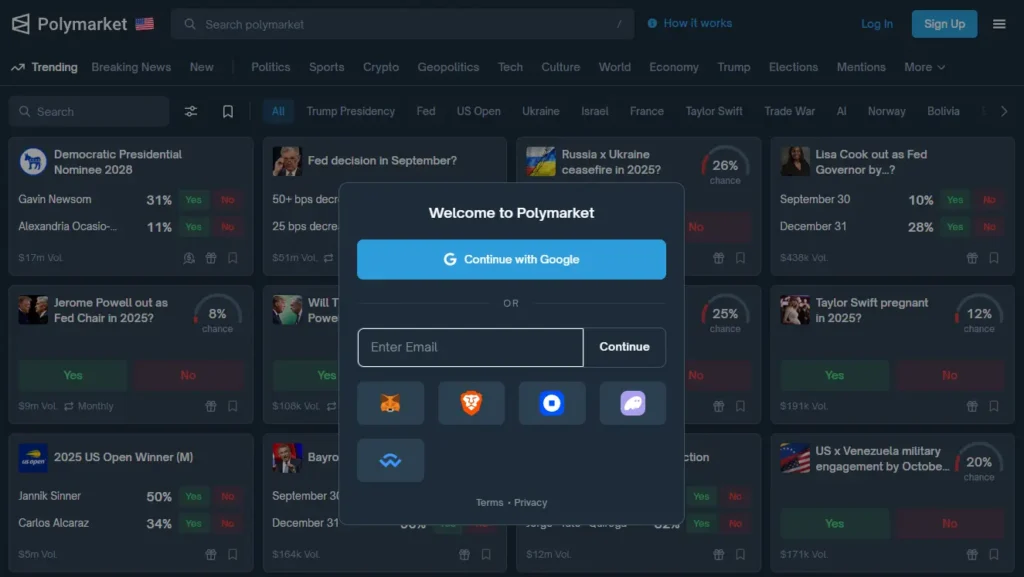
- Get your Polymarket wallet address: Once you’re logged in, click on “Deposit” to find your wallet address. This is where you will send funds before you can start providing liquidity.
- Transfer your funds: If you’ve connected with a crypto wallet and you already have some crypto in it, you can directly transfer funds to your account. Alternatively, you can use a centralized cryptocurrency exchange to transfer tokens directly to your Polymarket wallet. All transferred assets will be automatically converted to the USDC stablecoin. Polymarket supports many of the popular chains.
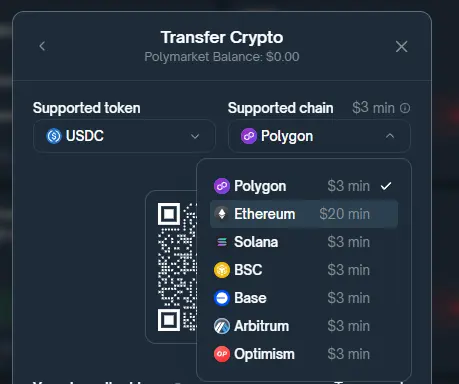
- Confirm the deposit: Once you have sent funds, return to the Polymarket deposit page. Your funds will now appear in your Polymarket wallet, ready for trading.
Become a Liquidity Provider by Placing Limit Orders
- Check the current rewards: Select the “Rewards” section under “More” in the upper right part of the website. This will show you the current liquidity rewards for different markets. Pick one with decent rewards and low competition. If the competition is high, you’ll receive proportionately lower rewards.
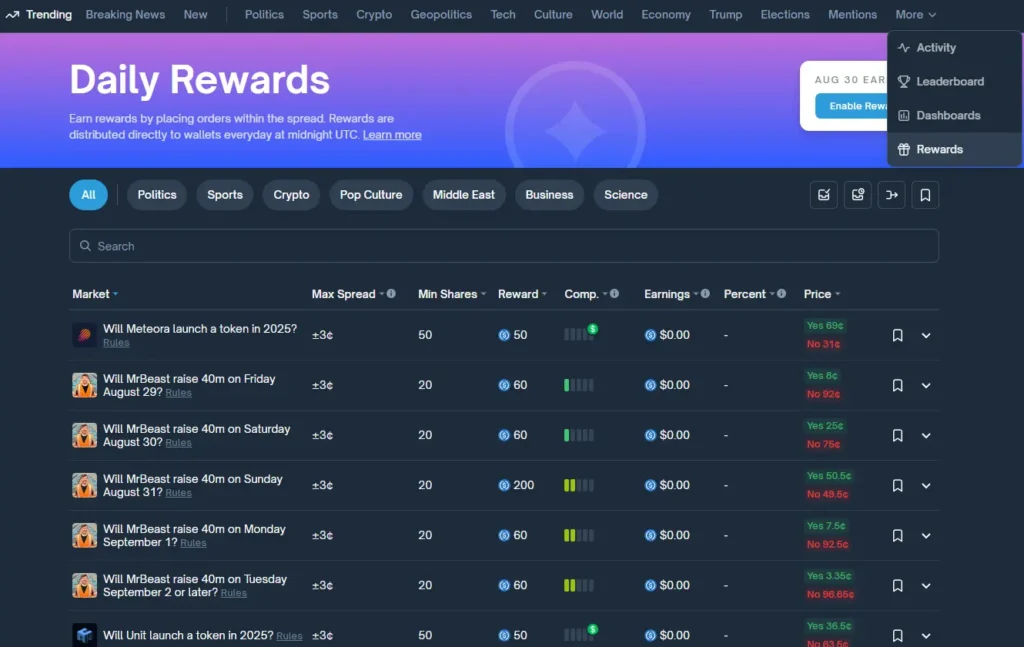
- Select a market page: Navigate to the specific Polymarket page. Each market has its own page where you can see the price of the outcome tokens and recent trading activity.
- Place a limit order: To qualify for liquidity rewards, you need to place two limit orders: one to buy and one to sell. This ensures that you are providing liquidity on both sides of the trade. Note that there’s a minimum number of shares that you must purchase for the order to go through.
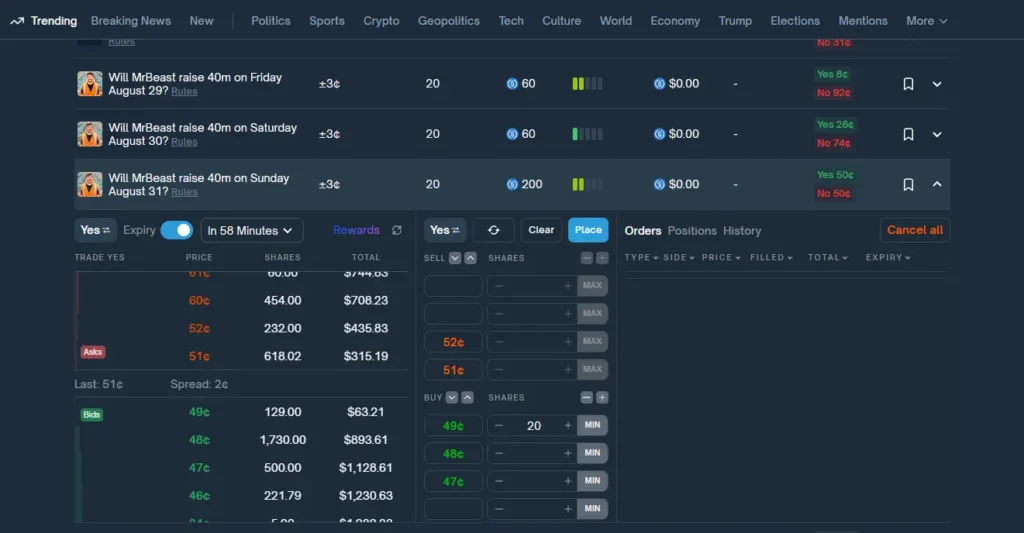
- Be close to the midpoint: For your orders to count toward the Liquidity Rewards Program, they must be close to the market’s midpoint price. The midpoint reflects the balance between “Yes” and “No” prices. Staying close to this number helps stabilize the market and increases your share of the reward pool.
- Earn rewards: Once your limit orders are active, you become a liquidity provider. The closer you keep your orders to the midpoint, the more stable the market becomes, and the higher your rewards can be. Rewards are distributed daily, so you won’t have to wait long.
Why Provide Liquidity on Polymarket?
Providing liquidity on Polymarket is not just about helping the platform. It can also be a way to generate returns without actively betting on outcomes. Let’s break down the main reasons why users decide to participate.
Support the Platform
Liquidity is the lifeblood of Polymarket. By placing limit orders, you make it easier for traders to enter and exit positions without facing wide spreads or illiquid conditions. This contribution supports the platform’s overall health and ensures that markets remain fair and efficient. Without liquidity providers, Polymarket would struggle to function as an attractive marketplace.
Incentive Programs
Polymarket also offers the Liquidity Rewards Program, which specifically incentivizes users to provide liquidity. By positioning your orders correctly, you become eligible for liquidity rewards. This makes liquidity provision a more attractive strategy compared to simply holding USDC on the sidelines.
Polymarket Liquidity Risks
While providing liquidity on Polymarket can be rewarding, it carries risks that traders should understand before committing any funds. Markets can shift quickly, and poorly managed liquidity can result in losses.
The biggest danger for liquidity providers is when the price of outcome tokens changes dramatically. Since you are holding both sides of a market, sudden moves can erode the value of your positions.
For example, let’s say Bob decides to add $100 USDC to a market where “Yes” tokens are trading at $0.90 and “No” tokens are at $0.10. He receives LP tokens and holds $90 worth of “Yes.” If the price of “Yes” suddenly falls to $0.50, Bob’s position is now worth only $50. Even though he still has exposure, he has lost over 40% of his original value.
This risk highlights the need for active management. Liquidity providers must monitor markets and adjust orders as conditions change. If you place orders too far from the midpoint, they may not qualify for rewards. If you place them too close without monitoring, you could get caught on the wrong side of a sudden market swing.
In addition to price risk, there are operational risks such as delays in confirming deposits and the complexity of managing multiple orders. These add another layer of responsibility for liquidity providers.
Closing Thoughts
Adding liquidity to Polymarket offers a unique way to earn rewards while supporting one of the most innovative platforms in crypto. Unlike traditional DeFi protocols, where you deposit into a pool and wait, here you take an active role by placing limit orders that stabilize the marketplace. If you position your orders near the midpoint and monitor your exposure, you can benefit from the platform’s incentive programs.
However, you should never overlook the risks. Price swings in outcome tokens can quickly change the value of your positions, and low-activity markets may not deliver meaningful rewards. Liquidity provision on Polymarket requires a blend of patience, management, and awareness of market conditions. It can be a worthwhile opportunity if approached with the right strategy and caution.