- Key Takeaways
- Seven F1 Crypto Sponsorships
- 1. Crypto.com × Formula 1 (Series-Level Partner & Race Title Sponsor)
- 2. OKX × McLaren (Primary Partner & Livery Collaborator)
- 3. Binance × BWT Alpine (Fan Token Partner)
- 4. Stake × Sauber (Team Naming Rights & Crypto-Betting Integration)
- 5. FTX × Mercedes (Partnership Collapse & Reputational Risk)
- 6. Bybit × Red Bull Racing (High-Value Deal With A Quiet Ending)
- 7. Velas × Ferrari (NFT Partnership Turned Cautionary Tale)
- Closing Thoughts


Key Takeaways
- Crypto has become a major financial pillar for Formula 1.
- The nature of sponsorships is evolving: it’s not just about logos – it’s about tech, engagement, and integration.
- Crypto-F1 partnerships come with both high reward and real risk.
- Crypto sponsorships are reshaping how F1 reaches and engages younger, tech-savvy audiences globally.
- The future of F1 sponsorships may shift toward fewer but deeper, more integrated crypto-partnerships rather than many shallow deals.
Few business stories illustrate the collision of innovation, money, and culture quite like the rapid rise of crypto sponsorships in Formula 1.
On one side sits F1, a sport long associated with cutting-edge engineering, velocity, financial sophistication, and global glamour. On the other sits the crypto industry, a sector obsessed with efficiency – transactional speed, technological evolution, market cycles – and a relentless belief in the future of digital finance.
A partnership between these two worlds almost feels inevitable.
The relationship accelerated around 2020/22, when blockchain companies flush with liquidity began seeking global recognition. F1, with a calendar that spans five continents and a broadcasting footprint rivaling any sport on Earth, offered precisely that gateway. Crypto firms didn’t just want logo placement – they wanted to align themselves with a sport that symbolised technical ambition and innovation.
But after early hype came growing pains: bankruptcies, lawsuits, scaled-back deals, and a renewed focus on sustainability and due diligence. Today, crypto remains part of F1’s commercial DNA – but with clearer boundaries, deeper partnerships, and a more realistic understanding of what blockchain companies bring to the sport.
To fully understand how this story evolved – and how it is still unfolding – we need to zoom in on the key partnerships.
In this article, we break down seven of the most influential Formula 1 crypto sponsorships, explaining what they involve, how they’ve shaped the sport, and what they reveal about the shifting dynamics between motorsport and digital finance.
Seven F1 Crypto Sponsorships
Below is a curated list of the most significant crypto-based Formula 1 sponsorships shaping the sport today. Each entry includes partnership details, context on the team’s sponsorship history, and analysis of how the deal influences F1.
1. Crypto.com × Formula 1 (Series-Level Partner & Race Title Sponsor)
When It Started
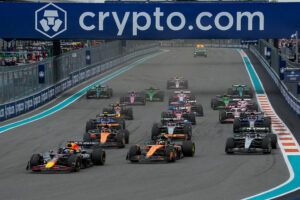
Crypto.com became a Global Partner of Formula 1 in 2021, signing a deal reportedly worth over $100million. The partnership was later extended through 2030, signaling long-term integration into F1’s ecosystem.
F1’s Sponsorship Context
Before Crypto.com, F1’s top-level partners were dominated by luxury brands, logistics companies, tech giants, and long-standing corporate sponsors. A blockchain brand taking up series-level real estate marked a major step toward digital financial integration – and a shift in F1’s commercial landscape.
What The Sponsorship Entails
-
Naming rights for the Formula 1 Crypto.com Miami Grand Prix
-
Trackside and digital branding across multiple races
-
NFT and digital collectible initiatives
-
Fan experience activations involving Web3 tools
Crypto.com is not just ‘visible’ – it is embedded in F1’s visual language, signaling that crypto is no longer an outsider, but a bona fide commercial partner.
2. OKX × McLaren (Primary Partner & Livery Collaborator)

When It Started
OKX became a Primary Partner of McLaren in 2022, later expanding its role to major branding placements and special edition liveries through 2023/25.
McLaren’s Sponsorship Context
Historically, McLaren partnered with major tech and automotive names – Vodafone, Mercedes, Dell, and Gulf Oil. As McLaren rebuilt its competitive identity, it also sought a modern sponsor profile. OKX represents a shift toward culturally expressive, design-oriented partnerships.
What The Sponsorship Entails
-
Large OKX branding on the McLaren race car and driver suits
-
Co-designed special liveries (e.g., the Monaco ‘Riviera’ theme)
-
Web3-powered fan experiences and digital campaigns
This deal shows how crypto sponsors are evolving from passive advertisers to creative collaborators, influencing not just businesses but aesthetics and fan culture.
3. Binance × BWT Alpine (Fan Token Partner)
When It Started
Binance signed on as Official Fan Token Partner and Esports Partner of BWT Alpine in 2022.
Alpine’s Sponsorship Context
As Renault rebranded the team to Alpine, it sought new-generation sponsors to match its refreshed identity. Binance filled a role previously untouched by legacy sponsors – introducing blockchain-based fan engagement tools.
What The Sponsorship Entails
-
Development of the ALPINE Fan Token, offering voting rights and digital rewards
-
Binance logos on the Alpine car and team kit
-
Joint Esports activations and NFT product lines
This sponsorship highlights the financialisation of fandom, where participation increasingly intersects with digital assets.
4. Stake × Sauber (Team Naming Rights & Crypto-Betting Integration)
When It Started
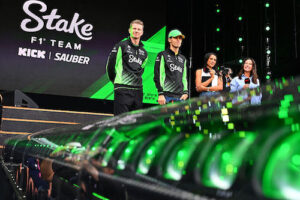
Beginning in 2024, Stake became the title sponsor of Sauber, rebranding the team as Stake F1 Team KICK Sauber through 2025.
Sauber’s Sponsorship Context
Sauber has often partnered with transitional or niche sponsors – Petronas, Credit Suisse, Alfa Romeo. With Audi set to take control in 2026, Sauber entered a commercially flexible period where high-risk, high-reward partnerships were possible.
What The Sponsorship Entails
-
Full team naming rights – an unprecedented move for a crypto-linked betting firm
-
Stake/KICK branding on the car, garage, driver suits, and media assets
-
Cross-platform collaborations with streaming and digital payment partners
The deal demonstrates how volatile industries seek maximum visibility during market peaks.
5. FTX × Mercedes (Partnership Collapse & Reputational Risk)
When It Started
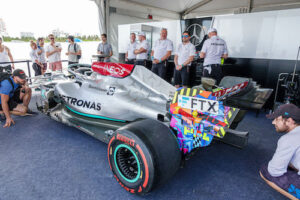
FTX joined Mercedes-AMG Petronas as a major sponsor in 2021, with branding featured prominently on the W12 and W13 cars.
Mercedes’ Sponsorship Context
Mercedes has long attracted premium tech and finance partners such as Petronas, Epson, and Qualcomm. FTX represented a new wave of high-growth financial technology firms seeking credibility via elite sports.
What the Sponsorship Entails
Originally:
-
Branding on the car’s nose and rear wing
-
Joint NFT initiatives
-
Access to the team’s hospitality and promotional channels
However, when FTX collapsed spectacularly in late 2022, Mercedes:
-
Terminated the partnership immediately
-
Removed FTX branding mid-weekend
-
Became indirectly involved in ongoing lawsuits concerning FTX’s promotional activities
This event became the symbolic end of the first crypto sponsorship boom, reminding teams of the financial and reputational risks inherent in partnering with unregulated digital finance companies.
6. Bybit × Red Bull Racing (High-Value Deal With A Quiet Ending)
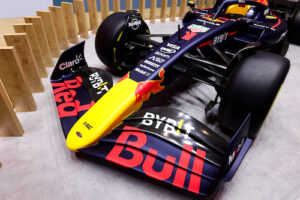
When It Started
In 2022, Bybit signed what was reportedly one of the largest crypto sports sponsorships ever, valued around $150million.
Red Bull’s Sponsorship Context
Red Bull’s commercial strategy revolves around aligning with fast-growing disruptors. Oracle, Honda, TAG Heuer, and Unilever have all held prominent positions. Bybit fit neatly into Red Bull’s innovative, edgy brand persona.
What The Sponsorship Entailed
-
Major logo placement on the RB18–RB20 cars
-
Support for Red Bull Racing’s NFT and fan-token initiatives
-
Content collaborations and community engagement programs
The deal ended quietly in 2024, without scandal or public fallout – demonstrating a shift toward more disciplined, mutually measured partnerships in the crypto space.
7. Velas × Ferrari (NFT Partnership Turned Cautionary Tale)
When It Started
Ferrari announced a multi-year partnership with Velas Network in late 2021, focusing heavily on NFTs and digital fan experiences.
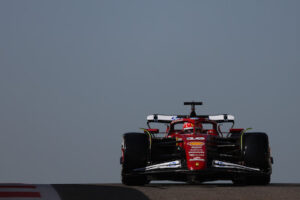
Ferrari’s Sponsorship Context
Ferrari historically partners with automotive, luxury, and financial giants – Shell, Ray-Ban, Santander. Velas represented an experimental move into digital collectibles during the peak NFT boom.
What The Sponsorship Entailed
-
Velas branding on the Ferrari F1 cars and team clothing
-
Co-development of premium NFT collections
-
Interactive digital fan events
However, amid market volatility and internal concerns about contractual obligations, Ferrari terminated the partnership early in 2023, forfeiting an estimated $30-55million in expected payments.
This outcome reinforces how fragile crypto-driven revenue streams can be, especially when paired with legacy brands demanding consistency and reliability.
Closing Thoughts
The relationship between Formula 1 and the crypto industry is a story of innovation, risk, reinvention, and cultural synergy.
Crypto brands initially entered F1 with overwhelming financial force, eager to buy global credibility and association with high-tech excellence. Teams welcomed this influx of capital – especially during and after the pandemic era when sponsorship markets were tightening.
But as the industry matured, the dynamics shifted.
-
Some partnerships deepened, becoming design or technology collaborations (OKX × McLaren, Crypto.com × F1).
-
Others collapsed dramatically, exposing the risks of aligning with unstable markets (FTX × Mercedes, Velas × Ferrari).
-
A new wave of deals began focusing on long-term integration rather than short-term hype (Stake × Sauber, Binance × Alpine).
Through it all, one thing has become clear: crypto is now embedded in F1’s commercial fabric, influencing how teams fund development, how fans engage with the sport, and how F1 presents itself to the world.
While the volatility of the digital asset industry ensures that challenges will continue, the alignment between F1’s culture – speed, precision, innovation – and crypto’s forward-looking ethos makes this partnership uniquely resilient.
As the next seasons unfold, expect fewer speculative deals and more strategic, deeply integrated collaborations, shaping not just F1’s branding but its technological evolution and global fan experience.