- What Is a Deflationary Token?
- Why Play-to-Earn Token Inflation Became GameFi’s Biggest Structural Risk
- What Makes SFDT a Deflationary Token?
- The Three-Round Presale: Progressive Pricing, Structured Vesting
- Is the SFDT Presale a Good Entry Point Before Listing?
- Deflationary Design Is How GameFi Survives Its Own Growth


Most play-to-earn projects mint their way into irrelevance. Reward tokens pour out faster than any market can absorb them, the price collapses and the P2E loop that made the game worth playing in the first place unravels alongside it. Axie Infinity’s Smooth Love Potion demonstrated the failure at ecosystem scale: SLP peaked above $0.35 in mid-2021, then shed over 99% of its value as continuous emissions overwhelmed demand. STEPN’s GST followed the same arc months later, falling from roughly $8 at peak to around two cents by late November 2022.
SkyFleetDash, a deflationary P2E racing game on BNB Smart Chain, was designed to avoid that outcome at the contract level. Its native SFDT token automatically burns 2% of every transfer, permanently. The project is CertiK-audited, holds CertiK team KYC verification and has already placed approximately 17 million SFDT with strategic backers ahead of a three-round public presale. With TGE targeted for Q3, investors examining the deflationary architecture and the supporting trust signals have a clear window before the first round opens.
What Is a Deflationary Token?
A deflationary token is a cryptocurrency whose circulating supply decreases over time through systematic burning, creating scarcity as on-chain activity grows. The distinction matters. Most projects announce periodic buyback-and-burn events tied to revenue targets. Those events often arrive late, scale with team discretion, or disappear when the treasury runs thin.
A hardcoded burn-on-transfer tax is structurally different. The burn fires on every transaction with no human input, governance vote, or override. SFDT uses this model. The 2% burn is set at the contract level and is immutable: every trade, conversion and payment in SFDT permanently removes 2% of the amount from total supply. On top of that continuous baseline, quarterly burn events are planned, layering additional supply compression on top of the per-transfer rate.
The result is a deflationary crypto mechanism that scales with the ecosystem. The more players trade assets, convert in-game rewards and participate in the marketplace, the more SFDT is permanently removed from supply — turning ecosystem growth into a supply headwind for the token.
Why Play-to-Earn Token Inflation Became GameFi’s Biggest Structural Risk
Without a matching supply sink, in-game reward emissions always eventually exceed demand — and the P2E reward loop becomes the mechanism of its own destruction.
The pattern is consistent across every failed case. Players earn token rewards for gameplay. Those rewards flow to open markets and are sold. If new buyers don’t absorb the volume, or if speculative inflows stall, the price falls. Lower prices reduce the P2E loop’s appeal, trigger player churn and further compress buy pressure. The spiral is self-reinforcing and, once established, nearly impossible to reverse without a structural intervention.
Axie and STEPN are the clearest cautionary cases, but the underlying failure is sector-wide. The common failure mode: inflationary tokens by default, with burn mechanisms that couldn’t keep pace.
Unlike most space-themed P2E projects, SkyFleetDash combines competitive spacecraft racing with a deflationary dual-token economy. The burn is hardcoded from day one, not patched in after the damage is done.
What Makes SFDT a Deflationary Token?
SFDT’s 2% burn fires on every on-chain transfer automatically — reducing total supply with every trade, conversion and payment, no team action required.
The deflation operates across two reinforcing layers:
- Per-transfer tax: every time SFDT moves on-chain, 2% of the transferred amount is permanently destroyed. The rate is immutable and cannot be paused, reduced, or removed.
- A planned schedule of quarterly burn events, providing additional periodic supply compression on top of the continuous baseline rate.
The dual-token economy amplifies the architecture. SkyFleetDash separates its in-game currency from the tradeable governance token:
- GC (GameCoin) — earned from competitive racing and in-game activity; absorbs the raw volume of in-game reward emissions without hitting external markets. GC is non-tradeable on exchanges.
- SFDT — the on-chain utility and governance token. Earned through GC-to-SFDT conversion, marketplace activity and tournament rewards.
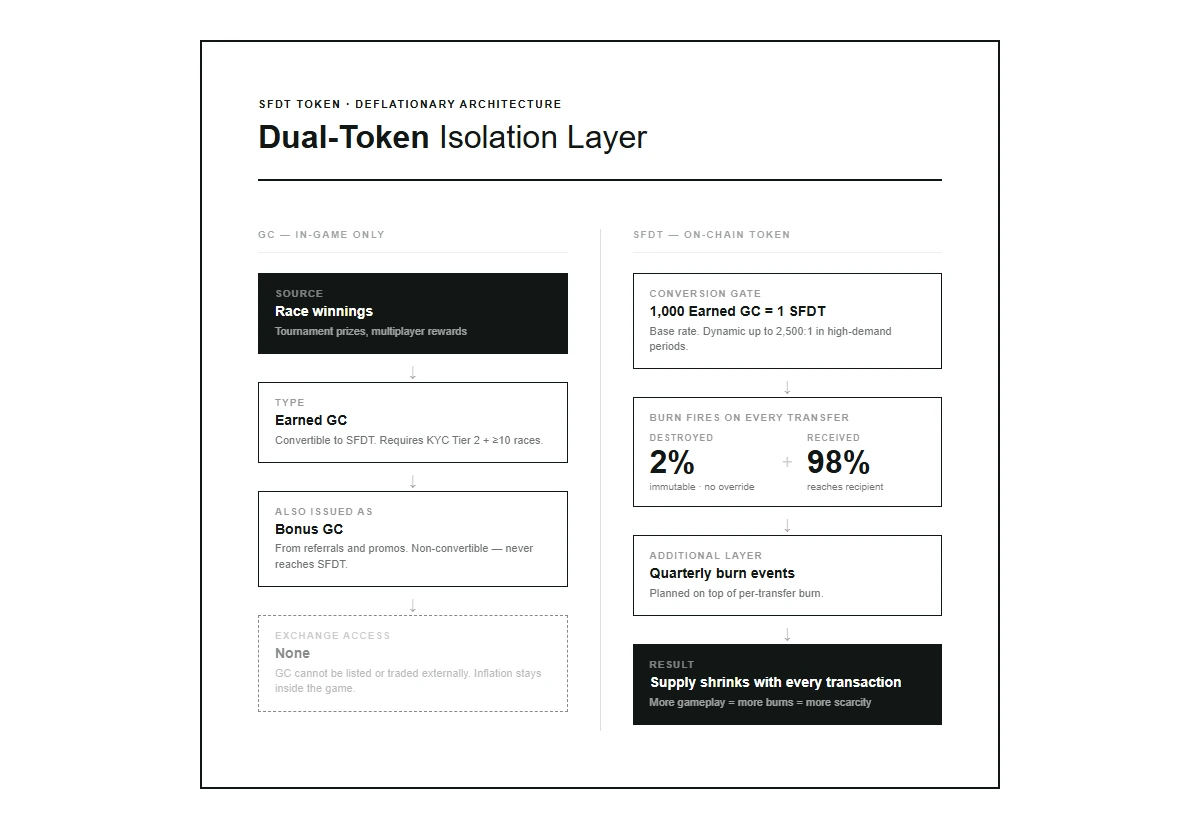
By routing most in-game emissions through GC first, the platform insulates SFDT from the constant sell pressure that killed SLP and GST. Players convert Earned GC into SFDT at a base rate of 1,000 GC per SFDT. That conversion triggers the 2% burn directly, meaning gameplay activity feeds the deflationary mechanism in real time.
SkyFleetDash is a BNB Smart Chain play-to-earn competitive racing game with a fixed 1-billion SFDT supply, an immutable 2% burn-on-transfer tax, CertiK-audited smart contracts and a three-round public presale ahead of a Q3 TGE.
| Metric | Detail |
|---|---|
| Total supply | 1,000,000,000 SFDT — fixed at launch, no further minting |
| Per-transfer burn | 2% of every transferred amount, immutable |
| Additional burns | Quarterly burn events planned on top of per-transfer |
| Dual-token isolation | GC absorbs in-game emissions; SFDT maintains on-chain scarcity |
| Smart contract | CertiK-audited; CertiK team KYC verified |
| Initial market cap | ~$13.5M (at $0.10 public launch, ~135M circulating SFDT) |
| Fully diluted valuation | $100M |
| TGE | Q3 |
The Three-Round Presale: Progressive Pricing, Structured Vesting
The SFDT presale covers three sequential rounds at up to 50% below the $0.10 public launch price, distributing 100M SFDT — exactly 10% of the fixed supply.
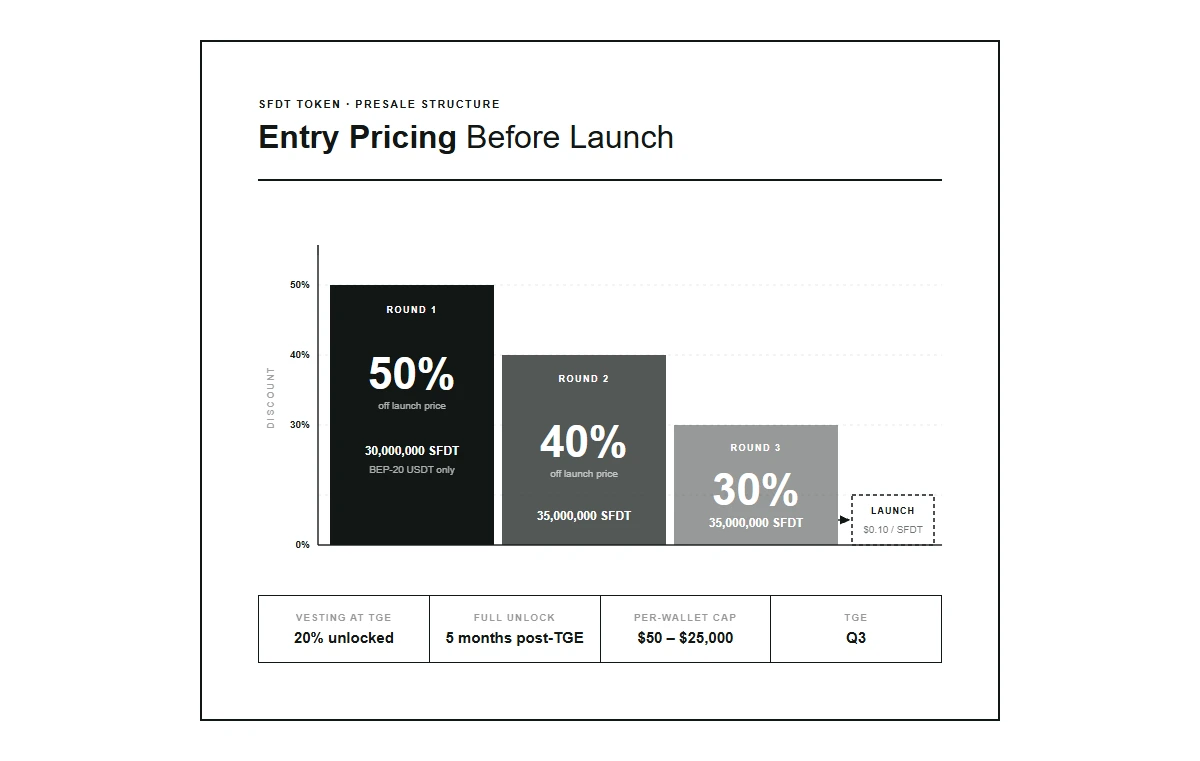
Each round closes before the next opens; payment options expand as the community grows.
| Round | Discount vs $0.10 Launch | Tokens Available | Payment Accepted |
|---|---|---|---|
| Round 1 | 50% off | 30,000,000 SFDT | BEP-20 USDT |
| Round 2 | 40% off | 35,000,000 SFDT | USDT, BNB, BUSD |
| Round 3 | 30% off | 35,000,000 SFDT | USDT, BNB, BUSD |
| Public Launch | — | 100M (separate allocation) | Via exchange listings |
Round 1 has not yet opened; the community will announce the start date. Rounds 2 and 3 follow sequentially. Per-wallet participation is capped between $50 and $25,000.
Presale tokens vest at 20% on TGE, with the remaining 80% released in equal monthly installments over four months — fully unlocked five months from the TGE date. Team allocation carries a one-year cliff followed by two-year linear vesting, structurally limiting insider liquidity at launch.
At the $0.10 public launch price, the initial circulating supply at TGE is approximately 135 million SFDT, resulting in an initial market cap of ~$13.5M and a fully diluted valuation of $100M. An additional 10% of the total supply is reserved for the public launch via exchange listings, with the exchange liquidity allocation to be locked on Team Finance or UNCX at the time of listing.
The vesting structure and the deflationary mechanism interact by design: as presale tokens unlock and move on-chain over the first five months, every transfer feeds the 2% burn. Structured release meets structural deflation.
Is the SFDT Presale a Good Entry Point Before Listing?
SFDT’s discount ladder, vesting schedule and immutable burn mechanically sidestep the inflationary failure modes that erased P2E token value across prior cycles.
What sets SkyFleetDash apart from comparable presales at this stage is the convergence of trust infrastructure ahead of the first public round:
- CertiK-audited smart contract — the most credible third-party security verification available for BNB Smart Chain projects; CertiK team KYC has also been obtained.
- ~17M SFDT placed with strategic backers ahead of public rounds — institutional commitment secured before the presale opens.
- Token allocations will be locked on Team Finance or UNCX at exchange listing — preventing team-side liquidity exits at TGE.
- Reserve Fund held in a 3-of-5 multisig wallet — with monthly transparency reports; withdrawals above 500K SFDT require published justification and moves above 2M SFDT require a DAO vote with a 72-hour voting period.
- Milestone-gated Development Fund — capital releases only on verified project delivery, capped at 10M SFDT per milestone.
Most presale-stage projects offer one or two of these signals. The combination of an immutable burn, a completed audit, institutional pre-placement and a locked-at-listing liquidity commitment reflects infrastructure-level seriousness, the type differentiating projects that survive their first year from those that don’t.
Deflationary Design Is How GameFi Survives Its Own Growth
The GameFi sector’s 2022 collapse was a tokenomics problem. Projects built reward loops without burn sinks, then relied on new-entrant demand to sustain the economy. When that demand stalled, the loops became the vectors of token destruction.
Deflationary mechanics are not unique to SFDT. Ethereum’s EIP-1559, live since August 2021, burns the base fee on every transaction. Over 4.3 million ETH were permanently removed from supply in the three years following activation, per CoinGecko Research. A structural change that has made ETH net deflationary during high-activity periods. BNB executes quarterly burns on a predetermined schedule tied to block production. What distinguishes SFDT’s design is that the deflation is gameplay-driven and continuous: every on-chain action involving SFDT — every trade, every GC conversion, every marketplace sale — automatically compresses supply.
That feedback loop is the architectural bet SkyFleetDash is making. If the racing ecosystem grows — more marketplace trades, more GC-to-SFDT conversions, more tournament activity across its 10-blockchain network — the burn rate accelerates with it. The mechanism is live in the contract and the audit is complete. The presale offers early entry at up to 50% below the public launch price.
For investors tracking deflationary crypto opportunities ahead of the Q3 TGE, the contract address and full presale details will be published at skyfleetdash.com at TGE.
This article is for informational purposes only and does not constitute financial, investment, or legal advice. Cryptocurrency presales involve significant risk. Conduct independent due diligence before making any investment decision.