STO Crypto Posts 500% Volatility Spike as USD1 Partnership and Neobank Upgrade Fuel Trader Attention


On April 2, 2026, StakeStone’s utility token, STO, saw its price jump by about 450% within a 24-hour period. The token touched an all-time high of $1.37, with $1.89 billion in trading volume, against a circulating supply of 225 million tokens, with a maximum of one billion. The gap between the circulating supply and the full token count tells traders the market has prices in years of adoption yet to materialize.
Behind the STO crypto numbers is StakeStone, a Singapore-founded omnichain liquidity protocol that describes itself as a crypto-native neobank, connecting yield generation, AI agent payments and institutional stablecoin distribution across chains.
What is STO Crypto?
STO is the governance token of the StakeStone ecosystem, with a fixed supply of 1 billion tokens. Users can lock STO to receive veSTO, which grants voting power over protocol decisions, ranging from liquidity incentives to yield allocation.
The design encourages long-term participation. Unlocking veSTO back into STO requires a 30-day vesting period, while parts of the reward system introduce deflationary pressure through token burns.
StakeStone’s broader ecosystem centers on yield-bearing assets:
- STONE: a liquid ETH derivative powered by adaptive staking
- STONEBTC: a BTC-based yield product spanning DeFi, CeDeFi, and real-world assets
Together, these products aim to generate yield while maintaining cross-chain liquidity.
A 500% STO Crypto Candle That Outpaced Fundamentals
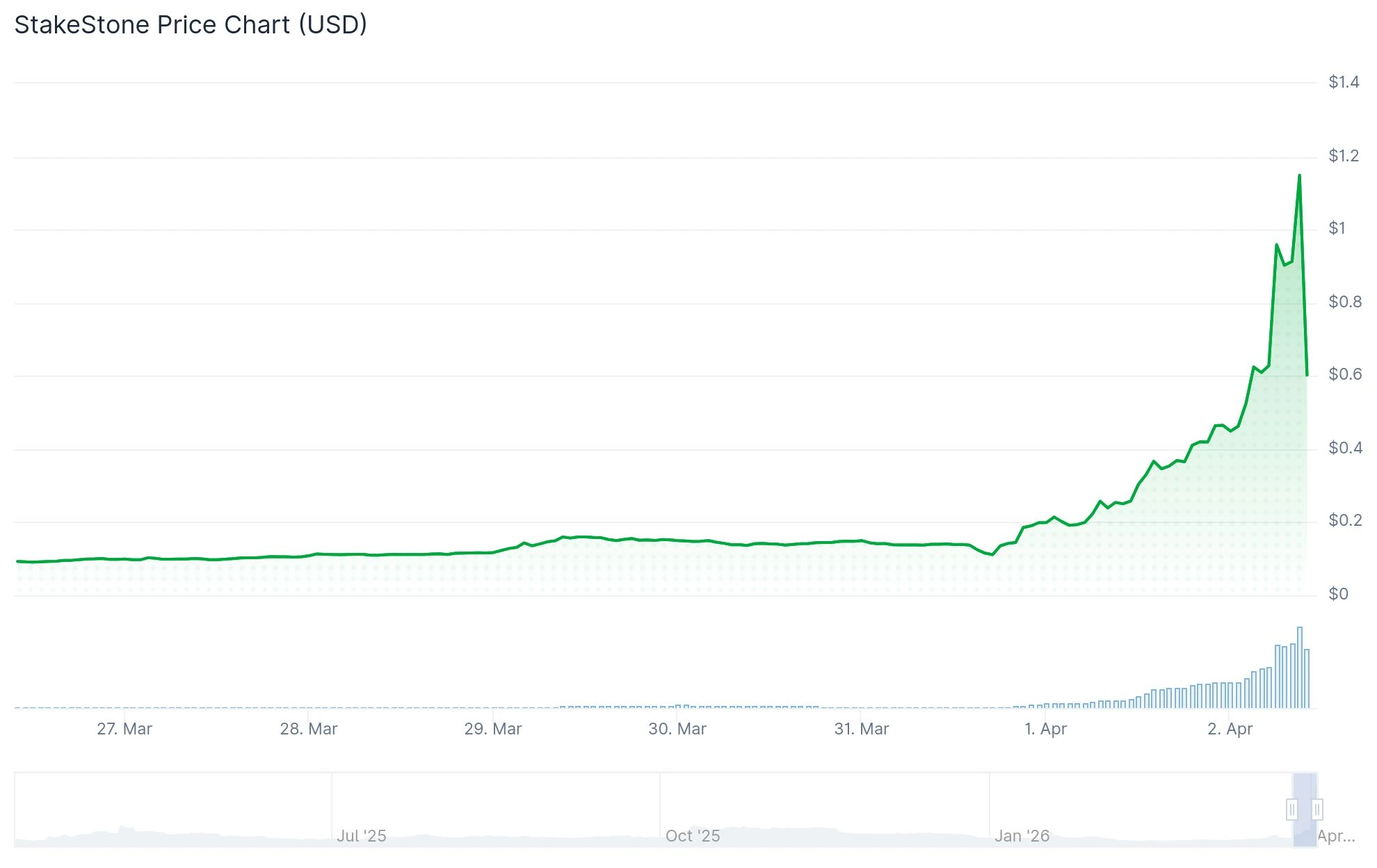
StakeStone hit its all-time high (ATH) of close to $1.20 on April 2, 2026, up 449.6% in 24 hours, with the weekly gain coming in at 217%. STO Crypto’s volume surpassed $1.89 billion against a market cap a fraction of that size. An RSI reading above 86 tells short-term traders momentum ran well ahead of any new fundamental information.
An RSI that high signals a token that moved faster than the news behind it. A cooling period typically follows. Meanwhile, STO’s fully diluted valuation prices in all 1 billion tokens, not the 225 million currently in circulation. Traders buying at the ATH are essentially betting the protocol grows into that gap.
Backed by Polychain, Built in Singapore: StakeStone’s Core Business
StakeStone completed a $22 million investment round led by Polychain Capital, with strategic investments from Binance Labs and OKX Ventures and additional participation from Nomad Capital, HashKey Capital, Amber Group and Bankless Ventures. Total funding across three rounds reached $32 million.
StakeStone integrates with over 20 blockchains and more than 100 protocols, giving liquidity providers venues to deploy capital without manually bridging assets between networks. The treasury accumulates blue-chip assets including ETH and BTC through platform exit fees, building reserves that veSTO holders can access through the Swap and Burn mechanism.
The USD1 Deal Is the Real Story
While price action grabbed attention, the more durable catalyst may be StakeStone’s USD1 Vault. StakeStone launched the USD1 Vault in partnership with CIAN Protocol and World Liberty Financial. The vault offers depositors fixed on-chain yield via the USD1 stablecoin. The USD1 Vault accepts deposits in USD1, USDT and USDC on the BNB chain and targets a 6% yield in USD1, automatically allocated through StakeStone’s rebalancing mechanism.
USD1 is backed 1:1 by U.S. Treasuries custodied by BitGo and has transacted more than $2.1 billion in issuance across Binance, Bitget and HTX. StakeStone distributes USD1 across its omnichain infrastructure, allowing holders to move tokens across different blockchains and access yield without locking assets.
For traders reading the STO price action, the deal positions StakeStone as the primary cross-chain minting and liquidity hub for one of the fastest-growing stablecoins in the market and a durable revenue source rather than a one-time catalyst.
StakeStone 2.0: Neobank Pitch or Deliverable Product?
StakeStone 2.0 expands the platform’s ambitions with features aimed at broader adoption:
- Social login via account abstraction
- Gasless transactions using EIP-7702
- AI-driven payment protocols (AP2 and x402)
- Automated yield routing through the OPAP system
If these systems perform reliably at scale, users effectively get a self-managing portfolio that reallocates capital in response to market conditions. The neobank framing holds only if those automated systems operate consistently under live conditions.
STO Price Prediction
The April 2, 2026 all-time high arrived on RSI readings well above 80. The gap between the current market cap and the fully diluted valuation at a 1 billion token maximum gives long-term bulls a target and skeptics a reason to wait for a lower entry.
Short-term, traders should expect elevated volatility as RSI mean-reverts. Medium-term, USD1 Vault revenue and the depth of StakeStone’s chain integrations will determine whether the April 2026 high serves as a ceiling or a base for the next move.