The Rise of RaveDAO Crypto and Its 2500% Price Surge: From Afterparty to Altcoin


It started with 200 people dancing at a crypto conference afterparty in Istanbul. Three years later, RaveDAO commands a community of over 100,000 attendees across global events. Its RAVE token has risen from $0.21 to an all-time high of approximately $9.70 in a matter of weeks.
Founders Wildwood Xu and Ronald Yung built the project after attending Devconnect Istanbul in 2023. They did it without venture backing at first, pulling in over $3M in event revenue from physical ticket sales and sponsorships before the token ever launched.
The question worth asking now is whether the fundamentals support the price action, or whether RAVEDAO crypto is running on hype alone.
RaveDAO Crypto Explained: The Web3 Project Turning Raves Into a RAVE Coin Ecosystem
RaveDAO operates as a community-governed live entertainment protocol headquartered in Dubai Digital Park, Silicon Oasis. The team has staged major events in Singapore, Dubai, Seoul, Bangkok, and Amsterdam, drawing headlining artists like Vintage Culture, Don Diablo, and Lilly Palmer. YZi Labs backed the project after its bootstrapped start, and Warner Music Group has since confirmed a partnership.
The ecosystem runs on more than music. Attendees collect Proof-of-Participation NFTs to build on-chain identities. Event organizers who want to use the RaveDAO brand must stake RAVE tokens to access the IP, tying commercial demand directly to token utility. Web3 ticketing platform PLVR handles ticket sales.
Meanwhile, the “Rave for Light” initiative routes 20% of event proceeds to social impact causes. In 2025, that meant funding over 400 sight-restoring surgeries at the Tilganga Eye Center in Nepal and supporting 150+ meditation programs through Nalanda West in the United States.
Tokenomics, Utility and What RAVEUSDT Traders Are Watching
The RAVE token runs across Ethereum, BNB Chain, and Base, with a fixed maximum supply of 1 billion. Circulating supply currently sits at roughly 248 million tokens, meaning about 24% of all RAVE is tradeable today. The ecosystem allocation takes 31% of the total supply and the community pool holds 30%, both with 12-month cliffs baked in.
Utility spans three main areas.
- Token holders participate in governance voting on DAO decisions.
- Event organizers stake RAVE to license the brand for B2B activations.
- Fans use the token for ticket purchases and VIP access.
On top of that, RaveDAO runs a buyback-and-burn mechanism tied to real event revenue, creating deflationary pressure that scales with how busy the calendar gets.
With only 23.9% of total supply in circulation, the fully diluted valuation reached $1.5 billion at peak, making the FDV-to-market-cap ratio a key figure for traders tracking dilution risk as vesting schedules roll forward.
What Drove the RAVE Coin Rally and Who’s Behind the Volume?
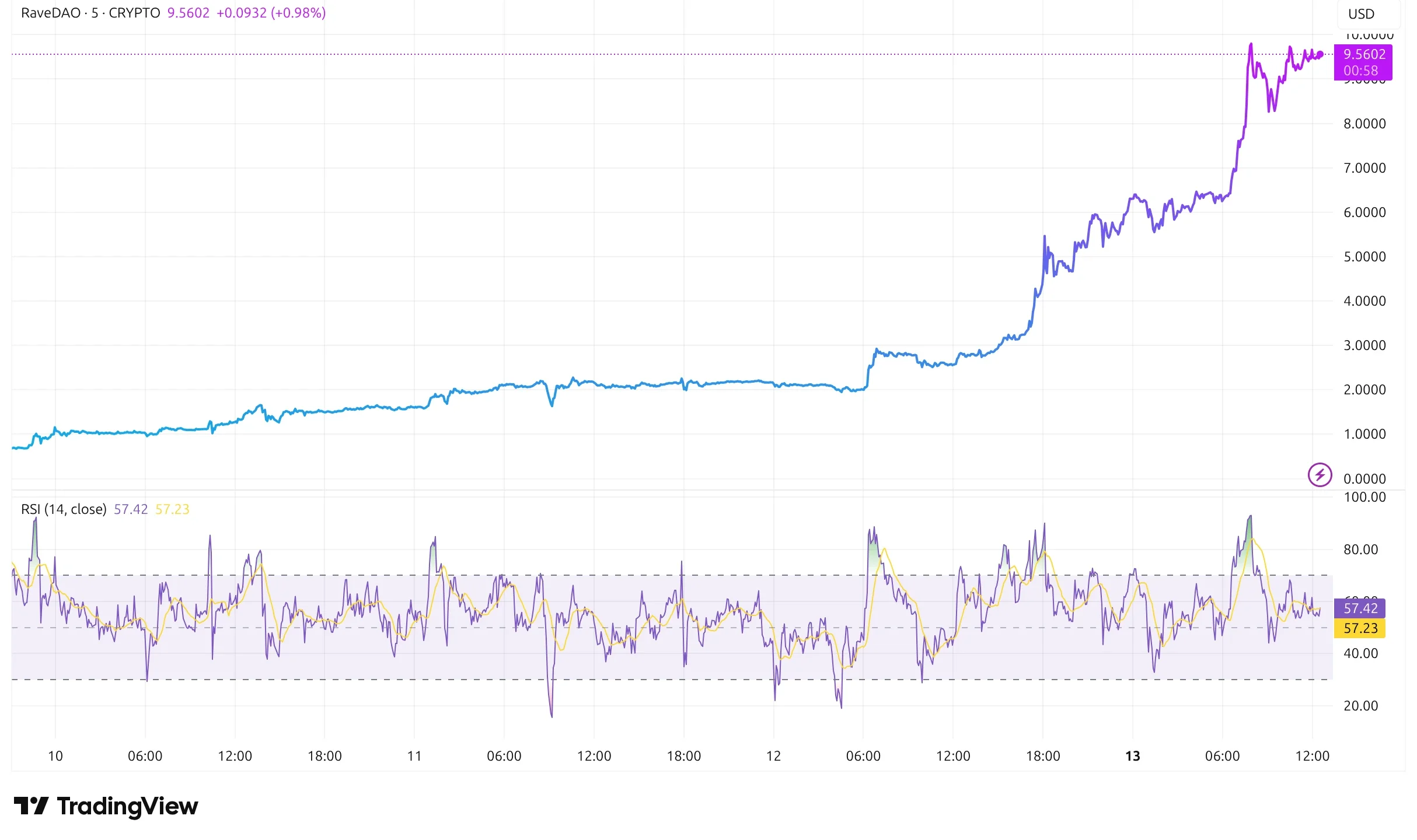
RAVEDAO crypto price movement to ATH in April 2026 | Source: TradingView
RAVE hit an all-time high of $9.70 on April 13, 2026, capping a run that started from a March low of around $0.20. Over the 7 days through April 12, the token surged 744%, with 30-day gains reaching over 700%. At the peak, RaveDAO’s market capitalization expanded by over $240 million in a single 24-hour window.
The thin circulating float amplified the move. Open interest peaked near $250 million, with analysts noting the rally carried stronger fingerprints of a derivatives-driven short squeeze than organic spot accumulation. Traders watching RAVEUSDT pairs should weigh that context carefully.
On-chain data shows wallets linked to the project’s deployment address moved 18.58 million tokens, worth around $40M at peak prices, to an exchange as the rally began, a distribution pattern worth monitoring regardless of the project’s underlying merits. The 14-day RSI reached approximately 95 at the peak, deep in overbought territory by any standard measure.
Is RAVEDAO Crypto a Long-Term Play or a Short-Term Trade?
RaveDAO brings more verifiable activity to the table than most tokens at this price point. The $3M in bootstrapped event revenue, confirmed corporate partnerships and on-chain charity disbursements give analysts something concrete to work with. Upcoming events, including a sold-out Dim Sum Rave in Hong Kong on April 18 and a co-hosting role at the Lisbon Dance Summit starting April 29, provide near-term catalysts for utility demand.
That said, the price action and the fundamentals are operating on different timelines right now. A real-world revenue model earns trust over quarters and years. A 900% monthly rally earns headlines over days. Traders treating RAVE as a short-term vehicle and long-term investors building around the entertainment thesis are both making rational decisions, just on completely different assumptions about what drives value here. The data exists to evaluate both cases. How you weight it comes down to your time horizon.