
Real-world assets and tokenized securities have transitioned from experimental pilots into active financial infrastructure. The sector now processes billions in institutional trading volume.
This shift is the structural maturation in how digital and traditional markets interact. Users increasingly demand the ability to manage traditional portfolios and digital assets within a single ecosystem. They do this rather than navigating fragmented applications.
As tokenization moves past isolated proofs of concept, multi-asset integration is becoming a baseline standard for global trading platforms. The recent launch of US equity trading and the upcoming rollout of tokenized stocks on Binance illustrate this convergence. Bringing TradFi instruments to crypto-native architecture bridges the historical gap between decentralized ecosystems and regulated equity markets.
Scaling On-Chain Equities: The Market Data
Moving traditional equities onto blockchain infrastructure has created measurable traction across the financial sector. Current market data shows the tokenized stock market surpassing $31.15 billion in distributed asset value. This reflects sustained demand for programmable assets.
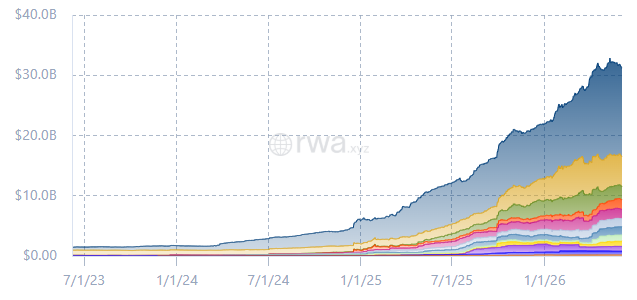
Much of this growth centers on specialized infrastructure providers like Ondo Finance, which has established a substantial footprint in the sector. Since late 2023, Ondo has accumulated over $550 million in total value locked. The firm processed $11 billion in cumulative trading volume across its platforms during this period.
This infrastructure supports tokenized representations of high-liquidity assets, offering exposure to major technology companies and index funds. Available assets include Apple, Tesla, Nvidia, Amazon, Meta, Microsoft, Alphabet, and the QQQ ETF.
Market operators view this expansion as a fundamental upgrade to market mechanics rather than a simple product addition. Binance Co-CEO Richard Teng noted that “tokenization has the potential to reshape financial markets by giving users greater control, more flexibility, and ultimately more financial freedom.”
He also described “a significant opportunity to make financial assets more accessible, more useful, and more connected across traditional and digital markets.” That is the core promise of tokenization: fewer barriers between asset classes and a more seamless way to move across financial markets.
The Infrastructure Layer: Execution, Clearing, and Custody
Setting up the backend for tokenized equities requires heavy integration between regulated brokerages and blockchain architecture. The operational reality of these markets depends entirely on execution, clearing, and custody providers bridging the gap. For the new equities rollout, Binance routes trades through Nest Trading Limited. This ADGM-licensed broker-dealer interfaces directly with US-regulated clearing brokers to execute client orders.
Alpaca serves as the core infrastructure provider for the clearing and custody processes. Operating as a self-clearing broker, Alpaca eliminates the need to rely on third-party clearinghouses. This capability provides the necessary compliance and security foundations for tokenized real-world assets.
The firm recently completed a $150 million Series D funding round and currently holds an estimated 94% market share in the custody of tokenized US stocks and ETFs. Having integrated execution and custody capabilities within a single regulated entity ensures that tokenized representations remain fully backed 1:1 by underlying shares held in audited accounts.
This architecture also supports advanced features like Fully Paid Securities Lending, allowing eligible users to generate passive income on their equity holdings. Such structural integrity minimizes counterparty risk and establishes the trust required to operate on-chain equity markets at a global scale.
Real-Time Dividends and Operational Efficiency
The practical application of this infrastructure changes the mechanics of equity ownership. A crypto-native investor can purchase fractional Apple shares using stablecoins like USDC or USDT in minutes. Doing so bypasses the delays typically associated with fiat funding and cross-border brokerage onboarding. The system supports fractional shares starting at just $5 and features zero-commission trading—significantly lowering participation barriers for global users.
Beyond immediate trade execution, the tokenized architecture modernizes post-trade processing. Legacy settlement systems often struggle with delays in corporate action eligibility and dividend distributions. The blockchain-integrated model enables real-time dividend reinvestment and immediate processing of corporate actions directly to the user’s account.
State Street Global Advisors estimates that removing intermediaries from the settlement chain via tokenization can cut issuance and post-trade processing costs by 40-50%. These operational efficiencies create tangible economic value. They also transform static equity holdings into dynamic assets that integrate smoothly into digital portfolios.
Establishing the Baseline for Future Financial Platforms
The boundary between traditional finance and cryptocurrency ecosystems is dissolving as capital markets continue to digitize. The integration of US equities and programmable bStocks on global exchanges points toward an environment where multi-asset capability is mandatory.
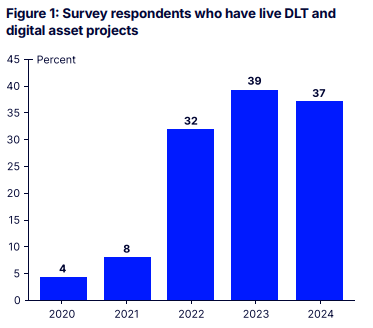
Deloitte’s 2026/2027 banking outlook indicates that tokenized infrastructure is rapidly transitioning from a competitive advantage to a baseline requirement for financial platforms. Firms that fail to adopt unified, programmable settlement layers risk operational obsolescence.
The current trajectory suggests that on-chain equity integration will soon dictate the standard for global market accessibility and asset mobility.


