Best Crypto Lottery Miners 2026: Top Solo Bitcoin Miners

- When you click links on this page, we may earn an affiliate commission. By using this website you agree to our terms and conditions and privacy policy.
- Participation in online gambling may be illegal in your country and is subject to age restrictions (18, 19, or 21, depending on the jurisdiction). Verify legality and age requirements before participating. Learn more
Crypto lottery miners are hobbyist alternatives to large, expensive, and power-hungry ASIC miners like the Antminer S21. They provide users with a small chance to earn big rewards by correctly solving a block on the blockchain.
Throughout this guide, we'll take a look at five of the best solo Bitcoin miners on the market, discussing why they're popular, the actual odds of earning rewards, and the mining protocols you can use.
What is a Crypto Lottery Miner?
Cryptocurrency mining is how networks like Bitcoin process transactions and mint new tokens. Only applicable to Proof-of-Work (PoW) blockchains, miners use computer hardware to compete to solve complex cryptographic equations.
The fastest solver is allowed to add a new block (batch of transactions) to the blockchain and earns a block reward for doing so. Originally, it was common to mine cryptocurrency using regular computer hardware (mostly GPUs and CPUs). However, highly efficient, purpose-built ASIC miners are now more commonly used.
A crypto lottery miner is a small-scale home mining device that lets users generate block rewards independently, without a dedicated ASIC miner, which can be complex to set up and expensive to maintain. SHA-256 lottery miners are the most common, as they enable mining popular cryptocurrencies such as Bitcoin and Litecoin.
What's the advantage of solo mining vs pool mining? In a pool, rewards are split among participants. However, lotto miners do not share rewards; instead, you compete to mine a block individually, and if successful, you receive transaction fees plus the full block reward of 3.125 BTC (roughly $255,000).
The chance of mining a block is low, hence 'lottery miner’. Users measure device performance in hashrate, typically terahashes per second (TH/s) for SHA-256 assets. Higher terahash units give users more chances to mint a block, but are typically more expensive and more power-hungry.
Why People Do It
Bitcoin mining often requires significant capital and infrastructure, making it challenging for beginners or hobbyists to participate. Even if you join a mining pool, you still have to actively manage your devices, while balancing fees and electricity costs, with relatively low earnings.
Professional cryptocurrency mining operations require substantial infrastructure, typically including warehouse space, high-voltage wiring, purpose-built crypto mining cooling systems, and a selection of specialized crypto mining devices, called ASIC miners.
However, crypto lottery miners have rapidly gained popularity among blockchain enthusiasts who want to start mining as a hobby without calculating profitability or spending thousands of dollars on a quickly outdated ASIC setup.
The devices enable low-wattage mining, ideal for people who want to participate while learning about the blockchain. A dedicated ASIC miner is large, can cost thousands of dollars, and significantly increases monthly electricity costs, while lottery miners are affordable (some cost around $100) and easy to set up/use.
While ASIC miners cater to people or companies willing to invest significantly in a full-scale, highly efficient operation, lottery miners are ideal for hobbyist crypto enthusiasts, people who want to deepen their understanding of blockchain technology, and those interested in mining but without the infrastructure or need for an ASIC farm.
Top Lottery Miners of 2026
Picking a lottery miner can be difficult. There are many options, and it can be difficult to determine which characteristics are important. To simplify the process, we've provided an overview of five of the best crypto lottery miners currently available.
Bitaxe Gamma Lottery Miner - Highly Popular All-In-One Lotto Miner
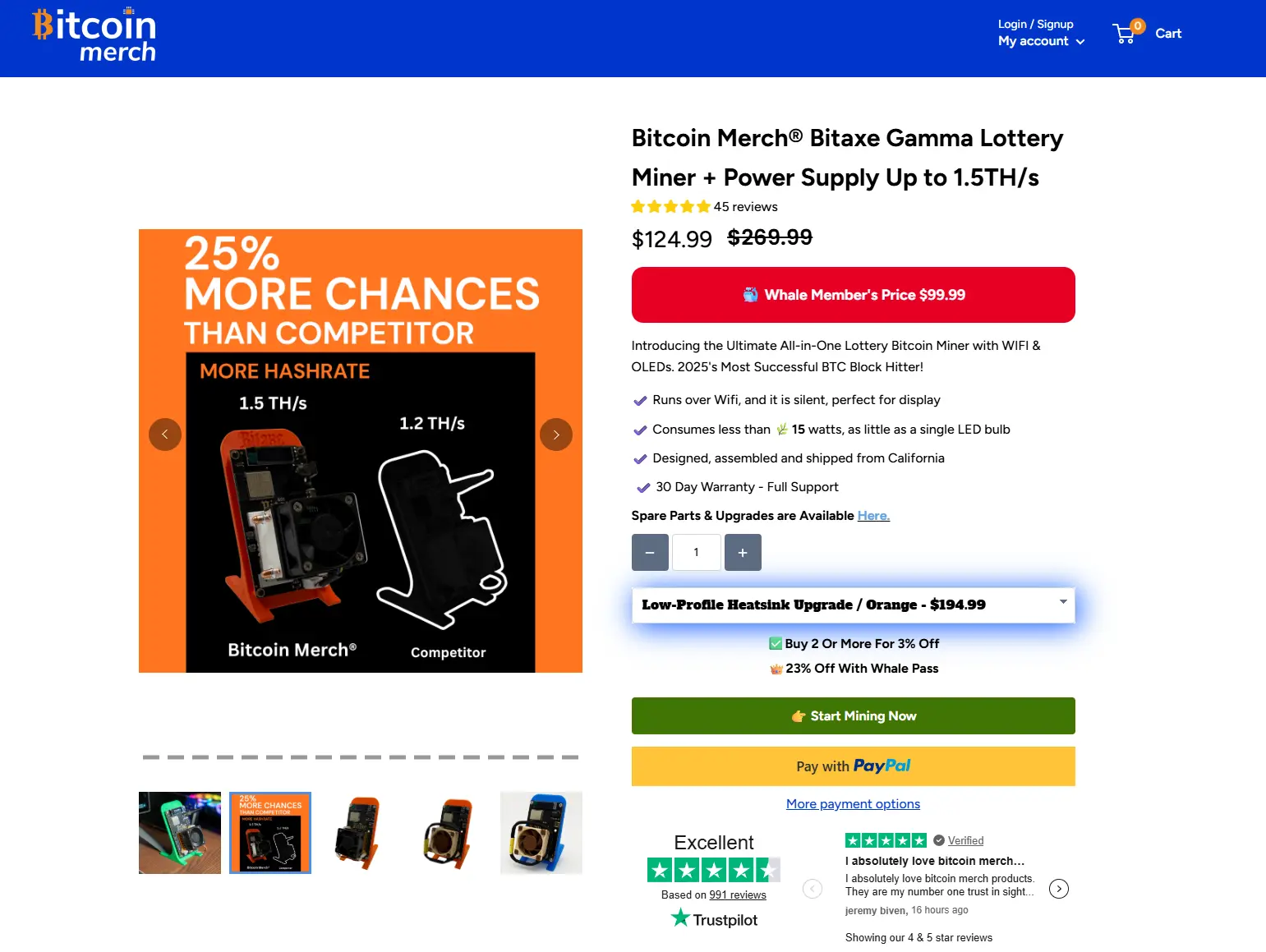
Few crypto lottery miners can compete with the Bitaxe Gamma in terms of efficiency, performance, and size. The device is highly popular, and for good reason. It packs an impressive amount of performance into a small form factor, offering up to 1.5 TH/s with a sub-15W energy draw.
The Bitaxe Gamma supersedes the Bitaxe Supra and uses open-source mining hardware, so parts are easy to replace and tinkering with the device is relatively straightforward. Despite its size, the Bitaxe Gamma specs are impressive. It uses a Bitmain BM1370 ASIC chip, found in Antminer S21 Pro devices.
While the device looks a little barebones, with exposed components and no enclosure, it's priced extremely competitively at $124.99. It offers straightforward connectivity via a WiFi chip; no computer is needed, making it a strong choice for people seeking an efficient, budget-friendly lotto miner.
The Bitaxe Gamma features active cooling via a 40mm fan, ensuring continued operation without overheating. I found the display (0.91-inch) slightly difficult to read due to its size, but the Bitaxe Gamma remains highly functional and is arguably the best lottery miner on the market.
Pros
- Extremly efficient
- Solid Hashrate
- Small form factor
- WiFi connectivity
- Quiet operation
Cons
- Small display
- Not aesthetically pleasing
| Manufacturer | Bitaxe |
| Hashrate | 1.5 TH/s |
| Power Consumption | 15 Watts |
| Cryptocurrencies | BTC, BCH, BSV |
| Algorithm | SHA-256 |
| Noise | 35 dB |
| Size | 109 × 71 × 64 mm |
| Price | $124.99 |
| Buy Now |
NerdQaxe++ Hydro - Water Cooled Lottery Miner
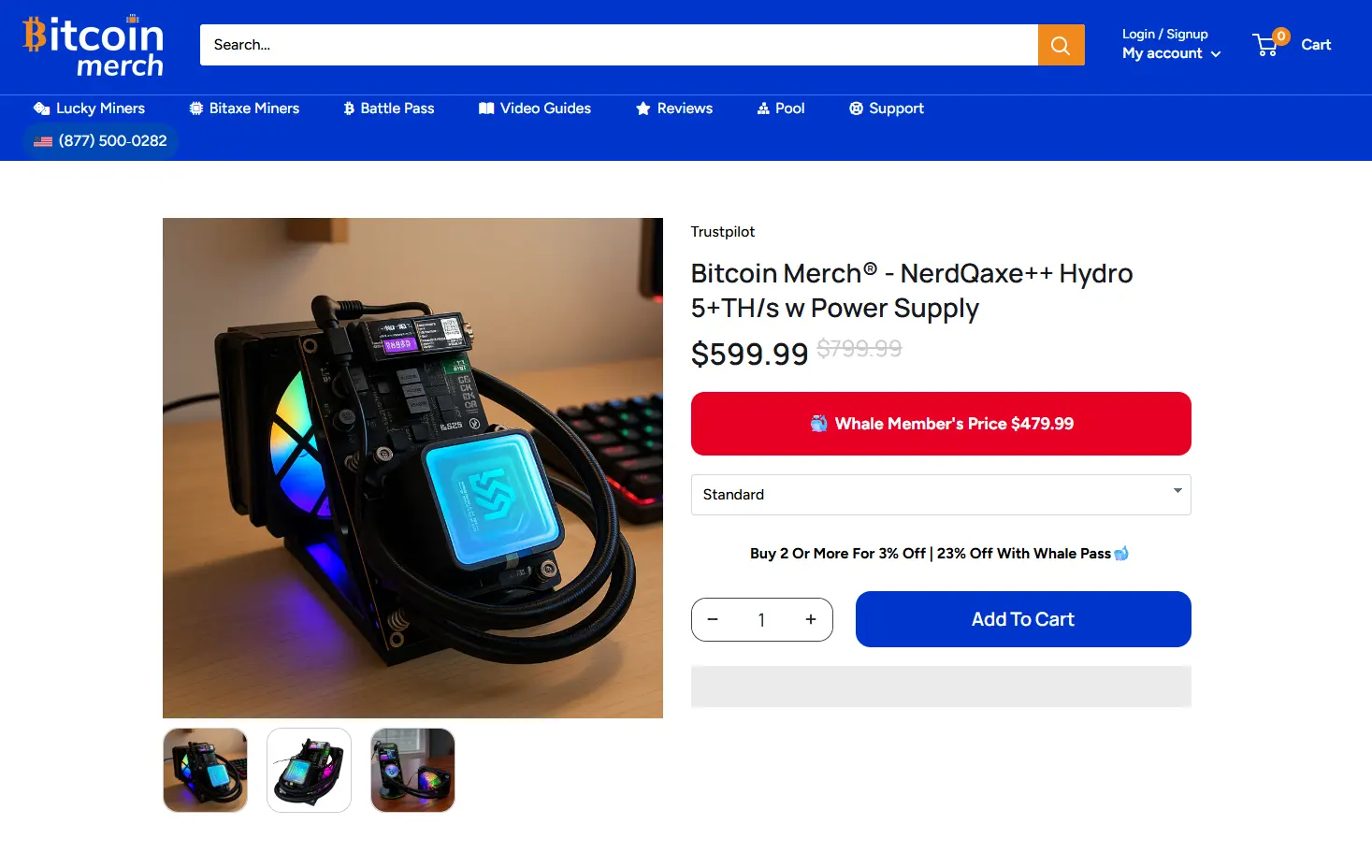
The NerdQaxe++ Hydro is a premium lottery miner that leverages water cooling to deliver a significantly higher hashrate than most alternatives. The device features a 1.9-inch display that makes it easy to monitor hashrate and view Bitcoin prices in real time. Key network statistics are also viewable, enhancing utility.
To achieve its impressive 5+ TH/s output, the NerdQaxe++ 2026 consumes a relatively substantial amount of energy (103W) compared to lower terahash lotto miners we've looked at. The NerdMiner setup process is straightforward, thanks to purpose-built firmware and ample online documentation.
Four Bitmain S21 Pro ASIC miner chips power the NerdQaxe++, delivering strong performance at a competitive power draw. To keep the device cool, it's equipped with a custom cooling system that includes RGB fans for stylish accent lighting.
The NerdQaxe++ features RGB lighting that looks cool and complements gaming setups. While the device is powerful, it has a couple of drawbacks. The visible components make it feel cheap, despite its $499.99 price tag. The NerdQaxe++ is one of the best lottery miners for people aiming to maximize performance.
Pros
- High hashrate output
- Excellent thermal performance
- RGB lighting
- Features 4 Bitmain S21 Pro chips
- Can track Bitcoin statistics
Cons
- Exposed components hinder durability and feel cheap
- Priced at a premium compared to other lotto miners
| Manufacturer | NerdMiner |
| Hashrate | 5+ TH/s |
| Power Consumption | 103 Watts |
| Cryptocurrencies | BTC |
| Algorithm | SHA-256 |
| Noise | 40 dB |
| Size | 20 x 10 x 5 mm |
| Price | $499.99 |
| Buy Now |
Avalon Nano 3S - High Performance Dual Purpose Lottery Miner
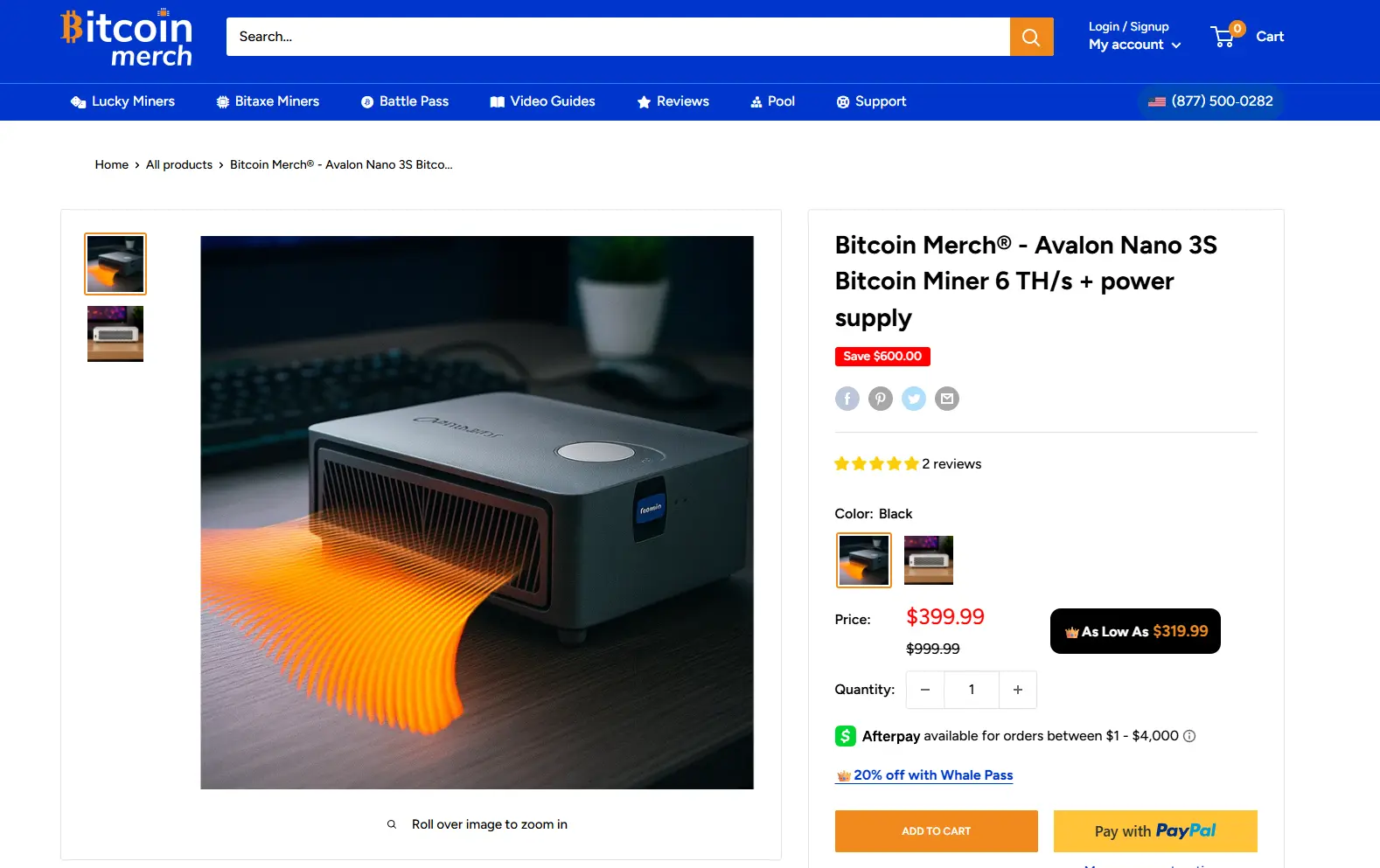
The Avalon Nano 3S is an efficient and quiet home crypto miner, ideal for first-timers in the ASIC space or for building a high-power lottery miner setup. It costs just $399.99 and outputs 6 TH/s, resulting in a 0.015 terahash-to-dollar ratio.
The Nano 3S's main advantage is its efficiency. It consumes 140W with an efficiency of 23.3 J/TH. Moreover, the 3S leverages excess heat to warm your space, helping to offset electricity costs, which is useful for a device that's not guaranteed to make a profit.
Avalon Nano S3 reviews indicate that its form factor slightly offsets performance/heating capabilities. At 205mm x 115mm x 57mm and 725g, the device is considerably larger than most lottery miners. The 3S is one of the market's top home crypto-mining devices because it is powerful, practical, and WiFi-enabled.
Pros
- High power lottery miner
- Low purchase price
- Easily fits into the home
- Reasonably efficient
- Low power draw and noise/heat output
Cons
- Not guaranteed to earn rewards from solo mining
- Low daily rewards
| Manufacturer | Canaan |
| Hashrate | 6 TH/s |
| Power Consumption | 140 Watts |
| Cryptocurrencies | BTC, BSV, BCH |
| Algorithm | SHA-256 |
| Noise | 33~ dB |
| Size | 205 x 115 x 57mm |
| Price | $399.99 |
| Buy Now |
NerdOCTaxe - High Terrahash Lottery Miner
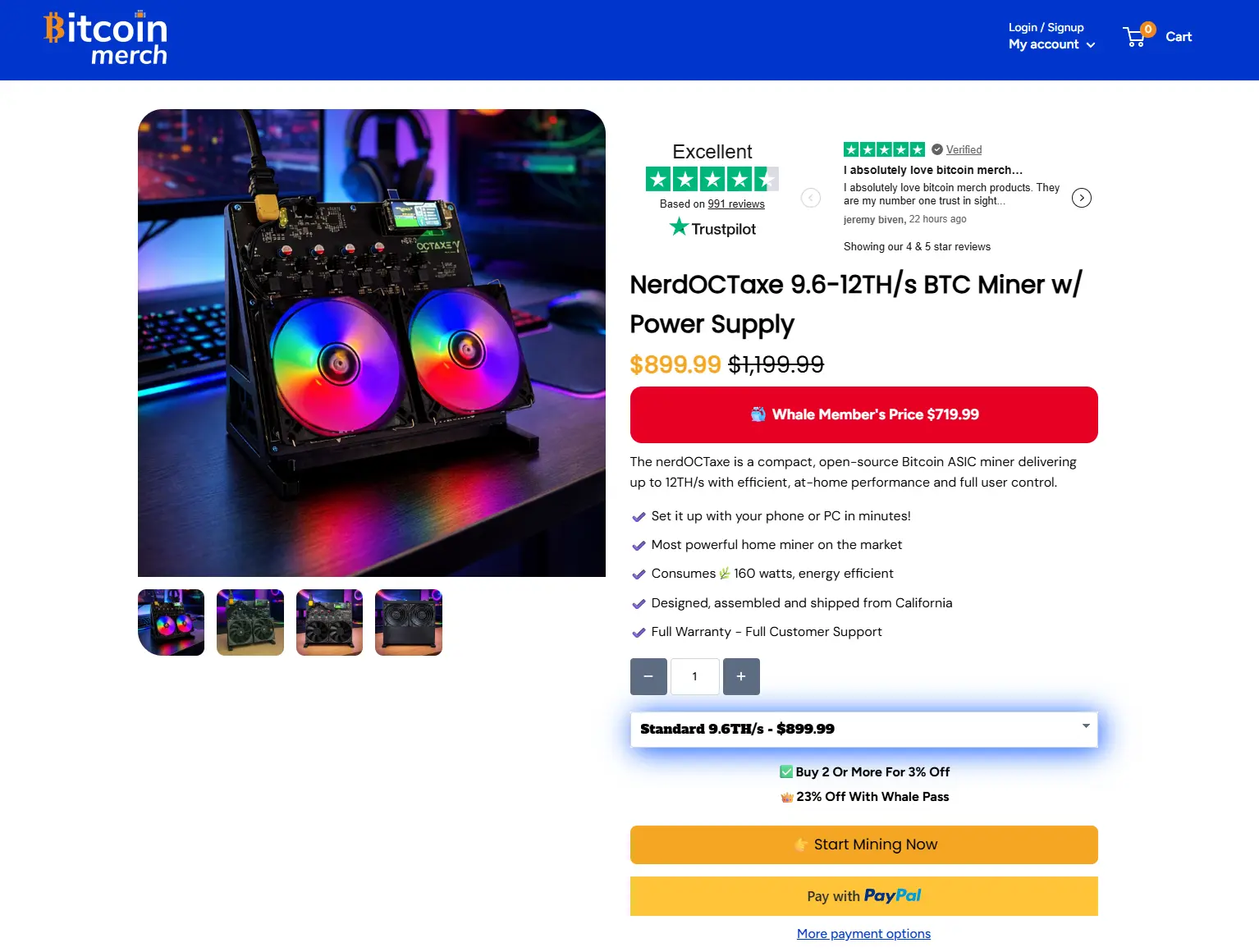
If you're looking to increase your chances of successfully mining a Bitcoin block, then you'll need to maximize your hashrate. The NerdOCTaxe is optimized for exactly that. The standard version costs $799.99 and provides 9.6 TH/s, while the four-fan performance version costs $849.99 and yields 12 TH/s.
While the NerdOCTaxe delivers unrivaled performance, it's one of the most expensive crypto lottery miners on the market. Despite offering 95% more performance than the NerdQAxe Hydro, the NerdOCTaxe consumes only 55% more energy, making it highly efficient compared to other lotto miners.
The device features WiFi, USB-C, and a 1.9-inch display, making it easy to connect to and monitor your miner. Eight BM1370 chips power the device, enabling its hashrate and efficiency. If you want to boost your chances of producing a block, the NerdOCTaxe is the best lottery miner on the market.
Pros
- Impressive hashrate
- Highly efficient
- Relatively quiet
- Available in two versions
- USB-C and WiFi connectivity
Cons
- Expensive compared to alternatives
- No enclosure
| Manufacturer | NerdMiner |
| Hashrate | 9.6 to 12 TH/s |
| Power Consumption | 160 Watts |
| Cryptocurrencies | BTC, BCH, BSV |
| Algorithm | SHA-256 |
| Noise | Below 40 dB |
| Size | 210 x 205 x 130 mm |
| Price | $799.99 |
| Buy Now |
Nerd Miner 2 - USB-Powered Mini Lottery Miner
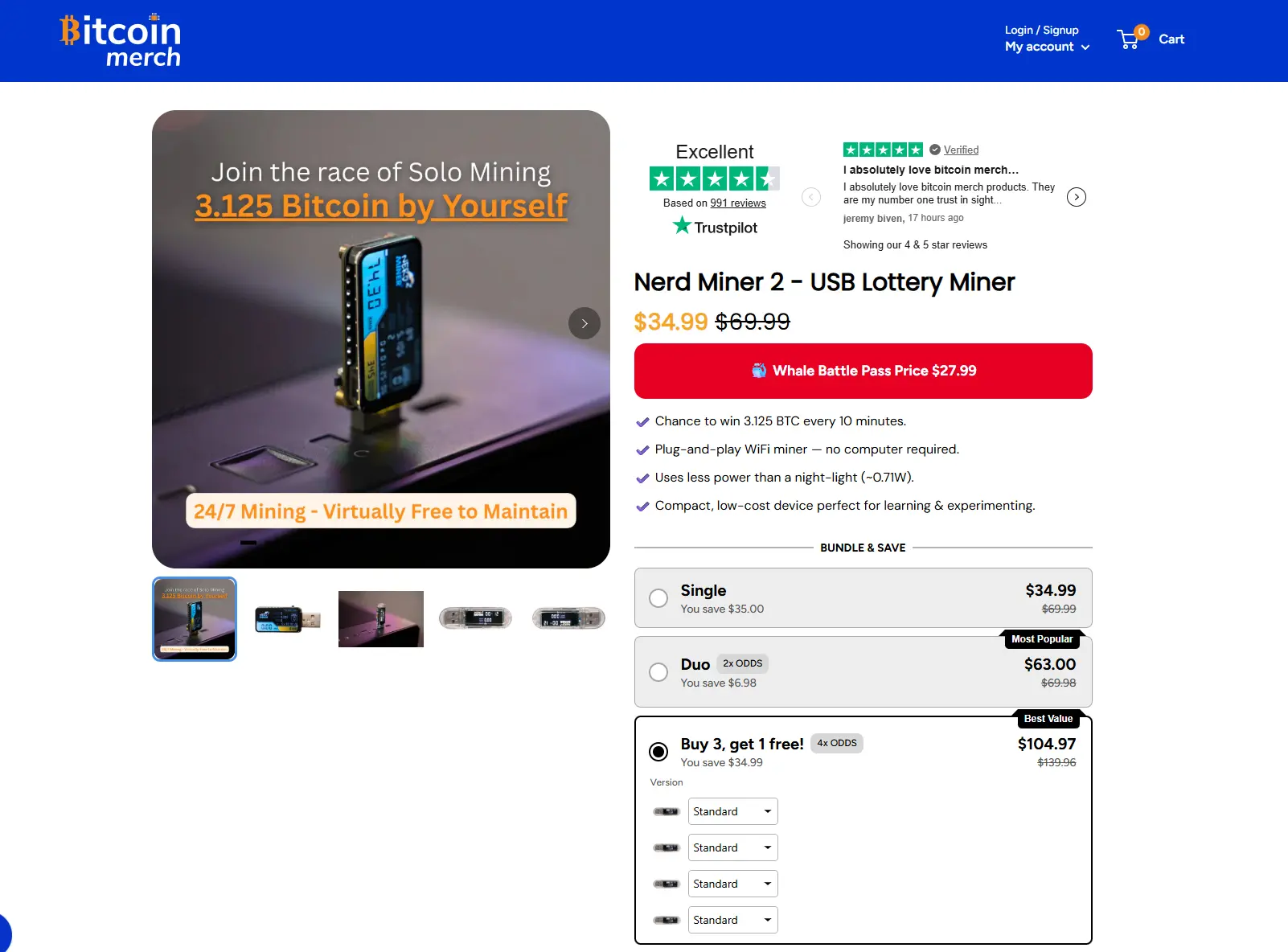
Higher hashrate leads to increased energy consumption. Given that crypto lottery miners already have a low chance of generating a profit, many people don't want to increase their electricity bills. If this sounds like you, then the Nerd Miner 2 could be exactly what you're looking for.
The device is an ESP32 USB Bitcoin miner. It plugs directly into a USB port and starts mining immediately. The Nerd Miner 2 consumes 0.71W, meaning it costs around $1.32 per year to run. However, it only outputs ~70 KH/s, so the chance of producing a block is extremely low.
Priced at $34.99, the cost of acquiring and operating a Nerd Miner 2 is minimal. While the device doesn't offer the best chance of producing a block due to its limited hashrate, it's a great way for people interested in mining to get started in a streamlined way.
Pros
- Plugs directly into a USB port
- Uses less than 1 Watt
- Low cost
- Plug-and-play with WiFi
- Quiet (no fan)
Cons
- Low chance of producing a block
- Limited to Bitcoin mining (high-difficulty)
| Manufacturer | NerdMiner |
| Hashrate | 70 KH/s |
| Power Consumption | 0.71 Watts |
| Cryptocurrencies | BTC |
| Algorithm | SHA-256 |
| Noise | Negligible |
| Size | 50 x 30 x 10 mm |
| Price | $34.99 |
| Buy Now |
Comparing the Lottery Miner Specs
It can be difficult to gauge how different lottery miners compare when reading reviews. Solo Bitcoin miners are advanced products, and it can be hard to filter through the jargon, so having the essentials in a comparison table can help people make an informed decision on which is best.
| Miner Model | Hashrate | Power Draw | Efficiency | Price |
|---|---|---|---|---|
| Bitaxe Gamma | 1.5 TH/s | 15W | 10 J/TH | $124.99 |
| NerdQaxe++ | 5+ TH/s | 103W | 20.6 J/TH | $499.99 |
| Avalon Nano S3 | 6 TH/s | 140W | 20.33 J/TH | $399.99 |
| NerdOCTaxe | 9.6 TH/s | 160W | 16.66 J/TH | $799.99 |
| NerdMiner v2 | 70 KH/s | 0.71W | 10,000+ J/TH | $34.99 |
- The Bitaxe Gamma balances efficiency, hashrate, and cost, while the NerdOCTaxe delivers unrivaled performance.
- While the NerdMiner v2 is highly inefficient, it's cheap and requires almost no electricity compared to any other lottery miner.
- While the Avalon S3 is comparable in efficiency to the NerdQaxe++, it can also be used as a heater, providing additional utility.
Understanding Your Odds
While lottery miners provide millions of chances to mine a full block, successfully doing so is statistically unlikely. It's challenging to estimate the odds of mining a block because you must consider your terahash output relative to the network's total hashrate and your timeframe.
Mining difficulty tracks how much harder it is to produce a block now compared to when the blockchain was initially released. Every 2,016 blocks (approximately every two weeks), the difficulty adjusts based on the network's total hashrate to ensure blocks are minted at a rate of 1 every 10 minutes.
Because difficulty frequently fluctuates and can rise or fall, it's challenging to assess the effectiveness of lottery miners. However, solo mining calculator tools like Solochance.org make it far easier to understand the chances you have of successfully mining a block.
| Hashrate | Chance per block | Chance per hour | Chance per day | Chance per week | Chance per month | Chance per year |
|---|---|---|---|---|---|---|
| 1 TH/s | 1 in 1,093,662,941 | 1 in 182,277,157 | 1 in 7,594,882 | 1 in 1,084,983 | 1 in 253,163 | 1 in 21,097 |
| 5 TH/s | 1 in 216,498,647 | 1 in 36,083,108 | 1 in 1,503,463 | 1 in 214,780 | 1 in 50,115 | 1 in 4,176 |
| 10 TH/s | 1 in 108,249,324 | 1 in 18,041,554 | 1 in 751,731 | 1 in 107,390 | 1 in 25,058 | 1 in 2,088 |
As we can see, higher hashrate exponentially increases the odds of mining a block at home. However, it's important to realistically assess your chances when estimating lottery mining profitability.
A 1 in 2,088 probability of winning 3.125 BTC seems substantial, but you would have to wait over 2,000 years for mining a block to be statistically likely. Moreover, achieving a consistent 10 Terahash output would require multiple lottery miners, increasing electricity costs, and moving into actively managed territory.
How to Set Up Your First Lottery Miner
So, you've acquired your solo Bitcoin mining hardware, but how do you set it up? Lottery miners are designed for ease of use, so the setup process is straightforward.
Step 1: Connect to a Power Source
First, you'll need to supply power to your lottery miner. Most devices support USB or a standard DC jack input. After a few seconds, the screen will light up, indicating it's ready for use.
Step 2: Configure Device
Next, you'll need to complete the WiFi miner's setup. You can usually connect to a lottery miner via a QR code or by entering the device's IP address in your web browser. You must ensure it's connected to the correct WiFi network and that the device is set up to your specifications.
Step 3: Choose a Solo Mining Protocol
Before you can start mining, you'll need to choose a solo mining protocol, like CKPool, because lottery miners cannot run a full node or handle transaction construction. Always double-check fees and difficulty before participating.
Step 4: Start Mining
Once the CKPool setup process is complete, your solo mining configuration is complete, and you're ready to start mining. Ensure your settings are correct, then turn the device on. Every 10 minutes, you'll have a chance to mint a block and earn the associated rewards.
Understanding ASIC Chips
In the early days of crypto mining, users generated hash power using regular computer hardware (CPUs and GPUs). However, as participation increased, miners shifted to specialized ASIC (Application-Specific Integrated Circuit) chips, which are tailor-made for solving cryptographic equations for mining without thermal throttling (a significant hurdle in GPU mining).
Modern lottery miners utilize chips created for dedicated ASIC mining devices. Bitmain's ASIC architecture is popular. The NerdQaxe++ Hydro, for example, leverages four BM1370 chips, which are found in the Bitmain Antminer S21 Pro and supersede the well-known BM1366 chip.
Because ASIC miners typically require more energy to achieve higher performance, hashing efficiency is a crucial factor when calculating lotto miner profitability. The industry-standard measurement is Joules per Terahash (J/TH). Devices with lower J/TH ratings result in lower bills than higher-J/TH devices with the same hash rate.
Solo Mining Protocols
Lottery miners typically feature WiFi connectivity, enabling them to easily interact with the blockchain and broadcast solutions on demand.
To ensure they're sufficiently powerful and efficient, lottery miners are specialized and optimized almost exclusively for hashrate and energy consumption. As a result, these devices lack ample storage or RAM to operate a full node, which is required for truly independent Bitcoin mining.
Instead, lottery miners interact with solo mining protocols. Using a solo mining protocol lets you mine crypto independently without requiring a full node, reducing hardware requirements, which is essential for low-cost lottery miners.
These protocols act as a blockchain gateway and handle work selection (the process of choosing which block the device attempts to mine). They also handle complex processes such as share validation, which verifies that the miner's input is genuine.
Stratum V2 is the current standard for mining protocol communication, replacing Stratum V1, which was previously one of the most common standards. It offers superior security, efficiency, and control compared to the previous iteration, resulting in better solo mining performance.
Although solo mining protocols do not take a share of the hashrate, they typically charge a fee to cover expenses. It's important to note that the protocol only charges fees when you successfully mine a block, so fees are rare but significant.
Solo.ckpool.org is one of the most popular solo mining protocols available. There are servers in various regions, like Europe and Oceania, to help reduce pool latency (the delay between the miner and the protocol). It's not for profit and anonymous. It charges a 2% fee, equivalent to roughly $5,100.
How You Know It's Working
Because solo mining odds are low, you could be running a lottery miner for weeks, months, or even years without it finding a block or generating any rewards. As such, it can be challenging to determine whether your solo Bitcoin miner is actually working.
However, there's a straightforward way to check whether the device is functioning correctly. Whenever the lottery miner's screen flashes or logs a best difficulty (best diff), it indicates that you could have found a block if the mining difficulty were lower.
Some devices feature mobile apps that display your current hashrate, mining efficiency, and best difficulty. If the device reports your hashrate as 0 TH/s, there's an issue. Likewise, if you never see the best difficulty, the setup process is incomplete.
Always double-check your miner is operating correctly after the initial setup process and at regular intervals thereafter. If a miner is inoperable for extended periods, it will drastically impact your chances of successfully mining a block.
Key Takeaways
- Lottery miners are generally low risk (minimal electricity draw and low initial purchase price) and high reward (block rewards are around $255,000).
- You are not guaranteed to earn rewards with a lottery miner. You do not earn a consistent income. You rely on finding a block, which is extremely rare, similar to winning a lottery jackpot.
- While ESP32 miners are cheap and require little electricity, they are extremely underpowered and primarily serve educational purposes. Devices with ASIC chips are considerably more powerful.
- Because rewards are not guaranteed, it's essential to balance hash rate and power draw. More efficient devices (lower J/TH) provide considerably more long-term value.
FAQs
How much electricity do these devices use?
The amount of electricity a crypto lottery miner uses varies significantly by model. Typically, higher terahash units, like the NerdQaxe++ (103W), draw more energy, while small ASIC miners, like the Nerd Miner 2 (0.71W), usually require less electricity.
Do I need a computer to run a crypto lottery miner?
While ASIC miners may need to be connected to a computer for management purposes, lottery miners are typically designed to run independently. They integrate a small, low-power computer to run the necessary mining software and a display to make it easier for users to manage.
What happens if I find a block?
When a miner you operate finds a block, the hash is quickly verified, and the block gets submitted to the blockchain. Your wallet will then receive the full block reward (3.125 BTC) and the additional network fees accrued during your block.
What is overclocking in lottery mining?
Overclocking is the process of applying additional voltage to a computer chip to increase its performance. It’s common for people to add additional cooling to lottery miners before overclocking to squeeze additional hashrate. Underclocking is the opposite; users undervolt the miner to reduce thermal load at the expense of output.