
|
Surround
Sound is the term commonly used to describe a system in which the
sound output appears to surround the listener that is, the technology gives the impression that sounds are coming from all possible directions. Surround sound is a way to
provide a more realistic and engaging experience.
Sitting in front of your
standard television or playing a
computer
game with basic $10
stereo speakers plugged in will provide you with sound.
You hear the music, voices and other sounds coming to you from
straight ahead. Using a surround sound system, however, you'll hear
variances in the sound and and it will be presented to you from
different directions. For example, the car driving off screen sounds
like it is coming from the left. While playing a 3D shooter game,
the rocket gun blasts sound as if they are being shot from overhead or grenades sound like they are
exploding at ground level.
Today consumers demand immersive
entertainment and surround sound plays a big part in delivering
engaging media. To this end, there's no lack of options when it
comes to surround sound technology and systems. All technical aspects aside,
Surround sound works because multiple audio
channels are received through
speakers
that are positioned at various locations in the room. This is
programmed into the source and the sound tracks are
decoded when the source is played. While this may seem simplistic, it's important to remember sound systems started out with monophonic sound,
a single channel system. In monophonic (mono) sound systems, the signal sent
to the sound system is encoded as one single stream of sound and the sound
is usually received through a single speaker. |
Key Terms to
Understanding Surround Sound:
Surround Sound
Surround sound is a term used to describe a type of audio output in
which the sound appears to "surround the listener" by 360 degrees.
Dolby
Digital
A standard for high-quality digital audio that is used for the sound
portion of video stored in digital format.
Channel
An individual discrete audio track. When referring to more than two
channels it is called multichannel.
|
Advancements led to
stereophonic sound (stereo) where the sound was split between two
channels, left and right. Stereo sound enabled listeners to hear some
ambiance of the production for example, a recording of a live concert in
stereo where you begin to hear playback from extraneous noises at the
performance. Surround sound takes it a step further by producing a live-quality effect. If you're at an actual concert, you hear sound from behind you, and
listening to a recording in surround can produce the effect of this noise
coming from behind you, or to the right, or even from above you and moving down.
Surround sound adds realism and a new field of depth to your listening
experience. This is accomplished not only because you have more speakers for output,
but because the sound recording itself contains more audio channels.
The A/V (audio/video) Receiver
At the heart of every home theater is an audio/video receiver (A/V). Using a
DVD movie as an example, the audio is encoded when the DVD is
produced by packing multiple audio channels into a compressed
format for storage. When you play the DVD movie, your DVD player or
A/V receiver (commonly called a a
home theatre receiver) decodes the
encoding scheme (i.e.
Dolby Pro Logic II
for example). Decoding capabilities of an A/V
receiver are built in. Most A/V receivers today can decode Dolby Digital and Digital
Theater
Sound (DTS), while higher-end receivers may also include
DTS-ES or THX
Surround. Today's A/V receivers allow you to control the video source and
other video options, but for sound you'll need it to route the sound from
different sources (TV, DVD, VHS), control bass, treble, and volume. You can
amplify signals to the speakers, and modern A/V receivers also handle the
all-important surround sound decoding.
5.1, 6.1 and 7.1 Channel
Surround Sound Systems
Both Dolby Digital and DTS are
5.1 channel formats.
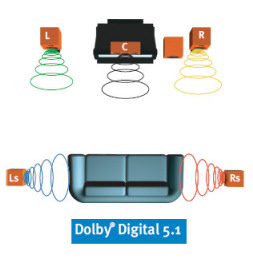
5.1 Surround
Sound is a multichannel sound
technology that produces five channels of sound in the left, right, center,
left-surround and right-surround positions. These five channels are the minimum
required to produce 5.1 surround sound. The .1 represents the channel for LFE (low frequency effects), which is usually sent to a subwoofer.
While 5.1 Surround Sound has
been the standard for some time now, newer A/V receivers are capable
of delivering 6.1
Surround Sound. 6.1 multichannel sound technology uses the
same set-up as a 5.1 system, but it has the addition of a sixth speaker that
takes the rear-center surround position (or back surround position) to provide a more
3-D sound. 6.1 Surround Sound uses Extended Surround sound formats (THX
Surround EX, DTS-ES).
Moving forward, we now also have
7.1 Surround
Sound, which splits the single rear-center surround speaker into individual left- and right-rear
surround. These systems are not a true
discrete 7.1 channel system as 7.1
formats don't currently exist. In a true discrete 6.1 surround system, the
back center surround position is separate from the surround left and
surround right positions. A 7.1 channel system uses matrixed
extended surround where the left-back and right-back (rear-center surround)
multichannels are blended together and stored.
|
|
|
Click each image to view a
larger diagram of speaker set-up for 5.1, 6.1, and 7.1 channel surround sound. Images are not to
scale. |
Common Surround Sound Formats
Dolby Surround: Dolby Surround is the
consumer version of the original Dolby multichannel analog film sound format
Dolby analog and Dolby SR (Spectral Recording). When a Dolby Surround
soundtrack is produced, four channels of audio information (left, center,
right and mono) surround are matrix-encoded onto two audio tracks. These
two tracks are then carried on stereo program sources such as videotapes and
TV broadcasts into the home where they can be decoded by Dolby Pro Logic to
recreate the original four-channel surround sound experience.
Dolby Digital: A standard for high-quality digital audio that is used
for the sound portion of video stored in digital format, especially videos
stored on DVD-ROMs. Dolby Digital delivers six channels in the so-called "5:1"
configuration: left, right, and center screen channels, separate left and
right sounds, and a subwoofer channel. This is sometimes called surround
sound or 3D sound.
Dolby Digital EX: Dolby Digital EX takes the Dolby Digital
5.1-channel setup one step further with an additional center-surround
channel (reproduced through one or two speakers) for extra dimensional
detail and an enveloping surround-sound effect. Feature films originally
released in Dolby Digital Surround EX (the cinema version) carry the encoded
extra surround channel in their subsequent DVD releases, as well as onto
5.1-channel digital satellite and TV broadcasts.
Dolby Pro Logic IIx: Dolby Pro Logic IIx is an extension of Dolby Pro
Logic II technology. This sophisticated algorithm processes native stereo-
and 5.1-channel material to produce 6.1 or 7.1 output channels. Dolby Pro
Logic IIx expands choice in playback system configuration (allowing 5.1 ,
6.1, or 7.1 playback channels) and, when incorporated into an audio/video
(AV) receiver or processor it allows a convenient upgrade path from a
traditional 5.1-channel sound system to 7.1 output channels.
Dolby TrueHD: Dolby TrueHD is the next-generation lossless technology
developed for high-definition disc-based media. Features of Dolby TrueHD
include the following: 100 percent lossless coding technology, up to 18 Mbps bit rate,
support for up to eight full-range channels of 24-bit/96 kHz audio, and it
is supported by High-Definition Media Interface (HDMI).
DTS: Short for Digital Theater Sound, it is a multichannel surround
sound format used in both commercial and consumer applications. DTS was
created by the company for which the technology was named, Digital Theater
Systems (which is now called DTS as well). DTS is a competing technology
with Dolby Digital.
DTS-ES: Short for Digital Theater Sound - Extended Surround. The 6.1 matrixed system enables cinemas to deliver extreme spatial effects that literally surround the audience. A rack mounting DTS-ES decoder
creates a back-surround (BS) channel from encoded surround tracks, in typical
theatre applications feeding a back-surround speaker array (configured
as left-back-wall and right-back-wall for stereo operation). The system is
compatible with all current extended surround formats and an auxiliary
surround channel is also provided for other applications. ES modes can be
selected via automation inputs or via the built-in DTS timecode reader,
which detects ES serial numbers for automatic DTS-ES playback.
TruSurround XT: TruSurround XT is the second generation of SRS TruSurround. Building upon its patented predecessor, TruSurround XT solves
the problem of playing 5.1 or 6.1 multichannel content over two speakers (or
headphones). TruSurround XT accepts input from up to a seven-channel (6.1) audio
source and processing a two-channel output. When receiving multichannel
content, TruSurround XT virtualizes the channels, creating "phantom"
speakers that appear to extend all around the listener. When receiving mono
or stereo content, TruSurround XT presents an expansive three dimensional
sound field.
|
Did You Know...
Despite the fact that IMAX cinemas use more than 300 speakers,
movies (at present time) have only a six-channel digital sound track. |
More Surround
Sound Terms: Multimedia
> Home
Entertainment >Surround
Sound
Vangie 'Aurora' Beal
Writer, www.Webopedia.com
Last updated: November 18, 2005
Dolby Laboratories

Dolby Laboratories develops and delivers products and technologies that make the
entertainment experience more realistic and immersive. For four decades Dolby
has been at the forefront of defining high-quality audio and surround sound in
cinema, broadcast, home audio systems, cars, DVDs, headphones, games,
televisions, and personal computers.
DTS Online

DTS, Inc. is a digital technology company dedicated to delivering the ultimate
entertainment experience. DTS decoders are in virtually every major brand of
5.1-channel surround processors, and there are more than 300 million
DTS-licensed consumer electronics products available worldwide.
How to Buy Surround Sound
Sound & Vision Online provides the simple steps that will take you from just
thinking about a great home theater to actually having one.
Home Cinema Choice Online
The online version of Home Cinema Choice magazine.
Surround-Sound Speaker Placement
This SoundStage article discusses issues and common problems associated with
surround sound speaker positioning.
Surround Sound Past, Present, and Future (PDF)
A history of multichannel audio from mag stripe to Dolby Digital. The first
commercially successful multichannel sound formats were developed in the early
1950s for the cinema. At the time, stereophonic sound, a concept new to the
public, was heavily promoted along with new wide-screen formats by a film
industry feeling threatened by the rapid growth of television.
5.1 Channel Setup

This was the first true surround sound setup. There was a four point surround
system but the lack of centre speaker prevented the true cinematic sound
experience.
6.1 Channel Setup

As you would expect the 6.1 speaker system adds an extra speaker to the 5.1
model. This speaker is the rear speaker. In the 6.1 setup the rear speaker is
positioned directly behind you.
7.1 Channel Setup

Again the introduction of another satellite speaker is required when using the
7.1 speaker. This system gets rid of the centre rear speaker and replaces it
with two rear surround speakers.
New Adventures in Hi-Fi
This hi-fi a& Computer audio article from cuts through the tech-babble and tells
the story of multi-channel audio, and details the latest 'high resolution'
surround sound formats. |