
A database, often abbreviated as DB, is a collection of information organized in such a way that a computer program can quickly select desired pieces of data.
Fields, Records and Files
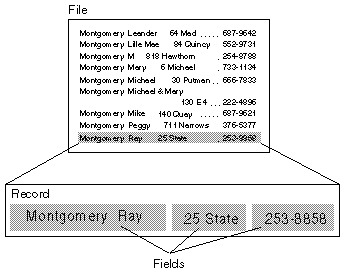
You can think of a traditional database as an electronic filing system, organized by fields, records, and files. A field is a single piece of information; a record is one complete set of fields; and a file is a collection of records. For example, a telephone book is analogous to a file. It contains a list of records, each of which consists of three fields: name, address, and telephone number.
An alternative concept in database design is known as Hypertext. In a Hypertext database, any object, whether it be a piece of text, a picture, or a film, can be linked to any other object. Hypertext databases are particularly useful for organizing large amounts of disparate information, but they are not designed for numerical analysis.
To access information from a database, you need a database management system (DBMS). This is a collection of programs that enables you to enter, organize, and select data in a database.
Increasingly, the term database is used as shorthand for database management system. There are many different types of DBMSs, ranging from small systems that run on personal computers to huge systems that run on mainframes.